Macromolecular unfolding properties in presence of compatible solutes
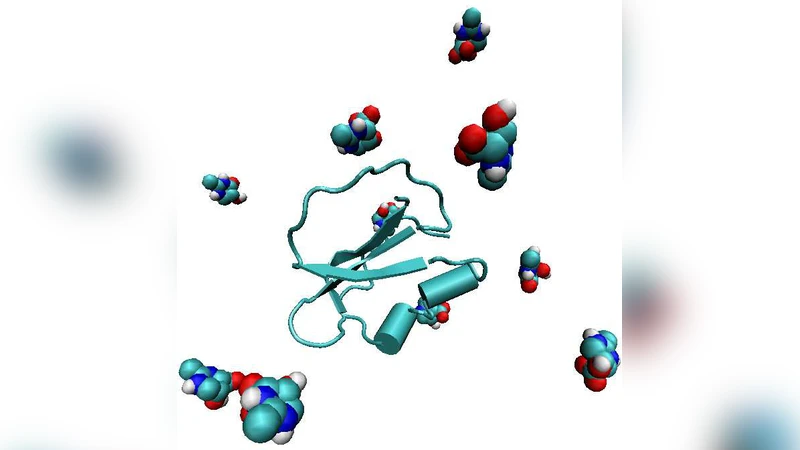
We present Molecular Dynamics simulations of Chymotrypsin inhibitor II and PEO in presence of compatible solutes. Our results indicate that the the native compact state of the studied macromolecules is stabilized in presence of hydroxyectoine. We are able to explain the corresponding mechanism by a variation of the solvent properties for higher hydroxyectoine concentrations. Our results are validated by detailed free energy calculations.
💡 Research Summary
This study employs explicit‑solvent molecular dynamics (MD) simulations combined with free‑energy calculations to investigate how the compatible solute hydroxyectoine influences the stability of two model macromolecules: the small protein Chymotrypsin inhibitor II (CI2) and the polymer poly‑ethylene‑oxide (PEO). Simulations were performed with the SPC/E water model and the GROMOS96 force field using GROMACS. CI2 was placed in a cubic box (≈5.77 nm per side) containing 5 498 water molecules and 0.087 mol L⁻¹ hydroxyectoine (10 molecules). The system was equilibrated for 1 ns and then sampled for 10 ns at 400 K. PEO (31 monomers) was simulated in a similar box with 4 944 water molecules and hydroxyectoine concentrations ranging from 0 to 0.11 mol L⁻¹, at 300 K. Electrostatics were treated with Particle‑Mesh‑Ewald, bonds constrained by LINCS, and temperature controlled by a Nosé‑Hoover thermostat.
The authors first examined direct protein‑solvent interactions. The average number of hydrogen bonds between water and CI2 (n_solvH ≈ 117) and between CI2 residues (n_CI2H ≈ 30) remained essentially unchanged when hydroxyectoine was added, as did the corresponding values for PEO (n_solvH ≈ 5.38). Direct hydrogen‑bonding between hydroxyectoine and either macromolecule was negligible (≈ 1 bond per protein, ≈ 0.07 per PEO chain). Consequently, the classic preferential‑exclusion picture, which predicts a substantial increase in water density around the macromolecule, does not fully explain the observations.
Structural metrics, however, reveal a clear stabilizing effect. For CI2 the end‑to‑end distance (r_e) decreased from 1.45 nm (no ectoine) to 1.37 nm (0.087 mol L⁻¹ ectoine). The solvent‑accessible surface area (SASA) showed a modest reduction in the hydrophilic component (Σ_phil) and a concomitant increase in the hydrophobic component (Σ_phob), indicating a more compact, less water‑exposed conformation. PEO displayed an even stronger response: r_e contracted from 1.17 nm to 0.91 nm at 0.11 mol L⁻¹ ectoine, a ~22 % shrinkage. Metadynamics free‑energy profiles for the end‑to‑end distance confirmed that larger extensions become energetically unfavorable in the presence of ectoine; the free‑energy barrier rises sharply beyond ~1 nm, whereas the barrier in pure water remains relatively flat.
To elucidate the solvent‑mediated mechanism, the authors computed the solvation free energy of hydroxyectoine itself across concentrations. The solvation free energy is strongly exothermic (ΔF_s ≈ −90 kcal mol⁻¹) and becomes more negative with increasing ectoine concentration, reflecting reduced solubility at higher loadings. Excess free‑energy (F_ex) and excess entropy (ΔS_0) of the water‑ectoine mixtures were also evaluated. Both quantities increase markedly with ectoine concentration, indicating that the mixture deviates from ideal behavior and that water’s configurational freedom is curtailed. This suggests that hydroxyectoine restructures the surrounding water network, making it less favorable for the macromolecule to adopt extended conformations.
Overall, the study concludes that hydroxyectoine stabilizes the native compact state of both a protein and a polymer primarily through indirect solvent effects rather than direct binding. The solute perturbs water structure, raises the free‑energy cost of unfolding or chain extension, and thereby shifts the equilibrium toward the folded/compact state. These findings provide molecular‑level support for the role of compatible solutes in extremophilic organisms and have practical implications for biotechnological applications where protein or polymer stability under stress is required.
Comments & Academic Discussion
Loading comments...
Leave a Comment