Low-Mach-number turbulence in interstellar gas revealed by radio polarization gradients
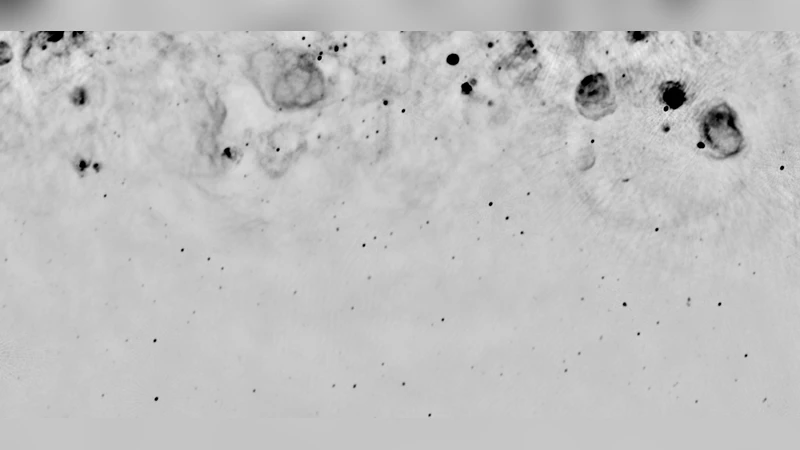
The interstellar medium of the Milky Way is multi-phase, magnetized and turbulent. Turbulence in the interstellar medium produces a global cascade of random gas motions, spanning scales ranging from 100 parsecs to 1000 kilometres. Fundamental parameters of interstellar turbulence such as the sonic Mach number (the speed of sound) have been difficult to determine because observations have lacked the sensitivity and resolution to directly image the small-scale structure associated with turbulent motion. Observations of linear polarization and Faraday rotation in radio emission from the Milky Way have identified unusual polarized structures that often have no counterparts in the total radiation intensity or at other wavelengths, and whose physical significance has been unclear. Here we report that the gradient of the Stokes vector (Q,U), where Q and U are parameters describing the polarization state of radiation, provides an image of magnetized turbulence in diffuse ionized gas, manifested as a complex filamentary web of discontinuities in gas density and magnetic field. Through comparison with simulations, we demonstrate that turbulence in the warm ionized medium has a relatively low sonic Mach number, M_s <~ 2. The development of statistical tools for the analysis of polarization gradients will allow accurate determinations of the Mach number, Reynolds number and magnetic field strength in interstellar turbulence over a wide range of conditions.
💡 Research Summary
The authors present a novel method for probing interstellar turbulence by exploiting the spatial gradient of the Stokes Q‑U vector, |∇P|, derived from high‑resolution 1.4 GHz radio polarization data obtained with the Australia Telescope Compact Array (ATCA). Traditional analyses of polarized emission rely on the scalar polarized intensity P = √(Q² + U²) and the polarization angle θ, both of which are not invariant under arbitrary rotations or translations in the Q‑U plane. Consequently, they can be severely corrupted by foreground emission, missing large‑scale structure, or instrumental effects, making it difficult to extract intrinsic physical information about the magneto‑ionic medium. In contrast, the magnitude of the polarization gradient, defined as |∇P| = √
Comments & Academic Discussion
Loading comments...
Leave a Comment