Stability of Filters for the Navier-Stokes Equation
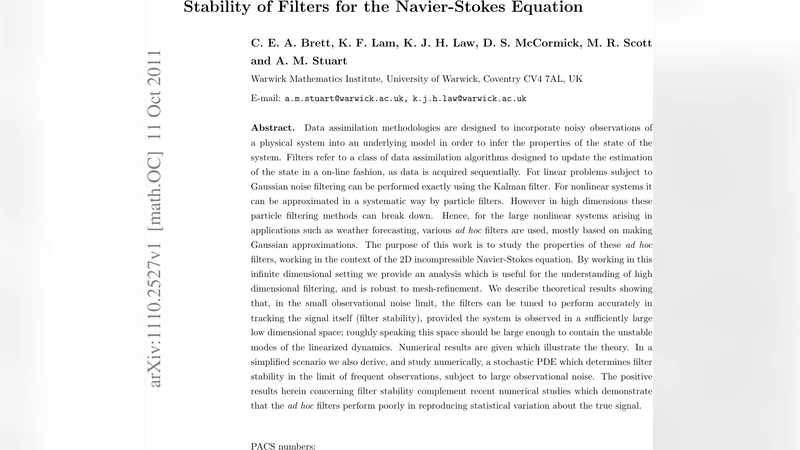
Data assimilation methodologies are designed to incorporate noisy observations of a physical system into an underlying model in order to infer the properties of the state of the system. Filters refer to a class of data assimilation algorithms designed to update the estimation of the state in a on-line fashion, as data is acquired sequentially. For linear problems subject to Gaussian noise filtering can be performed exactly using the Kalman filter. For nonlinear systems it can be approximated in a systematic way by particle filters. However in high dimensions these particle filtering methods can break down. Hence, for the large nonlinear systems arising in applications such as weather forecasting, various ad hoc filters are used, mostly based on making Gaussian approximations. The purpose of this work is to study the properties of these ad hoc filters, working in the context of the 2D incompressible Navier-Stokes equation. By working in this infinite dimensional setting we provide an analysis which is useful for understanding high dimensional filtering, and is robust to mesh-refinement. We describe theoretical results showing that, in the small observational noise limit, the filters can be tuned to accurately track the signal itself (filter stability), provided the system is observed in a sufficiently large low dimensional space; roughly speaking this space should be large enough to contain the unstable modes of the linearized dynamics. Numerical results are given which illustrate the theory. In a simplified scenario we also derive, and study numerically, a stochastic PDE which determines filter stability in the limit of frequent observations, subject to large observational noise. The positive results herein concerning filter stability complement recent numerical studies which demonstrate that the ad hoc filters perform poorly in reproducing statistical variation about the true signal.
💡 Research Summary
This paper investigates the stability of data‑assimilation filters for the two‑dimensional incompressible Navier‑Stokes equations, treating the governing PDE as an infinite‑dimensional dynamical system. The authors adopt a Bayesian framework in which the initial condition is a Gaussian prior and observations consist of noisy, low‑dimensional projections of the true state. The observation operator projects onto a finite set of Fourier modes; the complement contains the high‑frequency components that are not directly observed.
The forward model is written as a semigroup Ψ(t) acting on the Hilbert space H of divergence‑free, zero‑mean velocity fields. Key analytical tools include the Stokes operator A, the bilinear term B(u,u), and the projection operators Pλ (onto the observed modes) and Qλ (onto the unobserved modes). Proposition 2.3 establishes two crucial estimates: (i) the full‑state difference grows at most exponentially with rate β, and (ii) when the number of observed modes exceeds a threshold λ★ (which depends on the viscosity, forcing, and the size of the global attractor), the unobserved component contracts by a factor γ<1 over a single time step. This contraction property is the cornerstone of the subsequent stability analysis.
Under Assumption 3.1 the prior and observation noise are Gaussian, guaranteeing that the posterior distribution P(u₀|Y_j) exists, is absolutely continuous with respect to the prior, and is Lipschitz in the data in the Hellinger metric. Theorem 3.2 and Corollary 3.3 extend classical finite‑dimensional Bayesian filtering results to the infinite‑dimensional Navier‑Stokes setting, showing that the sequence of conditional measures P_j(u_j|Y_j) is well‑defined and remains supported in H¹.
The paper focuses on Gaussian‑approximate filters, in particular the three‑dimensional variational (3D‑VAR) method, which linearizes the dynamics and uses a fixed background error covariance. The main theoretical contributions are Theorems 4.3 and 4.7, which prove filter stability in two regimes. In the small‑observation‑noise limit, if the observation space contains all linearly unstable modes (i.e., λ>λ★) and the noise covariance Γ is sufficiently small, the mean‑square error between the filter estimate and the true state decays exponentially. When the observational noise is larger but still bounded, the error converges to a finite steady‑state bound that depends on Γ. These results formalize the intuitive requirement that the observed subspace must be “determining” for the underlying dynamics.
To address the opposite extreme—frequent observations with large noise—the authors derive a continuous‑time stochastic partial differential equation (SPDE) governing the evolution of the filter error. This SPDE combines the linearized Navier‑Stokes operator with the observation projection and a white‑noise forcing term representing the observation errors. Analysis of the SPDE shows that, despite large noise, the error covariance converges to a stationary solution provided the observation frequency is high enough, thereby offering a complementary perspective on filter performance.
Numerical experiments are conducted on a spectral discretization of the 2D Navier‑Stokes equations on a periodic domain. The authors vary the number of observed modes and the noise amplitude, comparing the discrete 3D‑VAR filter against the SPDE predictions. Results confirm the theoretical predictions: when the observation space satisfies the λ>λ★ condition and noise is modest, the filter accurately tracks the true trajectory and the error decays as expected; when these conditions are violated, the error grows rapidly and the SPDE model no longer predicts stability.
In conclusion, the paper provides the first rigorous infinite‑dimensional analysis of filter stability for a fluid‑dynamics PDE, linking the classical concept of determining modes to practical data‑assimilation design. It demonstrates that, even in high‑dimensional settings, appropriately chosen low‑dimensional observations can guarantee stable filtering, while also offering a stochastic PDE framework for understanding the impact of frequent, noisy observations. The work opens avenues for extending the analysis to non‑Gaussian priors, adaptive observation operators, and more realistic atmospheric and oceanic models.
Comments & Academic Discussion
Loading comments...
Leave a Comment