Projection-Forcing Multisets of Weight Changes
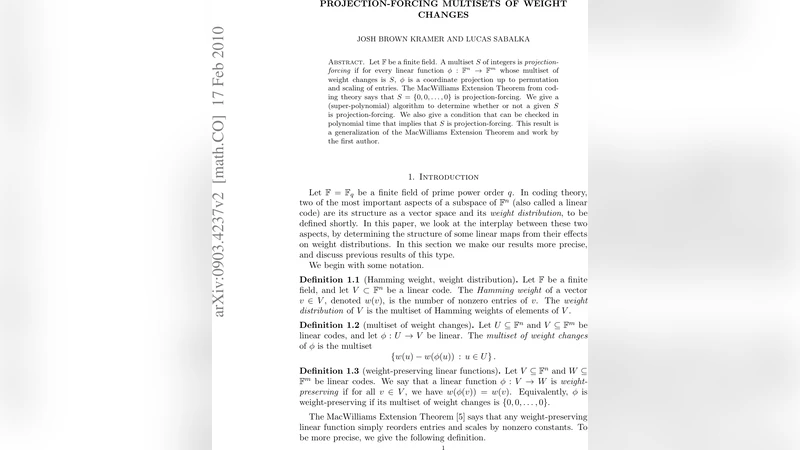
Let $F$ be a finite field. A multiset $S$ of integers is projection-forcing if for every linear function $\phi : F^n \to F^m$ whose multiset of weight changes is $S$, $\phi$ is a coordinate projection up to permutation and scaling of entries. The MacWilliams Extension Theorem from coding theory says that $S = {0, 0, …, 0}$ is projection-forcing. We give a (super-polynomial) algorithm to determine whether or not a given $S$ is projection-forcing. We also give a condition that can be checked in polynomial time that implies that $S$ is projection-forcing. This result is a generalization of the MacWilliams Extension Theorem and work by the first author.
💡 Research Summary
The paper investigates the structure of linear maps between vector spaces over a finite field F through the lens of “weight changes.” For a linear transformation φ : Fⁿ → Fᵐ and a vector x ∈ Fⁿ, the Hamming weight difference wt(φ(x)) − wt(x) is recorded; the multiset of all such differences (excluding the zero vector) is denoted by S. A multiset S is called projection‑forcing if every linear map whose weight‑change multiset equals S must be a coordinate projection, i.e., after a suitable permutation and scaling of coordinates, φ simply selects a subset of coordinates and possibly multiplies each by a non‑zero field element.
The classical MacWilliams Extension Theorem corresponds to the trivial case S = {0,…,0}, asserting that any weight‑preserving linear map is necessarily a coordinate projection. The authors generalize this theorem by characterizing those multisets S that force a map to be a projection. Their approach hinges on constructing the weight‑change matrix W(φ) whose i‑th column records the weight change contributed by the i‑th basis vector. They prove that if W(φ) can be expressed as a permutation‑scaled version of the identity matrix, then φ is a projection, and conversely any projection yields such a matrix.
To decide whether a given S is projection‑forcing, the authors present an algorithm that enumerates candidate weight‑change matrices consistent with S, prunes the search space using rank and determinant constraints, and finally verifies the remaining candidates. The worst‑case running time is super‑polynomial (roughly exponential in |S|), but the pruning steps make it practical for many instances. In addition, they identify a polynomial‑time sufficient condition: if the elements of S fall into exactly two distinct integer values a and b with prescribed multiplicities and satisfy a linear relation a = b + c for a fixed constant c, then S is guaranteed to be projection‑forcing. This condition is proved via combinatorial arguments on the possible column patterns of W(φ).
The paper includes several illustrative examples. Multisets such as {0,0,2,2,2,2} satisfy the polynomial‑time condition, confirming that any map realizing this S must be a projection. Conversely, multisets like {0,1,1,2} violate the condition, and the algorithm shows that non‑projection maps exist for them. These examples demonstrate both the power and the limitations of the sufficient condition.
Overall, the work extends the MacWilliams Extension Theorem to a broad class of weight‑change multisets, provides a concrete (though super‑polynomial) decision procedure, and offers a readily checkable sufficient criterion. The results deepen our understanding of when linear maps preserving certain weight distributions are forced to be coordinate projections, with potential implications for coding theory, cryptographic constructions, and the analysis of linear isometries in finite‑field settings.
Comments & Academic Discussion
Loading comments...
Leave a Comment