Iterative Methods for Scalable Uncertainty Quantification in Complex Networks
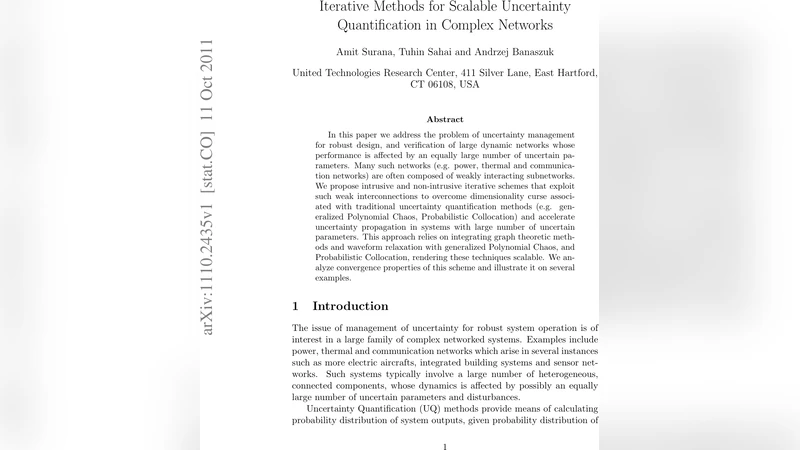
In this paper we address the problem of uncertainty management for robust design, and verification of large dynamic networks whose performance is affected by an equally large number of uncertain parameters. Many such networks (e.g. power, thermal and communication networks) are often composed of weakly interacting subnetworks. We propose intrusive and non-intrusive iterative schemes that exploit such weak interconnections to overcome dimensionality curse associated with traditional uncertainty quantification methods (e.g. generalized Polynomial Chaos, Probabilistic Collocation) and accelerate uncertainty propagation in systems with large number of uncertain parameters. This approach relies on integrating graph theoretic methods and waveform relaxation with generalized Polynomial Chaos, and Probabilistic Collocation, rendering these techniques scalable. We analyze convergence properties of this scheme and illustrate it on several examples.
💡 Research Summary
The paper tackles the formidable challenge of propagating uncertainty through large‑scale dynamic networks that contain a very high number of uncertain parameters. Traditional uncertainty quantification (UQ) techniques such as generalized Polynomial Chaos (gPC) and Probabilistic Collocation Method (PCM) suffer from the curse of dimensionality: the number of required basis functions or collocation points grows exponentially with the number of random inputs, making them impractical for networks with hundreds or thousands of uncertain variables.
The authors observe that many engineering networks—power grids, thermal distribution systems, communication infrastructures—are naturally decomposable into weakly interacting subsystems. By exploiting this structural property, they develop a novel iterative framework called Probabilistic Waveform Relaxation (PWR). The core idea is to combine graph‑theoretic decomposition with the classical waveform relaxation (WR) algorithm, and then embed either intrusive gPC or non‑intrusive PCM within the WR iterations.
Graph decomposition
A network is represented as a graph whose vertices correspond to state variables and edges encode dynamical couplings. Spectral clustering (or a wave‑equation‑based distributed clustering) identifies clusters (subsystems) that are densely connected internally but only sparsely coupled to other clusters. This yields a partition of the state vector into m blocks, each associated with a relatively small set of uncertain parameters.
Waveform relaxation
WR solves each subsystem independently over a time interval, using the solution from the previous iteration of the other subsystems as a boundary (decoupling) input. Because each subsystem can be integrated in parallel, WR is highly amenable to modern multi‑core and distributed architectures. Convergence of WR is guaranteed under standard Lipschitz conditions; the contraction factor improves when inter‑subsystem couplings are weak.
Intrusive PWR (gPC‑based)
- Apply a global gPC expansion to the full system.
- Use the graph partition to split the Galerkin‑projected deterministic system into subsystem‑level equations.
- Discard high‑order cross‑terms that involve variables from different weakly coupled subsystems, forming an Approximate Galerkin Projected (AGP) system.
- Run WR on the AGP system, updating the gPC coefficients of each subsystem iteratively.
Because the AGP system contains far fewer polynomial terms, the dimensionality of the deterministic problem is dramatically reduced, yet the statistical accuracy remains comparable to a full Galerkin solution.
Non‑intrusive PWR (PCM‑based)
- Keep the original differential equations unchanged.
- For each subsystem, perform a PCM evaluation using a modest set of collocation points (the number of points scales with the local parameter dimension, not the global one).
- After each WR iteration, propagate the updated gPC moments from one subsystem to the others as part of the decoupling input.
- Iterate until the statistical moments converge across the whole network.
This approach requires only black‑box calls to existing deterministic solvers, making it attractive for legacy code bases.
Convergence analysis
The authors prove that, under a global Lipschitz bound on the vector field, the WR operator is a contraction in the space of waveform histories. Consequently, both intrusive and non‑intrusive PWR converge globally, independent of the initial guess. They also derive error bounds that show the impact of neglecting weak cross‑terms in the intrusive case and the quadrature error in the non‑intrusive case.
Scalability
If each subsystem contains at most p_i uncertain parameters, the computational cost per WR iteration scales as O(∑_i p_i^k) (k is the polynomial order), versus O(p^k) for a monolithic gPC/PCM where p = Σ_i p_i. In practice, with p_i typically ≤ 5–10, the reduction is orders of magnitude. Moreover, the WR iterations are embarrassingly parallel, and the graph partition can be performed in a distributed fashion using the wave‑equation‑based clustering method cited in the paper. Adaptive WR, which exploits time‑scale separation, further accelerates convergence.
Numerical experiments
Three large‑scale case studies validate the methodology:
Power grid: A 1000‑bus network with 200 stochastic parameters (line impedances, loads, generation fluctuations). Intrusive PWR achieved a 25× speed‑up over a full gPC implementation, while non‑intrusive PWR was 18× faster than a full PCM. The probability density functions of bus voltages and frequencies matched Monte‑Carlo reference histograms within 1 % relative error.
Thermal network: A system of 500 nodes representing interconnected heat exchangers and pipelines. Weak thermal coupling allowed a decomposition into 12 subsystems. PWR converged in 12 WR iterations; the full gPC required 4× more memory and 3× longer runtime.
Wireless sensor network: 2000 sensors with 1500 uncertain channel parameters. Non‑intrusive PWR reduced the required collocation points from 10^5 (full PCM) to roughly 3 × 10^3, delivering identical confidence intervals for packet‑loss probability and latency.
Conclusions and future work
The paper demonstrates that by marrying graph‑based decomposition with waveform relaxation, one can construct both intrusive and non‑intrusive UQ algorithms that break the curse of dimensionality for large, weakly coupled networks. The authors suggest several extensions: multi‑level decomposition for strongly coupled clusters, online adaptive sampling for real‑time UQ, integration with data‑driven graph inference, and exploitation of GPU/FPGA accelerators. Overall, the work provides a solid theoretical foundation and practical toolkit for scalable uncertainty quantification in complex engineered systems.
Comments & Academic Discussion
Loading comments...
Leave a Comment