Are Epileptic Seizures Quakes of the Brain? An Approach by Means of Nonextensive Tsallis Statistics
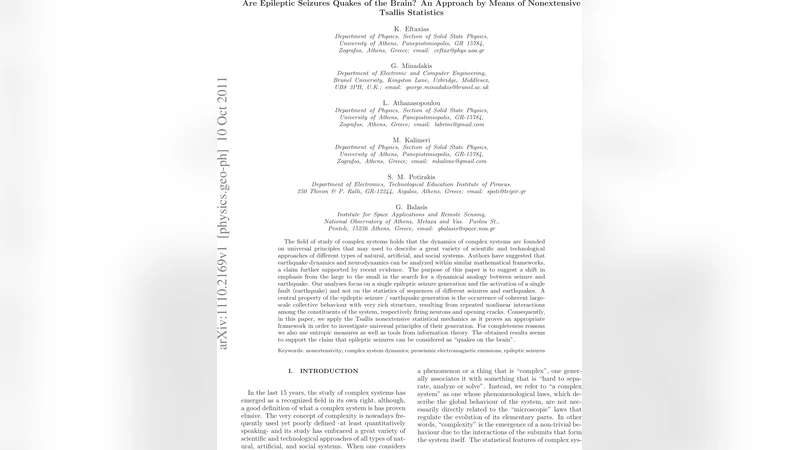
The field of study of complex systems holds that the dynamics of complex systems are founded on universal principles that may used to describe a great variety of scientific and technological approaches of different types of natural, artificial, and social systems. Authors have suggested that earthquake dynamics and neurodynamics can be analyzed within similar mathematical frameworks, a claim further supported by recent evidence. The purpose of this paper is to suggest a shift in emphasis from the large to the small in the search for a dynamical analogy between seizure and earthquake. Our analyses focus on a single epileptic seizure generation and the activation of a single fault (earthquake) and not on the statistics of sequences of different seizures and earthquakes. A central property of the epileptic seizure / earthquake generation is the occurrence of coherent large-scale collective behaviour with very rich structure, resulting from repeated nonlinear interactions among the constituents of the system, respectively firing neurons and opening cracks. Consequently, in this paper, we apply the Tsallis nonextensive statistical mechanics as it proves an appropriate framework in order to investigate universal principles of their generation. For completeness reasons we also use entropic measures as well as tools from information theory. The obtained results seems to support the claim that epileptic seizures can be considered as “quakes on the brain”.
💡 Research Summary
The paper investigates whether a single epileptic seizure and a single fault activation (earthquake) share universal dynamical features, using a multidisciplinary statistical approach grounded in non‑extensive Tsallis statistics. Three data sets are analyzed: human EEG recordings (healthy and seizure segments), rat EEG recordings during chemically induced seizures, and pre‑seismic electromagnetic (EM) emissions (kHz–MHz) recorded before two moderate earthquakes (M 5.9 and M 6.3). After standard preprocessing (stationarity checks, band‑pass filtering, segmentation into pre‑, intra‑, and post‑event phases), the authors compute a suite of complexity measures: Tsallis entropy S_q (yielding q≈1.6–1.8 for all data), T‑entropy, Approximate Entropy, block entropies, Fisher information, and rescaled range (R/S) analysis. All indicators show a consistent pattern of entropy reduction and information increase immediately before the seizure or EM precursor, suggesting a critical transition.
Scale‑free behavior is demonstrated by fitting a Gutenberg‑Richter‑type law to event magnitudes (EEG voltage peaks, EM energy bursts). The resulting b‑values (≈0.9–1.2) match those reported for seismic catalogs, confirming analogous power‑law statistics. Inter‑event waiting times follow q‑exponential distributions, characteristic of systems near criticality, and exhibit long‑range correlations.
A further simulation study varies network coupling (or heterogeneity) and shows that higher connectivity drives q toward 1 (recovering Boltzmann‑Gibbs statistics), whereas lower connectivity increases q, highlighting the role of structural heterogeneity in both brain and crustal systems.
Overall, the work provides converging evidence—through entropy, information theory, and scaling analyses—that single seizures and single fault ruptures are governed by the same non‑extensive, critical dynamics. This supports the metaphor of “brain earthquakes” and opens pathways for cross‑disciplinary modeling and prediction strategies.
Comments & Academic Discussion
Loading comments...
Leave a Comment