Deducing Electron Properties From Hard X-Ray Observations
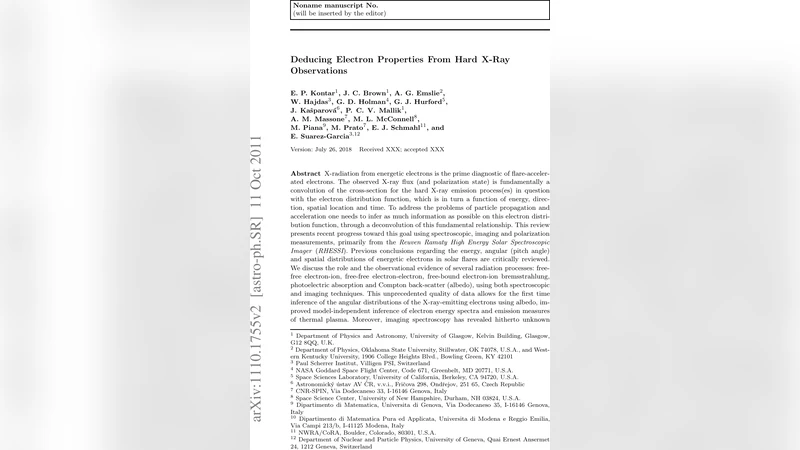
X-radiation from energetic electrons is the prime diagnostic of flare-accelerated electrons. The observed X-ray flux (and polarization state) is fundamentally a convolution of the cross-section for the hard X-ray emission process(es) in question with the electron distribution function, which is in turn a function of energy, direction, spatial location and time. To address the problems of particle propagation and acceleration one needs to infer as much information as possible on this electron distribution function, through a deconvolution of this fundamental relationship. This review presents recent progress toward this goal using spectroscopic, imaging and polarization measurements, primarily from the Reuven Ramaty High Energy Solar Spectroscopic Imager (RHESSI). Previous conclusions regarding the energy, angular (pitch angle) and spatial distributions of energetic electrons in solar flares are critically reviewed. We discuss the role and the observational evidence of several radiation processes: free-free electron-ion, free-free electron-electron, free-bound electron-ion bremsstrahlung, photoelectric absorption and Compton back-scatter (albedo), using both spectroscopic and imaging techniques. This unprecedented quality of data allows for the first time inference of the angular distributions of the X-ray-emitting electrons using albedo, improved model-independent inference of electron energy spectra and emission measures of thermal plasma. Moreover, imaging spectroscopy has revealed hitherto unknown details of solar flare morphology and detailed spectroscopy of coronal, footpoint and extended sources in flaring regions. Additional attempts to measure hard X-ray polarization were not sufficient to put constraints on the degree of anisotropy of electrons, but point to the importance of obtaining good quality polarization data.
💡 Research Summary
This review paper provides a comprehensive synthesis of the methods and recent results concerning the inference of energetic electron properties in solar flares from hard X‑ray observations, with a primary focus on data from the Reuven Ramaty High Energy Solar Spectroscopic Imager (RHESSI). The authors begin by formalizing the fundamental relationship between the observed photon intensity I(ε,Ω,t) and the underlying electron phase‑space distribution F(E,Ω′,r,t) through a linear convolution with the appropriate bremsstrahlung cross‑section Q(ε,E,θ′). They emphasize that, although this relationship is linear, the deconvolution (or “inverse problem”) is highly non‑trivial because Q depends on photon energy, electron energy, and the scattering angle, and because additional processes such as Compton back‑scatter (the albedo) and photoelectric absorption modify the observed spectrum.
Section 2 reviews the relevant radiation mechanisms: electron‑ion free‑free bremsstrahlung (the dominant process), electron‑ion free‑bound emission, and electron‑electron free‑free bremsstrahlung. The authors discuss analytic approximations (Kramers, Bethe‑Heitler) and more accurate numerical formulations, noting that angular dependence becomes crucial for highly beamed electron distributions.
Section 3 is devoted to the solar albedo. Photons emitted downward into the dense photosphere are partially reflected toward the observer, producing a characteristic “halo” component in both spectra and images. The authors describe two complementary approaches for correcting this effect: (i) a Green’s‑function based spectral de‑convolution that yields the primary photon spectrum, and (ii) imaging‑based techniques that exploit RHESSI’s visibility data to identify the spatial signature of the albedo halo. By isolating the albedo contribution, one can retrieve the true primary spectrum and also use the albedo strength as an indirect probe of the electron angular distribution.
Section 4 addresses the inversion of spatially integrated spectra to obtain the mean electron flux spectrum ⟨nV F(E)⟩. Traditional forward‑fitting methods, which assume a parametric form (e.g., broken power‑law with low‑energy cutoff), are contrasted with regularized inversion techniques such as Tikhonov regularization, maximum entropy, and Bayesian approaches. The latter provide model‑independent reconstructions that are robust against noise and capable of revealing subtle spectral features: high‑energy cutoffs, spectral breaks, and low‑energy turnovers. The authors illustrate how these features can be interpreted in terms of acceleration mechanisms, collisional transport, and the presence of a thermal component.
Section 5 focuses on electron anisotropy. Early studies inferred modest beaming from simple spectral ratios, but the authors show that albedo measurements and, where available, hard‑X‑ray polarization data provide stronger constraints. Polarization observations with RHESSI, although limited by statistical uncertainties, set upper limits on the degree of linear polarization and thus on the electron beaming factor. The combination of albedo‑derived angular information and polarization offers a promising pathway to quantify the pitch‑angle distribution of flare electrons.
Section 6 expands the analysis to spatially resolved electron distributions. By exploiting RHESSI’s rotating modulation collimators, the authors describe visibility‑based imaging spectroscopy that directly reconstructs electron flux maps F(E, r). This technique surpasses traditional CLEAN or MEM imaging in dynamic range and resolution, enabling the separation of coronal sources, footpoints, and extended loop‑top emission as a function of energy. The resulting electron maps reveal where acceleration occurs, how electrons propagate along magnetic loops, and where they deposit their energy, providing critical tests for models of magnetic reconnection and particle transport.
In the concluding Section 7, the authors summarize the major achievements: (i) refined spectral inversion methods that yield reliable electron spectra, (ii) the first systematic use of albedo to infer electron angular distributions, (iii) imaging spectroscopy that maps electron fluxes across flare structures, and (iv) initial, though still inconclusive, polarization constraints on anisotropy. They also outline remaining challenges: the need for higher‑quality polarization measurements, better characterization of the albedo Green’s functions, and improved statistical handling of high‑energy cutoffs. Future missions such as Solar Orbiter/STIX, FOXSI, and next‑generation polarimeters are highlighted as essential for advancing the field.
Overall, the paper presents a unified framework that combines spectroscopy, imaging, and polarization to extract the full six‑dimensional electron distribution (energy, pitch angle, spatial coordinates, and time) from hard X‑ray observations, thereby offering powerful diagnostics for solar flare acceleration and transport physics.
Comments & Academic Discussion
Loading comments...
Leave a Comment