Archetypal Athletes
Discussions on outstanding—positively and/or negatively—athletes are common practice. The rapidly grown amount of collected sports data now allow to support such discussions with state of the art statistical methodology. Given a (multivariate) data set with collected data of athletes within a specific sport, outstanding athletes are values on the data set boundary. In the present paper we propose archetypal analysis to compute these extreme values. The so-called archetypes, i.e., archetypal athletes, approximate the observations as convex combinations. We interpret the archetypal athletes and their characteristics, and, furthermore, the composition of all athletes based on the archetypal athletes. The application of archetypal analysis is demonstrated on basketball statistics and soccer skill ratings.
💡 Research Summary
The paper “Archetypal Athletes” introduces a data‑driven approach for identifying and characterizing outstanding athletes by applying archetypal analysis (AA) to multivariate sports statistics. Traditional ranking methods in sports often collapse high‑dimensional performance data into a single index (e.g., PER, FIFA rating), thereby discarding valuable information about the multidimensional nature of athletic performance. AA, originally proposed by Cutler and Breiman (2003), seeks a small set of “archetypes” that lie on the convex hull of the data cloud; every observation can then be expressed as a convex combination of these archetypes. The method solves the optimization problem
min ‖X – αZ‖² subject to α≥0, β≥0, α1=1, β1=1,
where X∈ℝⁿˣᵐ is the data matrix, Z = Xᵀβ contains k archetypes, and α∈ℝⁿˣᵏ gives the mixing coefficients for each athlete. An alternating constrained least‑squares algorithm iteratively updates α and β, guaranteeing a monotonic reduction in residual sum of squares (RSS).
The authors apply AA to two real‑world datasets:
-
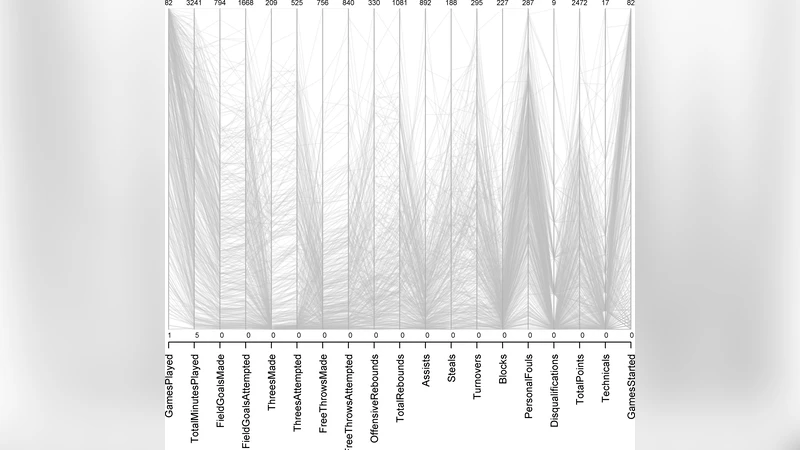
NBA 2009‑2010 season – 441 players with 19 standard statistics (minutes, points, rebounds, assists, etc.).
- First, a two‑dimensional illustration using minutes (Min) and field goals made (FGM) shows that k=3 captures the convex hull well: a “maximum scorer”, a “minimum scorer”, and a high‑minute/low‑efficiency player.
- For the full 19‑dimensional set, a scree plot of RSS versus k suggests an elbow at k=4 (RSS≈0.04). The four archetypes are interpreted as:
– Archetype 1: “Bench‑warmer” – low values across all stats.
– Archetype 2: “Rebound/defensive specialist” – high rebounds, blocks, fouls; low three‑point shooting.
– Archetype 3: “Three‑point shooter” – high three‑point attempts/made, low free‑throw and rebound numbers.
– Archetype 4: “All‑round offensive player” – high shooting, assists, low fouls. - The α‑coefficients reveal each player’s composition. For example, Kevin Durant and LeBron James have α₁≈0.9, indicating strong affiliation with Archetype 4 (offensive). Jason Kidd’s α₃≈0.94 places him near the inefficient scorer archetype. Players with α>0.8 for a given archetype are flagged as “near‑extreme” representatives.
-
European soccer skill ratings – 1,658 outfield players from the German Bundesliga, English Premier League, Italian Serie A, and Spanish La Liga, each rated on 25 skills (balance, stamina, dribble, pass, shot accuracy, etc.).
- Parallel coordinate plots show no obvious single‑dimension extremes. A scree plot again points to k=4 as a parsimonious solution.
- The four soccer archetypes are labeled:
– Archetype 1: “All‑round attacker” – high offensive skill scores, low defensive fouls.
– Archetype 2: “Defensive specialist” – high defensive and physical attributes, low attacking metrics.
– Archetype 3: “Play‑maker” – strong passing, vision, and ball‑control, moderate shooting.
– Archetype 4: “Versatile” – balanced high scores across most categories. - α‑vectors allow a nuanced view of each player’s skill composition, supporting scouting decisions (e.g., a player with α₁≈0.8 is a natural goal‑scorer, while α₂≈0.7 indicates a defensive anchor).
Key insights and contributions
- Data‑driven extreme identification: AA extracts extremal profiles directly from the observed multivariate distribution, avoiding arbitrary weighting schemes.
- Interpretability through α‑coefficients: The convex mixing weights provide a transparent, quantitative description of how much each archetype contributes to an individual athlete’s performance profile.
- Flexibility across sports: The method works equally well for basketball box‑score statistics and soccer skill ratings, demonstrating its general applicability.
- Practical relevance: Coaches can use archetype memberships to design role‑specific training, scouts can prioritize players whose α‑vectors match desired archetypes, and marketers can align endorsements with “archetypal” athletes.
Limitations
- Choice of k: The elbow method is heuristic; different k values can lead to alternative interpretations.
- Dependence on the dataset: Archetypes are defined relative to the sampled season/league; a new season may require re‑estimation.
- Potential for “virtual” archetypes: Since archetypes are convex combinations of observed points, they may not correspond to any real player, which can be conceptually challenging when communicating results to non‑technical stakeholders.
- Threshold subjectivity: The paper uses α>0.8 (or 0.95) as a cutoff for “near‑extreme” status, an arbitrary decision that influences which athletes are highlighted.
Future directions
The authors suggest extending AA to dynamic settings (tracking how a player’s α‑profile evolves over a season), incorporating kernel or non‑linear variants to capture more complex relationships, and integrating external metadata (position, team tactics, injury history) to enrich interpretation. Such extensions could broaden the utility of archetypal analysis beyond sports, into finance, medicine, and any domain where extreme, data‑driven prototypes are valuable.
In summary, “Archetypal Athletes” demonstrates that archetypal analysis offers a robust, interpretable framework for uncovering and quantifying extreme performance patterns in multivariate sports data, providing actionable insights for coaches, scouts, analysts, and marketers.
Comments & Academic Discussion
Loading comments...
Leave a Comment