Hydrological Cycle in the Danube basin in present-day and XXII century simulations by IPCCAR4 global climate models
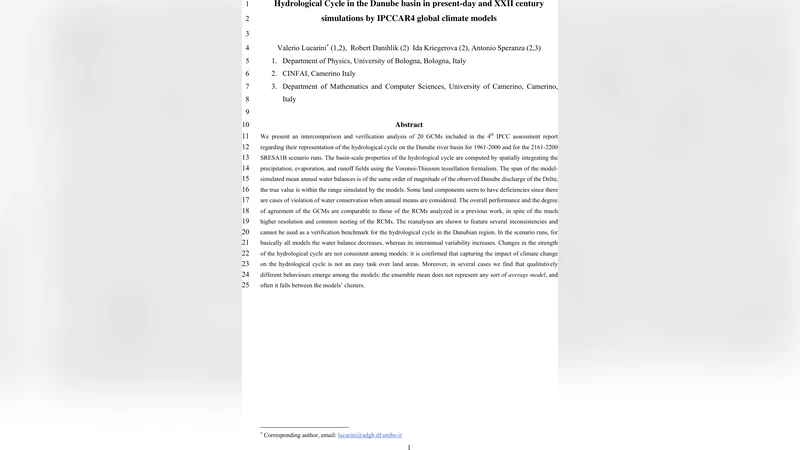
We present an intercomparison and verification analysis of 20 GCMs included in the 4th IPCC assessment report regarding their representation of the hydrological cycle on the Danube river basin for 1961-2000 and for the 2161-2200 SRESA1B scenario runs. The basin-scale properties of the hydrological cycle are computed by spatially integrating the precipitation, evaporation, and runoff fields using the Voronoi-Thiessen tessellation formalism. The span of the model simulated mean annual water balances is of the same order of magnitude of the observed Danube discharge of the Delta; the true value is within the range simulated by the models. Some land components seem to have deficiencies since there are cases of violation of water conservation when annual means are considered. The overall performance and the degree of agreement of the GCMs are comparable to those of the RCMs analyzed in a previous work, in spite of the much higher resolution and common nesting of the RCMs. The reanalyses are shown to feature several inconsistencies and cannot be used as a verification benchmark for the hydrological cycle in the Danubian region. In the scenario runs, for basically all models the water balance decreases, whereas its interannual variability increases. Changes in the strength of the hydrological cycle are not consistent among models: it is confirmed that capturing the impact of climate change on the hydrological cycle is not an easy task over land areas. Moreover, in several cases we find that qualitatively different behaviours emerge among the models: the ensemble mean does not represent any sort of average model, and often it falls between the models’ clusters.
💡 Research Summary
**
This paper conducts a comprehensive intercomparison and verification of the hydrological cycle over the Danube basin using the twenty global climate models (GCMs) that participated in the IPCC Fourth Assessment Report (AR4). The authors examine two periods: the historical 1961‑2000 interval and the future 2161‑2200 interval under the SRESA1B emissions scenario (CO₂ concentrations reaching 720 ppm). The study’s novelty lies in the use of a Voronoi‑Thiessen tessellation to spatially integrate precipitation, evaporation, and runoff fields across the entire basin, thereby minimizing area‑weighting errors that can arise from simple grid averaging.
Methodology
- Model data: 20 GCM outputs for the historical and scenario periods.
- Reanalysis products: ERA‑40 and NCEP‑NCAR, employed as potential verification benchmarks.
- Metrics: long‑term mean water balance (P‑E), its interannual standard deviation, and runoff (R). The water balance is compared against the observed Danube discharge at the delta (≈6 500 m³ s⁻¹). Consistency between (P‑E) and R is used as a test of water‑conservation within each model.
Key Findings – Historical Period
- The spread of model‑simulated mean annual water balances largely encompasses the observed discharge, indicating that, on average, the GCMs capture the basin‑scale water budget.
- However, several models display a mismatch between (P‑E) and runoff, violating the principle of water conservation when annual means are considered. This points to deficiencies in land‑surface schemes (soil moisture, vegetation, and parameterized evapotranspiration).
- The reanalysis datasets exhibit substantial inconsistencies: their spatially integrated water balances differ markedly from observations, rendering them unsuitable as verification references for the Danube basin.
Key Findings – Future Scenario
- Almost all models project a decrease in the mean water balance for 2161‑2200, while the interannual variability (standard deviation) increases. This dual signal suggests that climate change will tend to reduce average runoff but amplify the frequency and intensity of extreme events (droughts and floods).
- The magnitude and sign of the change are not consistent across models. Some models predict reduced precipitation with only modest changes in evaporation, leading to a pronounced drop in (P‑E). Others show simultaneous reductions in both precipitation and evaporation, resulting in a smaller net change. This lack of consensus underscores the difficulty of capturing land‑surface responses to warming in GCMs.
- The ensemble mean of the scenario runs does not represent any individual model’s behavior; instead, it often falls between distinct clusters of models (e.g., high‑variability vs. low‑variability groups). Consequently, relying on the simple arithmetic mean as a predictor of future hydrology may be misleading.
Comparison with Regional Climate Models (RCMs)
The authors reference their earlier work on RCMs, which, despite higher spatial resolution and nesting within a common AGCM, did not outperform the GCMs in reproducing the basin‑scale water balance. In fact, the RCMs sometimes degraded the large‑scale signal, suggesting that resolution alone does not resolve the fundamental land‑surface and convection parameterization issues.
Implications
- Robust verification of GCM hydrology must be based on basin‑integrated quantities (e.g., river discharge) rather than on gridded precipitation or evaporation fields, which are difficult to observe comprehensively.
- Water‑conservation checks (P‑E ≈ R) should become a standard diagnostic for model evaluation, helping to identify land‑surface scheme shortcomings.
- Future impact assessments for the Danube basin—and by extension for other large European river basins—should incorporate model‑cluster analyses and weighted ensembles rather than relying solely on the unweighted ensemble mean.
- Policymakers should be aware that projected reductions in average water availability are likely to be accompanied by heightened variability, implying increased risk of both water scarcity and flood events.
In summary, the paper demonstrates that while the suite of IPCC‑AR4 GCMs can broadly reproduce the Danube’s historical water balance, significant inter‑model spread, occasional violations of water conservation, and divergent future projections limit confidence in any single deterministic forecast. The study advocates for more nuanced multi‑model approaches, rigorous water‑budget diagnostics, and caution in using reanalysis products as verification benchmarks for basin‑scale hydrology.
Comments & Academic Discussion
Loading comments...
Leave a Comment