On stability of difference schemes
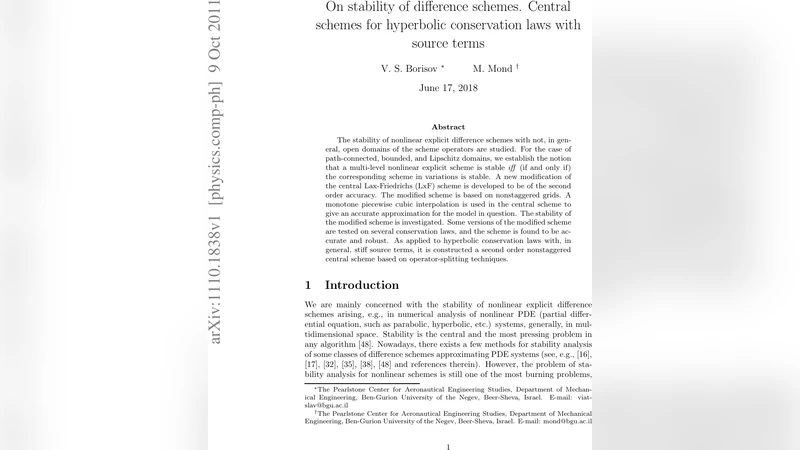
The stability of nonlinear explicit difference schemes with not, in general, open domains of the scheme operators are studied. For the case of path-connected, bounded, and Lipschitz domains, we establish the notion that a multi-level nonlinear explicit scheme is stable iff (if and only if) the corresponding scheme in variations is stable. A new modification of the central Lax-Friedrichs (LxF) scheme is developed to be of the second order accuracy. The modified scheme is based on nonstaggered grids. A monotone piecewise cubic interpolation is used in the central scheme to give an accurate approximation for the model in question. The stability of the modified scheme is investigated. Some versions of the modified scheme are tested on several conservation laws, and the scheme is found to be accurate and robust. As applied to hyperbolic conservation laws with, in general, stiff source terms, it is constructed a second order nonstaggered central scheme based on operator-splitting techniques.
💡 Research Summary
The paper addresses the long‑standing problem of stability analysis for nonlinear explicit finite‑difference schemes, especially those whose operator domains are not necessarily open. After a brief review of existing stability concepts, the authors introduce the notion of a “scheme in variations” (or variational scheme), which linearizes a nonlinear scheme at a given point by means of its Jacobian matrix. Because this variational scheme is linear, classical linear stability theory can be applied, and the authors prove that a multi‑level nonlinear explicit scheme is stable if and only if its variational counterpart is stable. This equivalence had previously been shown only for schemes whose domains are open; the present work extends it to internal path‑connected, bounded domains with Lipschitz boundaries (or, more generally, domains possessing the cone property).
To make the theory useful for practical computations, the authors develop a second‑order accurate central Lax‑Friedrichs (LxF) scheme on non‑staggered grids. Traditional staggered central schemes require two interleaved meshes, which complicates boundary treatment and can lead to spurious oscillations when higher‑order accuracy is pursued. By staying on a single grid, the new scheme avoids these difficulties. Accuracy is enhanced through a monotone piecewise‑cubic interpolation that preserves monotonicity while providing third‑order spatial reconstruction; this eliminates the negative numerical viscosity that typically produces Gibbs‑type oscillations in high‑order LxF variants.
The paper also tackles hyperbolic conservation laws with stiff source terms. Using operator‑splitting (or fractional‑step) techniques, the authors separate the homogeneous hyperbolic part—solved with the newly constructed central scheme—from the source term, which is integrated with an appropriate ODE solver (e.g., implicit Euler). Because the stability of the whole method follows from the stability of the variational scheme, the splitting does not compromise the overall stability.
A series of numerical experiments validates the theoretical findings. Test problems include the Burgers equation, the shallow‑water system, and a stiff relaxation system. For Courant numbers up to unity, the modified scheme exhibits second‑order convergence in the L2 norm, dramatically reduced spurious oscillations compared with the classic LxF method, and robust behavior even when the source term is highly stiff. The results confirm that the scheme respects the correct asymptotic limit, a crucial property for relaxation problems.
In summary, the paper makes three major contributions: (1) it establishes a rigorous equivalence between stability of a nonlinear explicit scheme and its linearized variational scheme on general (possibly non‑open) domains; (2) it constructs a second‑order, non‑staggered central LxF scheme that combines monotone cubic reconstruction with a solid stability foundation; and (3) it demonstrates that the method remains stable and accurate for hyperbolic systems with stiff source terms when combined with operator‑splitting. The work opens the door to further extensions, such as adaptive mesh refinement, high‑order time integration, and application to multidimensional problems on complex geometries.
Comments & Academic Discussion
Loading comments...
Leave a Comment