Numerical study on transient heat transfer under soil with plastic mulch in agriculture applications using a nonlinear finite element model
In this paper is developed a simple mathematical model of transient heat transfer under soil with plastic mulch in order to determine with numerical studies the influence of different plastic mulches on the soil temperature and the evolutions of temperatures at different depths with time. The governing differential equations are solved by a Galerkin Finite Element Model, taking into account the nonlinearities due to radiative heat exchange between the soil surface, the plastic mulch and the atmosphere. The model was validated experimentally giving good approximation of the model to the measured data. Simulations were run with the validated model in order to determine the optimal combination of mulch optical properties to maximize the soil temperature with a Taguchi’s analysis, proving that the material most used nowadays in Colombia is not the optimal and giving quantitative results of the properties the optimal mulch must possess.
💡 Research Summary
**
The paper presents a comprehensive numerical study of transient heat transfer in soil covered with plastic mulch, aimed at quantifying the influence of mulch optical properties on soil temperature and identifying optimal mulch characteristics for agricultural applications.
Model Development
A one‑dimensional transient heat diffusion equation is adopted for the soil domain, assuming semi‑infinite depth so that the temperature gradient vanishes at the bottom. The governing equation is coupled with nonlinear boundary conditions that account for convection and radiation between three interfaces: soil–mulch, mulch–ambient air, and soil surface to the atmosphere. Radiative exchange is modeled using the Stefan‑Boltzmann law (T⁴ terms) together with mulch transmittance (τ) and reflectivity (ρ) for both long‑wave (infrared) and short‑wave (solar) spectra. Convective heat transfer coefficients are taken from literature (Garzoli & Blackwell, 1981) and depend on wind speed.
Finite‑Element Discretization
The Galerkin finite‑element method is employed with uniform quadratic Lagrange elements (length Δz ≈ 0.02 m, 50 elements). Element matrices are assembled assuming constant soil thermal conductivity (k = 2.2 W/m·K) and volumetric heat capacity (c = 1.01 × 10⁶ J/m³·K). Time integration uses a backward Euler scheme, and the resulting nonlinear algebraic system (due to the T⁴ radiation terms) is solved by fixed‑point iteration at each time step. The mulch temperature, which does not store energy because of the film’s negligible thickness, is obtained simultaneously from an energy balance on the film. The entire algorithm is implemented in MATLAB.
Experimental Validation
Field experiments were conducted in the Savanna of Bogotá, Colombia, where a low‑density polyethylene (LDPE) mulch was installed over a test plot. Optical properties of the LDPE film were measured with FTIR (long‑wave) and UV‑VIS (short‑wave) spectrophotometers, yielding τ_l = 0.60, ρ_l = 0.398, τ_s = 0.733, ρ_s = 0.265. Meteorological data (solar radiation, ambient temperature, wind speed) were recorded every five minutes using a Casella NOMAD weather station, and soil surface temperature was measured with an OMEGA 871A thermocouple. The model, run with 50 elements and a 1 m deep bottom boundary, reproduced the measured temperature with a mean relative error of 5.76 %, as shown in the comparison plots. Discrepancies during rapid cloud passages are attributed to the five‑minute averaging of the weather data rather than model deficiencies.
Optimization via Taguchi Method
With the validated model, a Taguchi L₈ orthogonal array was employed to explore four mulch optical parameters (τ_s, ρ_s, τ_l, ρ_l) at three levels (0.01, 0.2, 0.7). Seven simulation runs generated maximum soil temperatures (T_max) ranging from 41 °C to 60 °C. The analysis identified the optimal combination as τ_s > 0.7 (high solar transmittance), ρ_s < 0.2 (low solar reflectivity), τ_l < 0.01 (very low infrared transmittance), and ρ_l > 0.7 (high infrared reflectivity). This configuration outperforms the commonly used LDPE mulch in Colombia, indicating that current commercial films are not thermally optimal for raising soil temperature.
Depth‑Time Temperature Behaviour
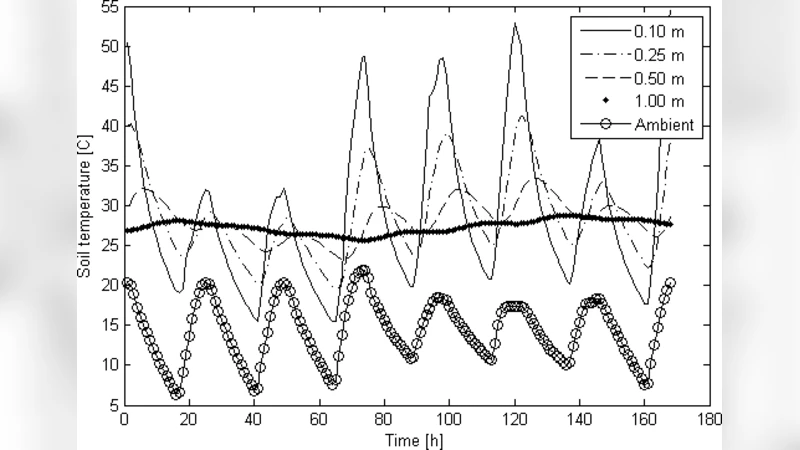
A full‑year simulation using typical Bogotá meteorological data revealed that diurnal temperature fluctuations essentially vanish at a depth of 1 m, confirming the semi‑infinite assumption used for validation. Over the entire year, temperature variations become negligible beyond 2.5 m depth. Weekly temperature profiles at several depths illustrate the damping of surface fluctuations with depth, providing practical guidance for mulch depth selection in frost‑prone regions.
Conclusions and Future Work
The study demonstrates that a nonlinear 1‑D finite‑element model can accurately predict soil temperature under various plastic mulches, and that Taguchi‑based optimization can identify superior mulch optical properties. The authors conclude that the LDPE film widely used in Colombia is sub‑optimal and propose the identified optimal property set for future mulch design. Planned future work includes developing non‑dimensional design curves for mulch selection, extending the model to two‑ or three‑dimensional domains, incorporating the finite thermal mass of thicker films, and exploring mulch solutions for protecting seedbeds against freezing temperatures in the Bogotá savanna.
Comments & Academic Discussion
Loading comments...
Leave a Comment