Auslander-Buchweitz approximation theory for triangulated categories
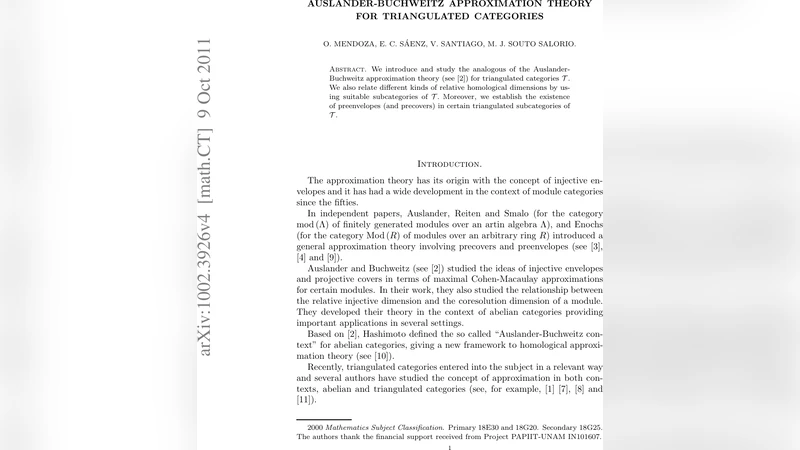
We introduce and develop an analogous of the Auslander-Buchweitz approximation theory (see \cite{AB}) in the context of triangulated categories, by using a version of relative homology in this setting. We also prove several results concerning relative homological algebra in a triangulated category $\T,$ which are based on the behavior of certain subcategories under finiteness of resolutions and vanishing of Hom-spaces. For example: we establish the existence of preenvelopes (and precovers) in certain triangulated subcategories of $\T.$ The results resemble various constructions and results of Auslander and Buchweitz, and are concentrated in exploring the structure of a triangulated category $\T$ equipped with a pair $(\X,\omega),$ where $\X$ is closed under extensions and $\omega$ is a weak-cogenerator in $\X,$ usually under additional conditions. This reduces, among other things, to the existence of distinguished triangles enjoying special properties, and the behavior of (suitably defined) (co)resolutions, projective or injective dimension of objects of $\T$ and the formation of orthogonal subcategories. Finally, some relationships with the Rouquier’s dimension in triangulated categories is discussed.
💡 Research Summary
The paper develops a triangulated‑category analogue of the classical Auslander‑Buchweitz approximation theory. Working inside a triangulated category 𝑇 (assumed k‑linear, Hom‑finite and Krull‑Schmidt), the authors fix a pair (𝑋, ω) where 𝑋⊂𝑇 is extension‑closed and ω⊂𝑋 is a weak cogenerator: every object of 𝑋 admits a triangle X→W→X′→ΣX with W∈ω and X′∈𝑋. This set‑up mirrors the Auslander‑Buchweitz hypothesis that a subcategory is resolving and possesses a (co)generator.
The first major contribution is a systematic definition of relative homology in this setting. Using 𝑋‑resolutions (triangles whose successive cones lie in 𝑋) the authors define an 𝑋‑relative projective dimension (𝑋‑res dim M) for any object M∈𝑇; dually they introduce an ω‑coresolution dimension. These dimensions give rise to relative Ext‑groups Extⁱ_𝑋(M,N) and Extⁱ_ω(M,N) obtained by applying Hom to the appropriate resolution or coresolution. The construction respects the triangulated structure: the long exact sequences of relative Ext arise from the octahedral axiom and the standard triangle axioms.
A central theorem (Theorem 3.5) proves the existence of 𝑋‑preenvelopes and 𝑋‑precovers for every object of 𝑇 under the above hypotheses. Concretely, for any M there is a distinguished triangle
M → X → C → ΣM,
with X∈𝑋 and C having finite ω‑coresolution dimension. This is the triangulated analogue of the classical Auslander‑Smalø‑Buchweitz result on approximations by a resolving subcategory. The proof combines the weak cogenerator property of ω with the existence of enough 𝑋‑projectives (objects that admit 𝑋‑resolutions of length zero) and uses successive approximations to build the required triangle.
The paper then investigates the relationship between the 𝑋‑resolution dimension of the whole category and Rouquier’s dimension dim 𝑇, which measures the minimal length of a generating sequence of objects. The authors show that
sup{𝑋‑res dim M | M∈𝑇} ≤ dim 𝑇,
and under additional generation hypotheses (e.g., 𝑋 generates 𝑇 and ω controls the resolution length) equality holds. This yields a new method for estimating Rouquier dimension via relative homological data.
Next, the authors study orthogonal subcategories 𝑋^{⊥} = {Y | Hom_𝑇(X, Σ^{>0}Y)=0 ∀X∈𝑋} and ^{⊥}𝑋 = {Y | Hom_𝑇(Σ^{>0}Y, X)=0 ∀X∈𝑋}. They prove that when 𝑋 is extension‑closed and ω is a weak cogenerator, 𝑋^{⊥} consists precisely of objects of finite 𝑋‑resolution dimension, while ^{⊥}𝑋 consists of objects of finite ω‑coresolution dimension. Moreover, these two orthogonal classes form a complete‑co‑complete pair, providing a triangulated version of the “cotorsion pair” familiar from abelian settings. This structure underlies many of the approximation results and allows the authors to construct mutation triangles that exchange objects between the two orthogonal halves.
To illustrate the theory, the paper works out two important classes of examples. In the bounded derived category D^{b}(A) of a finite‑dimensional algebra A, taking 𝑋 to be the subcategory of complexes with projective components and ω the subcategory of bounded complexes of projectives reproduces the classical Gorenstein‑projective approximation theory. In the stable module category of an Iwanaga‑Gorenstein algebra Λ, choosing 𝑋 as the Gorenstein‑projective modules and ω as the projectives yields the known existence of Gorenstein projective precovers and preenvelopes, now derived from the triangulated framework. These examples confirm that the abstract results specialize to familiar homological phenomena while also providing a unified language.
Finally, the authors discuss further directions. They note that finite 𝑋‑resolution dimension implies that every object of 𝑇 can be built from a finite chain of distinguished triangles whose vertices lie in 𝑋, suggesting a notion of “triangulated approximation” that could be useful for constructing explicit models of derived categories. They also propose investigating how the relative dimensions interact with t‑structures, silting theory, and the classification of thick subcategories, as well as exploring computational aspects of Rouquier dimension via relative homology.
In summary, the paper successfully transports the Auslander‑Buchweitz approximation machinery into the realm of triangulated categories. By introducing relative resolutions, proving the existence of preenvelopes and precovers, relating relative dimensions to Rouquier’s invariant, and establishing robust orthogonal pairs, it furnishes a powerful toolkit for homological algebraists working with derived, stable, or more exotic triangulated categories. The results not only generalize known approximation theorems but also open new avenues for studying the internal structure and complexity of triangulated categories.
Comments & Academic Discussion
Loading comments...
Leave a Comment