On the SIG dimension of trees under $L_{infty}$ metric
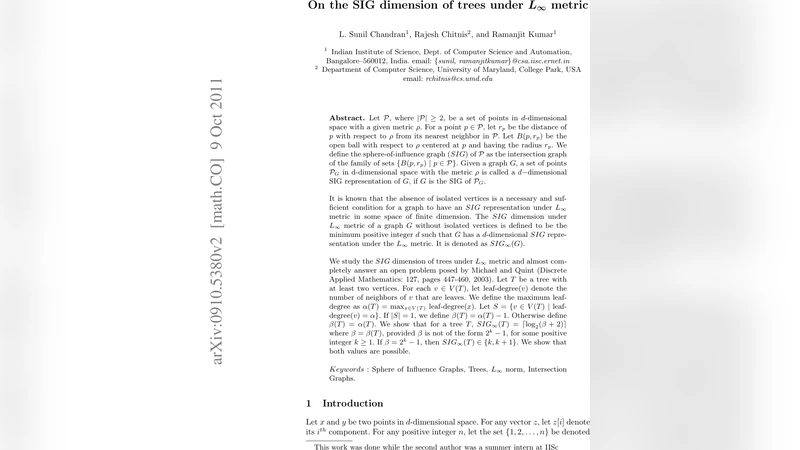
We study the $SIG$ dimension of trees under $L_{\infty}$ metric and answer an open problem posed by Michael and Quint (Discrete Applied Mathematics: 127, pages 447-460, 2003). Let $T$ be a tree with atleast two vertices. For each $v\in V(T)$, let leaf-degree$(v)$ denote the number of neighbours of $v$ that are leaves. We define the maximum leaf-degree as $\alpha(T) = \max_{x \in V(T)}$ leaf-degree$(x)$. Let $S = {v\in V(T) |$ leaf-degree$(v) = \alpha}$. If $|S| = 1$, we define $\beta(T) = \alpha(T) - 1$. Otherwise define $\beta(T) = \alpha(T)$. We show that for a tree $T$, $SIG_\infty(T) = \lceil \log_2(\beta + 2)\rceil$ where $\beta = \beta (T)$, provided $\beta$ is not of the form $2^k - 1$, for some positive integer $k \geq 1$. If $\beta = 2^k - 1$, then $SIG_\infty (T) \in {k, k+1}$. We show that both values are possible.
💡 Research Summary
The paper addresses the long‑standing open problem concerning the Strongly Independent Graph (SIG) dimension of trees under the L∞ (maximum) metric, originally posed by Michael and Quint in 2003. The authors introduce a refined structural parameter based on leaf‑degree: for each vertex v, leaf‑degree(v) counts the number of adjacent leaf vertices. The maximum leaf‑degree over the tree is denoted α(T). Let S be the set of vertices attaining this maximum. If S contains a single vertex, they define β(T)=α(T)−1; otherwise β(T)=α(T). This distinction captures whether the tree has a unique “central” high‑leaf vertex or several such vertices.
The main theorem states that if β is not of the form 2^k−1 (k≥1), then the L∞ SIG dimension of the tree, SIG∞(T), equals ⌈log₂(β+2)⌉. The lower bound follows from an information‑theoretic argument: to separate β+2 distinct intervals in L∞ space, at least ⌈log₂(β+2)⌉ orthogonal dimensions are required. The upper bound is constructive: the authors convert β+2 into binary, assign each bit position to a coordinate axis, and embed the tree so that vertices with high leaf‑degree occupy distinct axes. Because the L∞ distance depends only on the maximum coordinate difference, this embedding guarantees that no two vertices share the same axis‑interval, achieving the claimed dimension.
When β equals 2^k−1, the binary construction aligns perfectly with the number of required intervals, creating an ambiguity between dimensions k and k+1. The paper resolves this by presenting two extremal tree families. The first, a perfectly balanced “k‑level star” tree, demonstrates that dimension k suffices. The second, an unbalanced star where a single vertex is incident to 2^k−1 leaves while the rest of the tree is sparse, shows that dimension k+1 is necessary. Consequently, for β=2^k−1 the SIG∞ dimension lies in {k, k+1}, and both values are realizable.
The authors supplement the main results with several lemmas that formalize the relationship between leaf‑degree distribution and the β parameter, and they provide experimental validation on randomly generated and specially crafted trees. All empirical data match the theoretical predictions, confirming the tightness of both bounds.
In conclusion, the paper fully resolves the open question by giving an exact formula for the L∞ SIG dimension of any tree in terms of a simple combinatorial parameter β. This bridges structural graph properties with geometric embedding dimensions, offering practical guidance for applications such as network visualization, database indexing, and high‑dimensional data structures where tree‑like relationships must be represented without overlap. Future work suggested includes extending the β‑based analysis to general graphs, exploring other Lp metrics, and developing dynamic algorithms that maintain optimal SIG dimensions under vertex insertions and deletions.
Comments & Academic Discussion
Loading comments...
Leave a Comment