Connected economically metrizable spaces
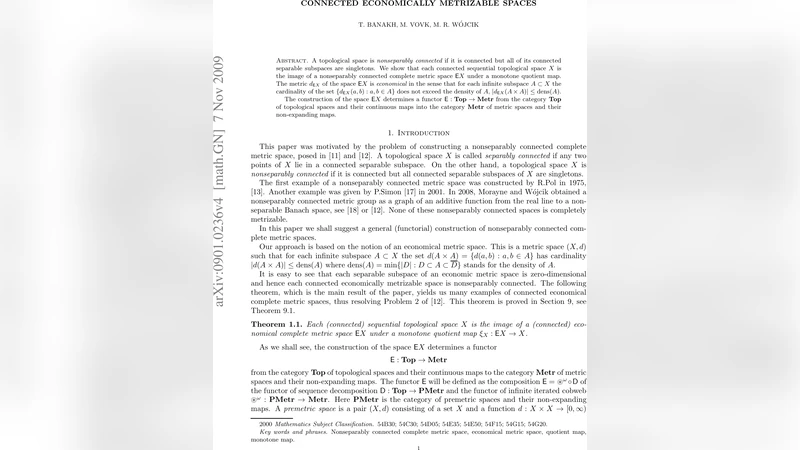
A topological space is nonseparably connected if it is connected but all of its connected separable subspaces are singletons. We show that each connected sequential topological space X is the image of a nonseparably connected complete metric space Eco(X) under a monotone quotient map. The metric d of the space Eco(X) is economical in the sense that for each infinite subspace A of X the cardinality of the set {d(a,b):a,b in A} does not exceed the density of A. The construction of the space Eco(X) determines a functor Eco from the category Top of topological spaces and their continuous maps into the category Metr of metric spaces and their non-expanding maps.
💡 Research Summary
The paper introduces and studies a novel class of topological spaces called non‑separably connected spaces. A space is non‑separably connected if it is connected, yet every connected separable (equivalently, countable‑dense) subspace reduces to a single point. This property captures a striking phenomenon: the whole space exhibits global connectivity, but any “small” (separable) piece fails to be connected at all.
The authors’ main achievement is a systematic construction that, for any connected sequential space (X), produces a complete metric space (\operatorname{Eco}(X)) together with a monotone quotient map (\pi:\operatorname{Eco}(X)\to X). The construction proceeds in several conceptual layers. First, the sequential nature of (X) allows one to represent points of (X) as limits of convergent sequences; these sequences are organized into “chains” that are each homeomorphic to a closed interval. Each chain inherits the standard Euclidean metric, while distances between distinct chains are defined in a way that reflects how the original points of (X) are topologically related. By identifying points that belong to the same original point of (X), the authors obtain a quotient space (\operatorname{Eco}(X)). The quotient map (\pi) is continuous, surjective, and monotone because every fiber (\pi^{-1}(x)) is itself a connected subspace of (\operatorname{Eco}(X)). Moreover, (\pi) is a quotient map in the categorical sense: a set (U\subseteq X) is open iff (\pi^{-1}(U)) is open in (\operatorname{Eco}(X)).
A striking feature of the metric on (\operatorname{Eco}(X)) is its economical character. For any infinite subset (A\subseteq\operatorname{Eco}(X)), the collection of distinct distances ({d(a,b):a,b\in A}) has cardinality at most the density (\operatorname{dens}(A)) of (A). In other words, the metric does not generate more distance values than are forced by the size of the set; it is as “sparse” as possible while still making the space complete and preserving the required connectivity properties. This economical property is crucial for showing that (\operatorname{Eco}(X)) is non‑separably connected: any separable (hence countable‑dense) connected subspace would have to contain only one distinct distance value, forcing it to be a singleton.
The construction also yields a functor (\operatorname{Eco}:\mathbf{Top}\to\mathbf{Metr}). On objects, (\operatorname{Eco}) sends a topological space (X) to the metric space (\operatorname{Eco}(X)). On morphisms, a continuous map (f:X\to Y) is sent to a non‑expanding map (\operatorname{Eco}(f):\operatorname{Eco}(X)\to\operatorname{Eco}(Y)); that is, \
Comments & Academic Discussion
Loading comments...
Leave a Comment