$k^*$-Metrizable Spaces and their Applications
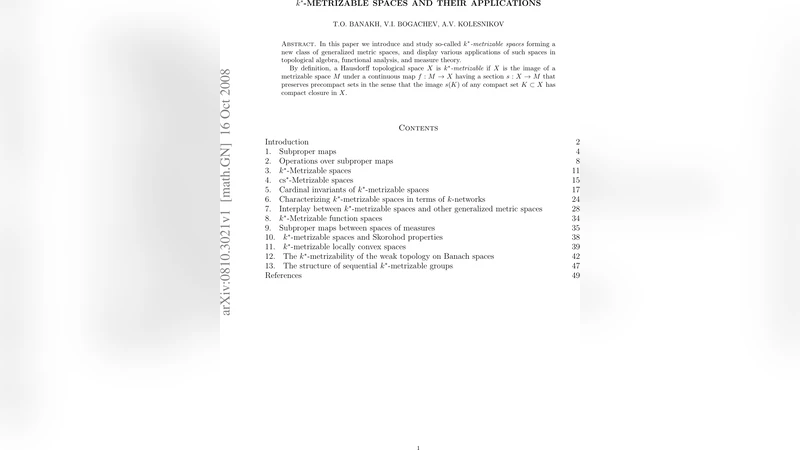
In this paper we introduce and study so-called $k^$-metrizable spaces forming a new class of generalized metric spaces, and display various applications of such spaces in topological algebra, functional analysis, and measure theory. By definition, a Hausdorff topological space $X$ is $k^$-metrizable if $X$ is the image of a metrizable space $M$ under a continuous map $f:M\to X$ having a section $s:X\to M$ that preserves precompact sets in the sense that the image $s(K)$ of any compact set $K\subset X$ has compact closure in $X$.
💡 Research Summary
The paper introduces a new class of generalized metric spaces called k*‑metrizable spaces. A Hausdorff space X is defined to be k*‑metrizable if there exists a metrizable space M and a continuous surjection f : M → X that admits a section s : X → M with the property that for every compact subset K ⊂ X, the image s(K) has compact closure in M. This “precompact‑preserving” section bridges the compact structure of X with a genuine metric model M, allowing many metric‑type arguments to be transferred to non‑metrizable settings.
The authors first develop the basic theory. They prove that k*‑metrizable spaces are hereditary with respect to closed subspaces, stable under countable products, and preserved by open continuous images. Moreover, every k*‑metrizable space is a k‑space, and it carries a σ‑compact k‑network, which yields several equivalent characterizations (e.g., existence of a σ‑locally finite base of precompact sets, or a complete regularity condition combined with a suitable network). The paper also shows that the class sits strictly between the classical metrizable spaces and the broader class of k‑spaces: every metrizable space is k*‑metrizable, but there exist k‑spaces that fail to be k*‑metrizable.
A substantial part of the work is devoted to applications. In topological algebra, the authors demonstrate that free topological groups F(X) and free topological vector spaces L(X) over a k*‑metrizable space X inherit k*‑metrizability. Consequently, many algebraic constructions (subgroups, quotient groups, semidirect products) preserve the property, providing a robust framework for studying algebraic objects that are not metrizable but retain metric‑like behavior.
In functional analysis, the paper investigates Banach spaces equipped with the weak topology σ(E,E*). It is shown that if E is k*‑metrizable in its norm topology, then both the weak topology on E and the weak* topology on its dual E* are k*‑metrizable. This leads to new compactness criteria for sets of continuous linear functionals and extends classical results such as Alaoglu’s theorem to a broader topological context.
The measure‑theoretic applications focus on spaces of probability measures. Endowing P(X) with the Prokhorov metric, the authors prove that if X is k*‑metrizable then (P(X),d_P) is also k*‑metrizable. This yields a generalized Skorohod representation theorem: sequences of probability measures converging weakly can be realized as almost sure convergence of random variables on a common probability space, even when the underlying space is not metrizable but only k*‑metrizable.
Finally, the paper outlines several open problems, such as the behavior of k*‑metrizability under uncountable products, its categorical characterization, and potential connections with descriptive set theory. Overall, the work establishes k*‑metrizable spaces as a versatile and powerful tool, unifying several strands of topology, algebra, analysis, and probability under a common framework.
Comments & Academic Discussion
Loading comments...
Leave a Comment