On scatteredly continuous maps between topological spaces
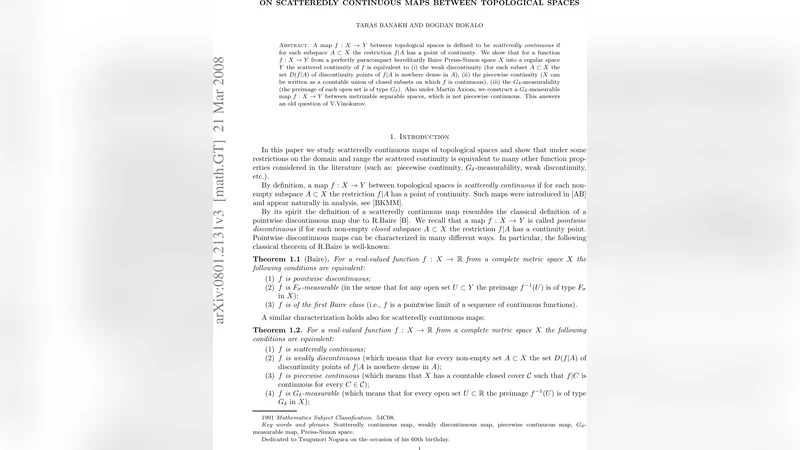
A map $f:X\to Y$ between topological spaces is defined to be {\em scatteredly continuous} if for each subspace $A\subset X$ the restriction $f|A$ has a point of continuity. We show that for a function $f:X\to Y$ from a perfectly paracompact hereditarily Baire Preiss-Simon space $X$ into a regular space $Y$ the scattered continuity of $f$ is equivalent to (i) the weak discontinuity (for each subset $A\subset X$ the set $D(f|A)$ of discontinuity points of $f|A$ is nowhere dense in $A$), (ii) the $\sigma$-continuity ($X$ can be written as a countable union of closed subsets on which $f$ is continuous), (iii) the $G_\delta$-measurability (the preimage of each open set is of type $G_\delta$). Also under Martin Axiom, we construct a $G_\delta$-measurable map $f:X\to Y$ between metrizable separable spaces, which is not piecewise continuous. This answers an old question of V.Vinokurov.
💡 Research Summary
The paper introduces the notion of scatteredly continuous maps between topological spaces and investigates how this concept relates to three well‑studied weakenings of continuity: weak discontinuity, σ‑continuity, and Gδ‑measurability. A map (f:X\to Y) is called scatteredly continuous if for every subspace (A\subset X) the restriction (f|_{A}) possesses at least one point of continuity. The authors work under the hypothesis that the domain (X) is a perfectly paracompact, hereditarily Baire, Preiss‑Simon space, while the codomain (Y) is regular.
The central result (Theorem 1) states that for such spaces the following four conditions are equivalent:
- Scattered continuity of (f).
- Weak discontinuity: for every (A\subset X) the set of discontinuity points (D(f|_{A})) is nowhere dense in (A).
- σ‑continuity: (X) can be written as a countable union of closed subsets (F_{n}) such that each restriction (f|{F{n}}) is continuous.
- Gδ‑measurability: for every open set (U\subset Y) the preimage (f^{-1}(U)) is a (G_{\delta}) subset of (X).
The proof proceeds in two main parts. First, assuming scattered continuity, the authors exploit the Preiss‑Simon property of (X) to show that for any subspace (A) the discontinuity set (D(f|{A})) cannot be dense; it must be of first category, establishing weak discontinuity. Second, starting from weak discontinuity, the perfect paracompactness and hereditary Baire nature of (X) are used to construct a countable closed cover ({F{n}}) on which (f) becomes continuous, thereby obtaining σ‑continuity. The implication σ‑continuity ⇒ Gδ‑measurability is standard: a countable union of closed sets on which (f) is continuous yields a (G_{\delta}) preimage for any open set. The remaining implications are proved by direct verification of the definitions.
A striking application of the equivalence is the construction, under Martin’s Axiom (MA), of a map (f:X\to Y) between separable metrizable spaces that is Gδ‑measurable but not piecewise continuous (i.e., it cannot be made continuous on any countable closed cover). The authors build a special filter and a countable chain of dense open sets using MA, then define (f) so that each open set in (Y) pulls back to a (G_{\delta}) set in (X) while the discontinuity set remains dense in every non‑trivial closed piece. This provides a negative answer to a long‑standing question of V. Vinokurov, who asked whether Gδ‑measurability necessarily implies piecewise continuity.
The paper also derives several corollaries. When (X) is a complete metric space, the Preiss‑Simon condition is automatically satisfied, so the four properties collapse into a single notion; this recovers and extends classical results linking Baire‑1 functions with Gδ‑measurable functions. Moreover, the authors exhibit simple counterexamples showing that if the Preiss‑Simon hypothesis is dropped, the equivalence can fail.
In the concluding section the authors discuss the broader significance of scattered continuity as a unifying framework for various continuity relaxations. They suggest future research directions, such as extending the equivalence to non‑regular codomains, investigating relationships with Borel‑measurability, or exploring analogous results in non‑paracompact or non‑Hausdorff settings. Overall, the work deepens our understanding of how topological structure of the domain governs the behavior of “almost continuous’’ maps and resolves an open problem that has persisted in the literature for decades.
Comments & Academic Discussion
Loading comments...
Leave a Comment