Good Fences: The Importance of Setting Boundaries for Peaceful Coexistence
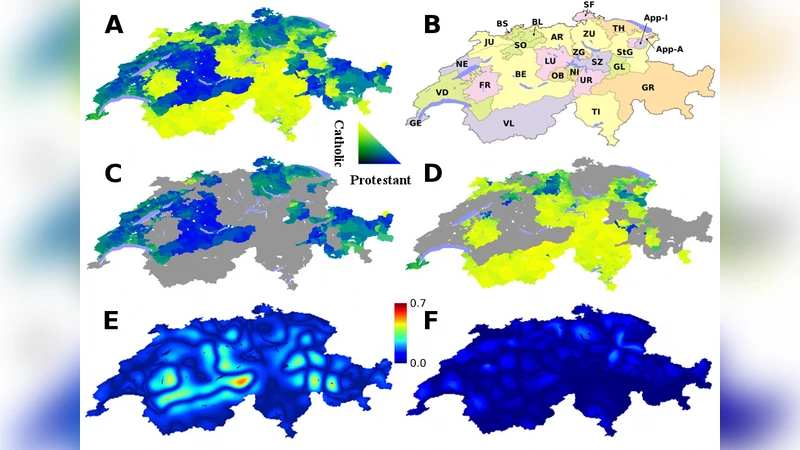
We consider the conditions of peace and violence among ethnic groups, testing a theory designed to predict the locations of violence and interventions that can promote peace. Characterizing the model’s success in predicting peace requires examples where peace prevails despite diversity. Switzerland is recognized as a country of peace, stability and prosperity. This is surprising because of its linguistic and religious diversity that in other parts of the world lead to conflict and violence. Here we analyze how peaceful stability is maintained. Our analysis shows that peace does not depend on integrated coexistence, but rather on well defined topographical and political boundaries separating groups. Mountains and lakes are an important part of the boundaries between sharply defined linguistic areas. Political canton and circle (sub-canton) boundaries often separate religious groups. Where such boundaries do not appear to be sufficient, we find that specific aspects of the population distribution either guarantee sufficient separation or sufficient mixing to inhibit intergroup violence according to the quantitative theory of conflict. In exactly one region, a porous mountain range does not adequately separate linguistic groups and violent conflict has led to the recent creation of the canton of Jura. Our analysis supports the hypothesis that violence between groups can be inhibited by physical and political boundaries. A similar analysis of the area of the former Yugoslavia shows that during widespread ethnic violence existing political boundaries did not coincide with the boundaries of distinct groups, but peace prevailed in specific areas where they did coincide. The success of peace in Switzerland may serve as a model to resolve conflict in other ethnically diverse countries and regions of the world.
💡 Research Summary
The paper tests a spatial‑conflict theory that predicts ethnic violence solely from the geographic distribution of populations. Using high‑resolution census data for Switzerland (2634 municipalities) the authors map linguistic (German, French, Italian) and religious (Catholic, Protestant) groups onto a spatial grid. A wavelet filter identifies “patches” of a characteristic size (18–60 km) that, when large enough to impose cultural norms but still overlapping with other groups, are prone to violence. The model first computes a propensity to violence without any boundaries, yielding high values (≈0.48 for language, ≈0.57 for religion). Physical boundaries—mountain ridges, lakes—are extracted via edge detection on elevation data, while political boundaries are taken from cantonal and sub‑cantonal (Graubünden circles) maps. Incorporating these boundaries dramatically lowers the predicted propensity (to ≈0.30 for language, ≈0.20 for religion), showing that natural and administrative borders can effectively separate groups or create well‑mixed zones, both of which suppress conflict. The Jura mountain range, identified as a porous boundary, produces a residual high propensity that matches the historical linguistic conflict leading to the creation of the Canton of Jura in 1978. Similarly, without cantonal/circle borders, religious tension spikes, but the existing political divisions keep the propensity low. To demonstrate generality, the same methodology is applied to the former Yugoslavia, reproducing known conflict hotspots and peaceful enclaves with correlation coefficients up to 0.89. The study concludes that well‑defined physical or political boundaries are a robust mechanism for preventing inter‑ethnic violence, offering a practical tool for peace‑building policies beyond the specific historical, economic, or social contexts traditionally emphasized.
Comments & Academic Discussion
Loading comments...
Leave a Comment