Extension of the $nu$-metric for stabilizable plants over $H^infty$
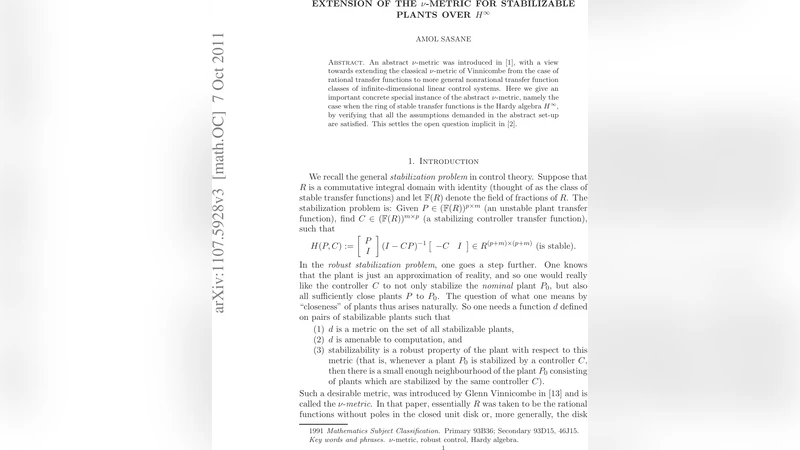
An abstract $\nu$-metric was introduced by Ball and Sasane, with a view towards extending the classical $\nu$-metric of Vinnicombe from the case of rational transfer functions to more general nonrational transfer function classes of infinite-dimensional linear control systems. In this short note, we give an important concrete special instance of the abstract $\nu$-metric, by verifying that all the assumptions demanded in the abstract set-up are satisfied when the ring of stable transfer functions is the Hardy algebra $H^\infty$. This settles the open question implicit in \cite{BalSas2}.
💡 Research Summary
The paper addresses an open problem left by Ball and Sasane (and implicitly by Vinnicombe) concerning the extension of the ν‑metric from rational transfer functions to more general, possibly infinite‑dimensional, transfer‑function classes. In the abstract framework of Ball‑Sasane, a ν‑metric is defined on the set of stabilizable plants provided four structural assumptions (A1)–(A4) hold for a pair of algebras (R,S) and a group homomorphism ι from the invertible elements of S into an abelian group G. The present work shows that these assumptions are satisfied when the ring of stable transfer functions R is the Hardy algebra H∞, i.e. bounded holomorphic functions on the open unit disc, and the larger Banach algebra S is taken to be C_b(A_ρ), the algebra of continuous bounded functions on an annulus A_ρ = {z∈ℂ | ρ<|z|<1} for some fixed ρ∈(0,1).
First, the authors verify that C_b(A_ρ) is a unital, commutative, semisimple Banach algebra equipped with the involution * given by pointwise complex conjugation on the annulus. The natural inclusion I: H∞ → C_b(A_ρ) (restriction of a Hardy function to the annulus) is injective, establishing (A2).
Next, for any invertible element F∈inv C_b(A_ρ) the authors consider its “radial slices’’ F_r(ζ)=F(rζ) for ζ on the unit circle and r∈(ρ,1). Each slice lies in inv C(T) and possesses an integer winding number w(F_r). By a homotopy argument they prove that w(F_r) is independent of r; this enables the definition of a global winding map W: inv C_b(A_ρ)→ℤ by W(F)=w(F_r). They then demonstrate that W satisfies the three required properties: (I1) W(FG)=W(F)+W(G), (I2) W(F*)=−W(F), and (I3) local constancy (continuity when ℤ carries the discrete topology). These are proved using elementary properties of winding numbers on the circle and the continuity of the functions involved.
The crucial (A4) condition – that an element of R which is invertible in S is already invertible in R – is established via a Nyquist‑type argument. If f∈H∞ has a non‑vanishing restriction to the annulus (i.e., I(f)∈inv C_b(A_ρ)), then the winding number W(I(f)) equals zero, which by the classical Nyquist criterion for the disk algebra A(D) implies that each dilated function f_r(z)=f(rz) is invertible in A(D). Passing to the limit as r→1 shows that f has a bounded holomorphic inverse, i.e. f∈inv H∞. Conversely, if f∈inv H∞ then clearly I(f)∈inv C_b(A_ρ) and W(I(f))=0. Hence (A4) holds.
Having verified (A1)–(A4), the abstract ν‑metric of Ball‑Sasane becomes concrete in this setting. For two stabilizable plants P₁,P₂∈S(R,p,m) with normalized left/right coprime factorizations, one defines matrices G₁,G₂ as in the abstract theory. The ν‑metric is then
d_ν(P₁,P₂)=‖e G₂ G₁‖_{S,∞}
provided that det(G₁* G₂)∈inv S and W(det(G₁* G₂))=0; otherwise the distance is defined to be 1. Here ‖·‖_{S,∞} denotes the Gelfand norm on C_b(A_ρ).
Finally, the authors show that when R is restricted to the subring of rational functions (i.e., the disk algebra A(D)), the Banach algebra S reduces to C(T) and the above definition collapses to the classical ν‑metric introduced by Vinnicombe. Thus the construction truly extends the ν‑metric to the full Hardy algebra, preserving all its desirable robustness properties: d_ν is a genuine metric on stabilizable plants, it is computable via Toeplitz operators, and the stability margin satisfies µ_{P,C} ≥ µ_{P₀,C} − d_ν(P,P₀).
In summary, the paper provides a concrete realization of the abstract ν‑metric for H∞ by embedding H∞ into a suitable Banach algebra of annular functions and using the winding number as the index map. This resolves the open question left in Ball‑Sasane’s work, demonstrates that the ν‑metric retains its robustness interpretation in the infinite‑dimensional setting, and bridges the gap between the classical rational theory and the broader Hardy‑space framework.
Comments & Academic Discussion
Loading comments...
Leave a Comment