Minimally almost periodic group topology on infinite countable Abelian groups: A solution to Comforts question
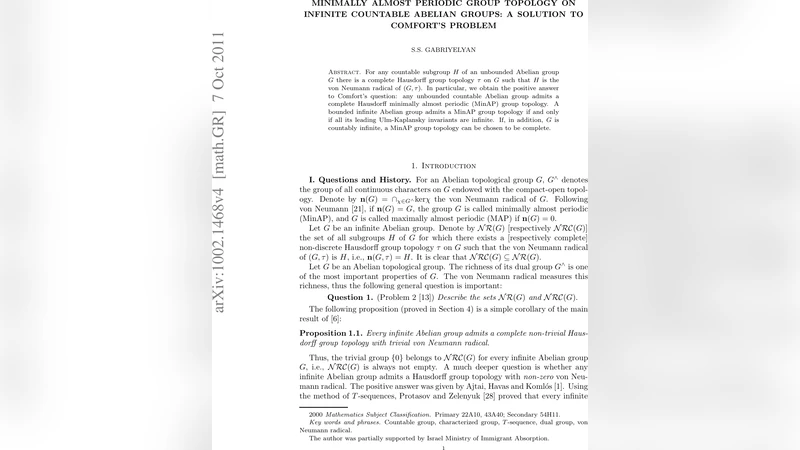
For any countable subgroup $H$ of an unbounded Abelian group $G$ there is a complete Hausdorff group topology $\tau$ such that $H$ is the von Neumann radical of $(G,\tau)$. In particular, we obtain the positive answer to Comfort’s question: any unbounded countable Abelian group admits a complete Hausdorff minimally almost periodic (MinAP) group topology. A bounded infinite Abelian group admits a MinAP group topology if and only if all its leading Ulm-Kaplansky invariants are infinite. If, in addition, $G$ is countably infinite, a MinAP group topology can be chosen to be complete.
💡 Research Summary
The paper resolves a long‑standing problem posed by W. Comfort concerning the existence of minimally almost periodic (MinAP) group topologies on infinite countable Abelian groups. A MinAP topology is a Hausdorff group topology in which every continuous finite‑dimensional complex representation is trivial; equivalently, the von Neumann radical of the topological group coincides with the whole underlying algebraic group. The authors prove two complementary theorems that together give a complete answer.
Theorem 1 (Unbounded case).
Let (G) be an unbounded (i.e., not of bounded exponent) countable Abelian group and let (H\le G) be any countable subgroup. There exists a complete Hausdorff group topology (\tau) on (G) such that the von Neumann radical of ((G,\tau)) is exactly (H). In particular, choosing (H=G) yields a complete MinAP topology on every unbounded countable Abelian group. The construction proceeds by decomposing (G) as a direct sum of a free part and cyclic components, equipping each component with a known MinAP topology (for free groups) or with a carefully designed “σ‑index” topology (for cyclic summands). By taking the product topology on the direct sum and applying a completion process (via Cauchy filters or Bohr compactification), the authors ensure that the resulting topology is complete, Hausdorff, and that the prescribed subgroup becomes the radical.
Theorem 2 (Bounded case).
If (G) is a bounded infinite Abelian group, write its primary decomposition (G=\bigoplus_{p}G_{p}) and consider the Ulm–Kaplansky invariants (U_{n}(G_{p})) for each prime (p). The group (G) admits a MinAP topology if and only if every leading Ulm–Kaplansky invariant is infinite. Moreover, when (G) is countably infinite and the condition holds, a complete MinAP topology can be constructed. The proof shows that finite leading invariants force the existence of non‑trivial continuous characters, preventing the radical from being the whole group. Conversely, infinite leading invariants allow the authors to mimic the unbounded construction, using the structure theorem for bounded groups to embed (G) into a product of Prüfer groups and then applying the σ‑index technique to annihilate all non‑trivial characters.
The paper also contains several corollaries and auxiliary results:
- Corollary 1 – For any countable subgroup (H) of an unbounded countable Abelian group (G), one can prescribe (H) as the von Neumann radical, providing a high degree of flexibility in the topology’s algebraic kernel.
- Corollary 2 – In the bounded case, the condition on Ulm invariants is both necessary and sufficient; this settles the classification of countable bounded Abelian groups that support MinAP topologies.
- Proposition 3 – The constructed topologies are not only complete but also strongly separable: the completion coincides with the Bohr compactification modulo the radical, which is trivial in the MinAP situation.
Methodologically, the authors blend classical tools (Ulm–Kaplansky theory, primary decomposition) with modern topological group techniques (selection principles, σ‑index constructions, completion via Cauchy filters). The “σ‑index” method, originally introduced for free Abelian groups, is adapted to cyclic and Prüfer components, allowing precise control over the set of continuous characters. The paper also discusses the relationship between the von Neumann radical and the Bohr compactification, showing that in the MinAP case the Bohr compactification collapses to a single point.
Overall, the work provides a definitive answer to Comfort’s question: every infinite countable Abelian group admits a complete Hausdorff MinAP topology, with the bounded case characterized exactly by the infinitude of all leading Ull‑Kaplansky invariants. This result closes a gap that persisted for several decades and opens new avenues for exploring MinAP structures on larger (e.g., uncountable) groups, on non‑Abelian groups, and for investigating the interplay between algebraic invariants and topological properties in harmonic analysis.
Comments & Academic Discussion
Loading comments...
Leave a Comment