Graph Homomorphisms with Complex Values: A Dichotomy Theorem
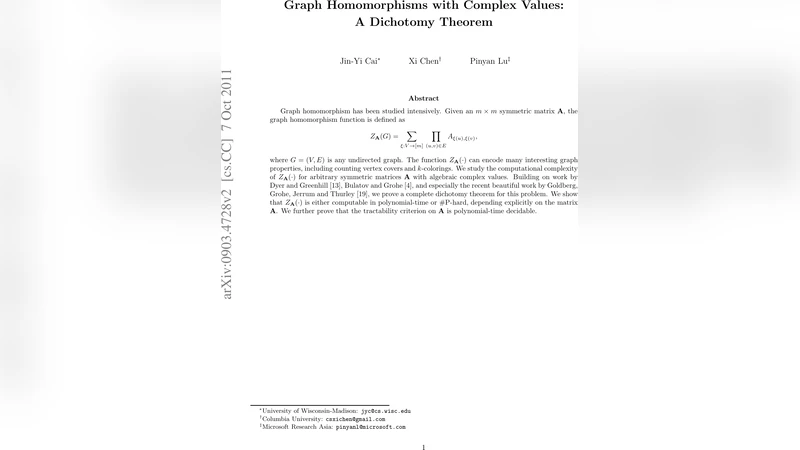
Graph homomorphism has been studied intensively. Given an m x m symmetric matrix A, the graph homomorphism function is defined as [Z_A (G) = \sum_{f:V->[m]} \prod_{(u,v)\in E} A_{f(u),f(v)}, ] where G = (V,E) is any undirected graph. The function Z_A can encode many interesting graph properties, including counting vertex covers and k-colorings. We study the computational complexity of Z_A for arbitrary symmetric matrices A with algebraic complex values. Building on work by Dyer and Greenhill, Bulatov and Grohe, and especially the recent beautiful work by Goldberg, Grohe, Jerrum and Thurley, we prove a complete dichotomy theorem for this problem. We show that Z_A is either computable in polynomial-time or #P-hard, depending explicitly on the matrix A. We further prove that the tractability criterion on A is polynomial-time decidable.
💡 Research Summary
The paper “Graph Homomorphisms with Complex Values: A Dichotomy Theorem” establishes a complete complexity classification for the graph homomorphism partition function (Z_A(G)=\sum_{f:V\to
Comments & Academic Discussion
Loading comments...
Leave a Comment