Polynomial integrality gaps for strong SDP relaxations of Densest k-subgraph
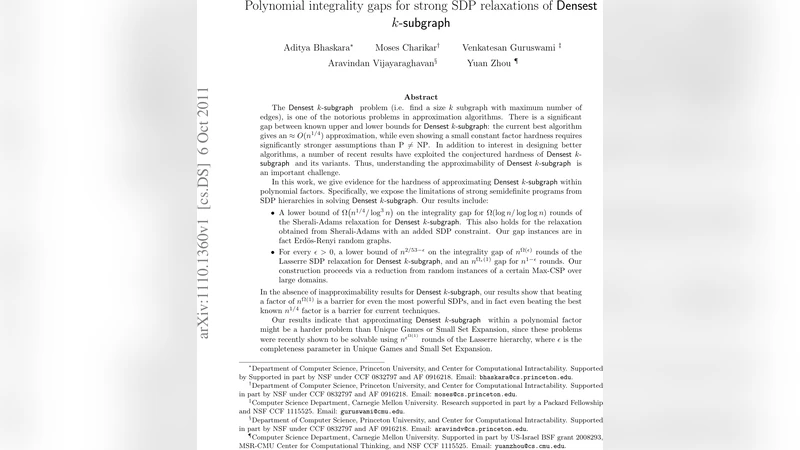
The densest k-subgraph (DkS) problem (i.e. find a size k subgraph with maximum number of edges), is one of the notorious problems in approximation algorithms. There is a significant gap between known upper and lower bounds for DkS: the current best algorithm gives an ~ O(n^{1/4}) approximation, while even showing a small constant factor hardness requires significantly stronger assumptions than P != NP. In addition to interest in designing better algorithms, a number of recent results have exploited the conjectured hardness of densest k-subgraph and its variants. Thus, understanding the approximability of DkS is an important challenge. In this work, we give evidence for the hardness of approximating DkS within polynomial factors. Specifically, we expose the limitations of strong semidefinite programs from SDP hierarchies in solving densest k-subgraph. Our results include: * A lower bound of Omega(n^{1/4}/log^3 n) on the integrality gap for Omega(log n/log log n) rounds of the Sherali-Adams relaxation for DkS. This also holds for the relaxation obtained from Sherali-Adams with an added SDP constraint. Our gap instances are in fact Erdos-Renyi random graphs. * For every epsilon > 0, a lower bound of n^{2/53-eps} on the integrality gap of n^{Omega(eps)} rounds of the Lasserre SDP relaxation for DkS, and an n^{Omega_eps(1)} gap for n^{1-eps} rounds. Our construction proceeds via a reduction from random instances of a certain Max-CSP over large domains. In the absence of inapproximability results for DkS, our results show that even the most powerful SDPs are unable to beat a factor of n^{Omega(1)}, and in fact even improving the best known n^{1/4} factor is a barrier for current techniques.
💡 Research Summary
**
The paper investigates the approximability limits of the Densest k‑Subgraph (DkS) problem through the lens of powerful semidefinite programming (SDP) hierarchies, specifically the Sherali‑Adams (SA) linear‑programming hierarchy and the Lasserre SDP hierarchy. DkS asks for a subgraph of size k with the maximum number of edges in a given graph G(V,E). The best known algorithm achieves an O(n^{1/4+ε})‑approximation, while hardness results only rule out constant‑factor approximations under strong assumptions such as the random 3‑SAT conjecture or quasi‑random PCPs. Consequently, it is unclear whether the gap between algorithmic performance and known hardness is intrinsic or merely a limitation of current techniques.
The authors provide two main families of integrality‑gap constructions that demonstrate polynomial‑factor gaps for both hierarchies, even when a large (polylogarithmic or polynomial) number of rounds is allowed.
-
Sherali‑Adams Lower Bound
- They consider SA with L ≤ (log n)/(10 log log n) rounds.
- The gap instance is an Erdős‑Rényi random graph G(n,p) with p = n^{‑1/2}·log n, giving an expected degree D = √n / log n. The target subgraph size is set to k = √n.
- In such a graph, any actual k‑subgraph has density at most O(log² n) (hence min‑degree O(log² n)).
- The authors construct a feasible SA solution with “pseudo‑density” d = Ω( n^{1/4} / L ). The construction assigns to each vertex set S a variable x_S = n^{‑1/4·(st(S)+1)}·L^{‑|S|}, where st(S) denotes the size of the minimum Steiner tree spanning S. This choice respects all SA constraints (the inclusion‑exclusion consistency, edge‑cover constraints, and degree constraints) while inflating the objective value far beyond the true optimum.
- Consequently, even after Ω(log n / log log n) SA rounds, the integrality gap remains Ω( n^{1/4} / log³ n ), showing that SA cannot break the n^{1/4} barrier.
-
Lasserre Lower Bounds
- The authors turn to the stronger Lasserre hierarchy, which introduces vector variables U_S for each subset S of vertices with |S| ≤ r. The SDP constraints enforce positive semidefiniteness of the moment matrix and consistency with the original integer program.
- Two regimes are analyzed:
a) Polynomial‑round gap: For any ε > 0, they exhibit a gap of n^{2/53 − ε} after n^{Ω(ε)} Lasserre rounds. The construction reduces a random Max‑CSP instance over a large alphabet to a DkS instance. By carefully encoding CSP constraints into graph edges, they ensure that the Lasserre SDP can “pretend” that a dense subgraph of size roughly n^{2/53} exists, while any true subgraph of size k = √n has only O(log² n) edges.
b) Almost‑full‑round gap: When the number of rounds is n^{1‑ε}, the gap becomes n^{Ω(1)}. The same reduction technique yields an instance where the SDP solution remains high despite the true optimum being negligible. - In both cases, the pseudo‑solution assigns vectors whose norms correspond to the SA‑style Steiner‑tree scaling, thereby satisfying the Lasserre constraints (including the additional “minimum‑degree” SDP constraint).
- Importantly, these gap instances are also Erdős‑Rényi random graphs (or random bipartite graphs under a special distribution), showing that natural random instances already defeat high‑level Lasserre relaxations.
-
Implications and Comparison
- Prior integrality‑gap results for lift‑and‑project hierarchies typically matched known NP‑hardness factors (e.g., Max‑k‑CSP, graph coloring). Here, the gaps are substantially stronger than any existing hardness for DkS, which currently only rules out constant‑factor approximations under non‑standard assumptions.
- The results suggest that DkS is intrinsically harder for SDP‑based methods than problems like Small‑Set Expansion (SSE) or Unique Games, for which n^{ε}‑round Lasserre hierarchies already yield polynomial‑time algorithms.
- Consequently, improving the O(n^{1/4}) approximation for DkS will likely require fundamentally new algorithmic ideas beyond the current SDP hierarchy framework.
-
Technical Contributions
- Introduction of a Steiner‑tree‑based pseudo‑distribution for SA variables that respects all high‑level constraints while inflating the objective.
- Development of a reduction from random large‑domain Max‑CSP to DkS that preserves the integrality gap under Lasserre relaxations.
- Demonstration that random graphs, which are natural and widely studied, already serve as hard instances for both SA and Lasserre hierarchies at high levels.
-
Conclusion and Future Directions
- The paper establishes that even the most powerful known SDP hierarchies cannot achieve sub‑polynomial approximation ratios for DkS; the n^{Ω(1)} barrier appears insurmountable within these frameworks.
- This motivates the search for alternative algorithmic paradigms (e.g., combinatorial methods, new hierarchy designs, or problem‑specific relaxations) to break the n^{1/4} barrier.
- Moreover, the work provides a benchmark for future hardness‑of‑approximation research on DkS, indicating that any proof of polynomial‑factor hardness must either exploit stronger complexity assumptions or target techniques beyond SDP hierarchies.
Comments & Academic Discussion
Loading comments...
Leave a Comment