Sources of Inter-package Conflicts in Debian
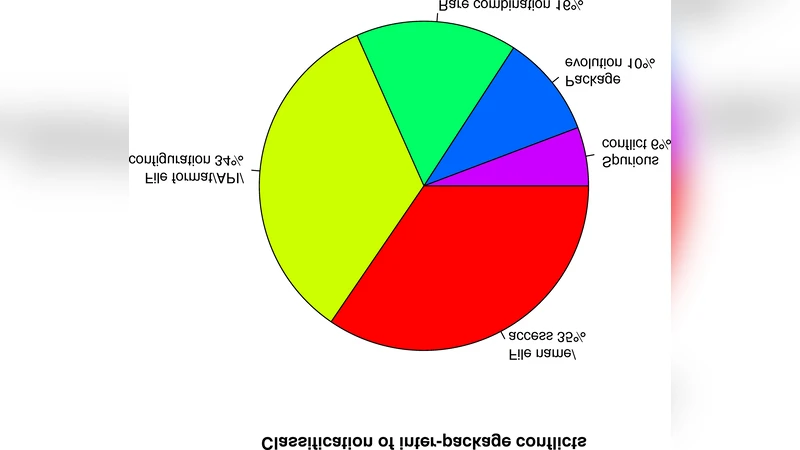
Inter-package conflicts require the presence of two or more packages in a particular configuration, and thus tend to be harder to detect and localize than conventional (intra-package) defects. Hundreds of such inter-package conflicts go undetected by the normal testing and distribution process until they are later reported by a user. The reason for this is that current meta-data is not fine-grained and accurate enough to cover all common types of conflicts. A case study of inter-package conflicts in Debian has shown that with more detailed package meta-data, at least one third of all package conflicts could be prevented relatively easily, while another one third could be found by targeted testing of packages that share common resources or characteristics. This paper reports the case study and proposes ideas to detect inter-package conflicts in the future.
💡 Research Summary
The paper investigates inter‑package conflicts in the Debian GNU/Linux distribution, focusing on why such conflicts escape detection during normal testing and how they can be mitigated. Inter‑package conflicts arise only when two or more packages are installed together in a particular configuration, making them harder to locate than intra‑package bugs. The authors argue that the root cause is the coarse‑grained nature of Debian’s package metadata, which records dependencies and conflicts only at the package level and does not describe the concrete resources (files, devices, ports, services) that packages provide or consume.
To quantify the problem, the authors extracted a snapshot of the Ultimate Debian Database (UDD) as of 23 January 2011, which contained 79 936 open bug reports. They performed a keyword search for “break”, “conflict”, and “overwrite”, yielding 929 initial matches. By further filtering for bug titles that explicitly mention another package name, the set was reduced to 290 entries, of which 241 were distinct reports. Manual inspection eliminated 51 false positives, leaving 190 candidate reports. After downloading the full bug reports and reviewing their contents, 51 were found not to involve inter‑package conflicts, leaving 139 genuine cases for detailed analysis.
The authors classified these 139 conflicts into five broad categories:
-
Shared resource conflicts (files, devices, library symbols, etc.) – 48 cases. Some are caught by the package manager at install time (e.g., two packages providing the same file), but many remain undetected until runtime when a program accesses a clobbered resource.
-
Configuration and shared data conflicts – 31 cases. Installation scripts modify /etc configuration files or change data formats, causing syntactic or semantic incompatibilities. Examples include automatic alteration of a config file that breaks another package’s parser, or a version‑specific data format that newer components cannot read.
-
Previously untested package combinations – 22 cases. Certain bugs become visible only when two particular packages are present together; each package works fine in isolation, but their interaction reveals a defect.
-
Package evolution issues – 14 cases. Renaming, splitting, merging, or version upgrades of packages require corresponding updates in other packages’ metadata. When maintainers forget to adjust these relationships, stale dependency or conflict declarations cause failures.
-
Spurious conflict reports – 9 cases. Bug reports mistakenly label a problem as a conflict, although no actual incompatibility exists for the current package versions.
Statistical analysis shows that roughly one‑third of conflicts stem from shared resources, another third from configuration/data issues, and the remainder from rare combinations, evolution problems, or reporting errors. The study highlights two main opportunities for improvement. First, enriching metadata with fine‑grained resource declarations (e.g., virtual packages representing specific files, devices, or ports) would allow the package manager to pre‑empt many install‑time failures. Second, targeted testing that exercises shared configuration files and data formats across package pairs could automatically uncover many runtime conflicts. The authors estimate that with these measures, at least one third of the observed conflicts could have been prevented, and another third could be detected through systematic testing.
In the discussion, the paper notes that current tools (apt‑get, dpkg) already prevent some file‑level clashes but lack the expressive power to capture more subtle interactions such as post‑install script side‑effects or API changes. They propose developing automated tools to extract file lists from packages, verify consistency of virtual package declarations, and generate combinatorial test suites for packages that share resources. Moreover, they suggest integrating metadata validation into the Debian package maintenance workflow to catch outdated or missing conflict information early.
The conclusion reiterates that inter‑package conflicts are a significant source of instability in large FOSS distributions and that improving metadata granularity, automating its verification, and expanding test coverage are essential steps toward more reliable package ecosystems. Future work includes building prototype tools for fine‑grained metadata generation, evaluating their impact on conflict reduction, and extending the methodology to other distributions such as Fedora or Arch Linux.
Comments & Academic Discussion
Loading comments...
Leave a Comment