On the Parameterized Complexity of Default Logic and Autoepistemic Logic
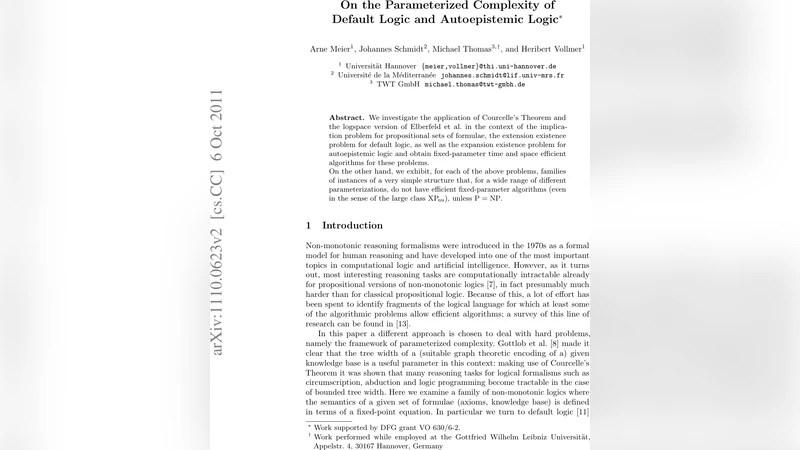
We investigate the application of Courcelle’s Theorem and the logspace version of Elberfeld etal. in the context of the implication problem for propositional sets of formulae, the extension existence problem for default logic, as well as the expansion existence problem for autoepistemic logic and obtain fixed-parameter time and space efficient algorithms for these problems. On the other hand, we exhibit, for each of the above problems, families of instances of a very simple structure that, for a wide range of different parameterizations, do not have efficient fixed-parameter algorithms (even in the sense of the large class XPnu), unless P=NP.
💡 Research Summary
The paper investigates the parameterized complexity of two central non‑monotonic reasoning formalisms: Reiter’s default logic and Moore’s autoepistemic logic. Both formalisms have a decision problem that asks whether a given knowledge base admits a stable extension (for default logic) or a stable expansion (for autoepistemic logic). These problems, called Ext and Exp respectively, are known to be Σ₂^p‑complete, placing them well beyond the reach of polynomial‑time algorithms in the classical setting.
The authors adopt a structural parameterization approach, focusing on the tree‑width of a graph representation of the knowledge base. They first encode propositional formulae and default rules as relational structures over a finite vocabulary τ_B,prop (for plain propositional formulae) and τ_B,d (for default theories). Using monadic second‑order (MSO) logic, they express satisfiability, implication, and the existence of a stable extension/expansion as MSO sentences. This encoding mirrors earlier work on logic programming, abduction, and circumscription.
With the MSO encodings in hand, the authors apply Courcelle’s Theorem, which guarantees that any MSO‑definable property can be decided in linear time on graphs of bounded tree‑width. Moreover, they exploit the log‑space variant of Courcelle’s Theorem due to Elberfeld, Jakoby, and Tantau, which yields algorithms that run in O(log n) space. Consequently, they obtain the following positive results:
-
Theorem 3: For any fixed bound k on the tree‑width of the structure A_{F,G} (representing premise and conclusion sets), the implication problem for propositional B‑formulae can be solved in time O(f(k)·(|F|+|G|)) and space O(log(|F|+|G|)). Thus the problem lies in the class PLS (parameterized log‑space).
-
Theorem 5: For any fixed bound k on the tree‑width of the structure A(W,D) (representing a default theory), the extension existence problem Ext for B‑default logic is solvable in time O(f(k)·|(W,D)|) and space O(log|(W,D)|). Hence Ext is also in PLS.
These results show that tree‑width is a powerful parameter: when it is bounded, both default logic and autoepistemic logic become tractable not only in time but also in space, a significant improvement over the general Σ₂^p‑hardness.
The second major contribution is a series of lower‑bound results that demonstrate the limits of parameterized tractability for these problems. The authors construct very restricted families of knowledge bases:
- Default theories where every rule consists only of literals (no complex formulas).
- Even more restricted theories where rules involve only propositions or the constant ⊥.
For any parameterization κ that remains bounded (by a constant c) on these restricted families, they prove that if P ≠ NP then the corresponding parameterized problem (Ext, κ) does not belong to XPₙᵤ, the non‑uniform analogue of XP. The proof proceeds by a polynomial‑time reduction from SAT to these restricted default theories (as shown in Lemma 5.6 of a prior work). Since SAT is NP‑complete, the existence of an XPₙᵤ algorithm would imply P = NP, contradicting the assumption.
Furthermore, they strengthen the lower bound for the even more restricted case: under the assumption L ≠ NL, the problem is not in XLₙᵤ, the log‑space analogue of XPₙᵤ. This shows that not only time‑efficient FPT algorithms are impossible, but also space‑efficient parameterized algorithms cannot exist for these parameterizations.
To explain why these simple instances nevertheless have unbounded tree‑width, the authors introduce the notion of a “pseudo‑clique”. A pseudo‑clique is a graph structure that, while not a true clique, can be embedded into the relational encoding of the knowledge base and forces the tree‑width to grow arbitrarily. By embedding pseudo‑cliques into the restricted default theories, they demonstrate that the tree‑width parameter is the only structural measure that yields tractability for these logics; all other natural parameters fail.
In summary, the paper delivers a balanced picture:
-
Positive side: When the tree‑width of the underlying graph representation is bounded, both the implication problem for propositional formulas and the extension/expansion existence problems for default and autoepistemic logic admit fixed‑parameter tractable algorithms that run in linear time and logarithmic space (PLS). This is achieved via MSO encodings and Courcelle’s Theorem (including its log‑space variant).
-
Negative side: For a broad class of natural parameterizations—any that stay constant on families of knowledge bases consisting only of literals or single propositions—no fixed‑parameter algorithm exists unless major complexity collapses occur (P = NP or L = NL). Moreover, these families have unbounded tree‑width, underscoring that tree‑width is essentially the only useful structural parameter for achieving tractability in these non‑monotonic logics.
The work thus clarifies the exact role of structural graph parameters in the algorithmic treatment of default and autoepistemic reasoning, providing both practical algorithmic tools for bounded‑tree‑width instances and rigorous evidence of inherent hardness for more general cases.
Comments & Academic Discussion
Loading comments...
Leave a Comment