Non-separable h-homogeneous absolute F_{sigma delta}-spaces and G_{delta sigma}-spaces
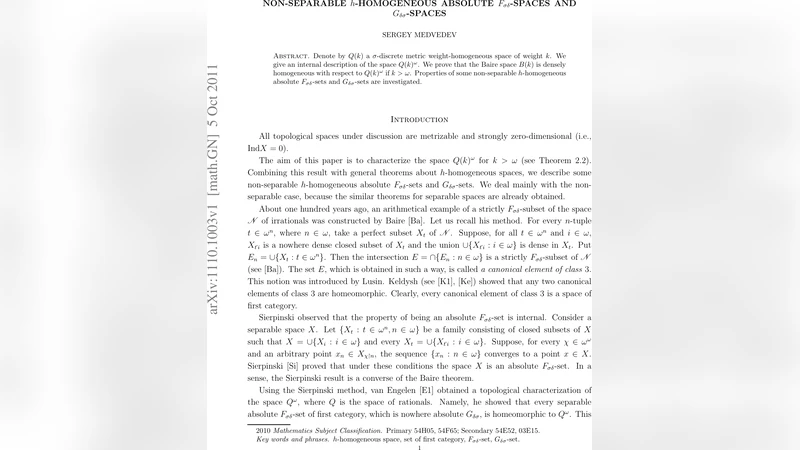
Denote by Q(k) a \sigma-discrete metric weight-homogeneous space of weight k. We give an internal description of the space Q(k)^\omega. We prove that the Baire space B(k) is densely homogeneous with respect to Q(k)^\omega if k > \omega. Properties of some non-separable h-homogeneous absolute F_{\sigma \delta}-sets and G_{\delta \sigma}-sets are investigated.
💡 Research Summary
The paper investigates the topology of non‑separable, h‑homogeneous absolute Fσδ‑ and Gδσ‑sets, focusing on the σ‑discrete metric space Q(k) of weight k (where k is an uncountable cardinal) and its countable power Q(k)^ω. The authors first recall the definitions of h‑homogeneity (every non‑empty clopen subset is homeomorphic to the whole space) and weight‑homogeneity (every non‑empty open set has the same weight as the whole space). They define Q(k) as the σ‑product of countably many copies of a discrete space D of cardinality k, i.e. the set of all sequences in k^ω that are eventually zero, with the basic point (0,0,…). For k=ℵ₀ this space is homeomorphic to the rational line Q, while for larger k it provides a non‑separable analogue.
A series of lemmas (1.3–1.5) develop technical tools for extending homeomorphisms defined on nowhere‑dense closed subsets of h‑homogeneous spaces to the whole space while keeping the extension arbitrarily close (in the metric) to a given map. Lemma 1.10 gives a representation of any absolute Fσδ‑set as a countable union of clopen, σ‑discrete, weight‑homogeneous pieces, which is crucial for later constructions.
The central result, Theorem 2.2, gives an internal description of Q(k)^ω: it is a σ‑discrete, weight‑homogeneous, zero‑dimensional complete metric space in which every non‑empty clopen set is homeomorphic to the whole space. Moreover, Q(k)^ω is shown to be homeomorphic to the Baire space B(k)=k^ω equipped with the standard product metric. This extends the classical result that Q^ω (the countable power of the rationals) is homeomorphic to the Cantor set C.
Using the extension lemmas, the authors prove that for any uncountable k, the Baire space B(k) is densely homogeneous with respect to Q(k)^ω: given any two non‑empty clopen subsets A, B⊂B(k), there exists a homeomorphism between A and B that can be extended to a homeomorphism of the whole B(k) arbitrarily close to any prescribed map. This “dense homogeneity” mirrors the known separable case but now holds in the non‑separable setting.
Section 3 studies products of the form Q(τ)×Q(k)^ω (with ω ≤ k ≤ τ) and their dense complements in the larger Baire space B(τ). The authors show that B(τ) can be expressed as a dense union of such product sets, and that the complements are also h‑homogeneous absolute Fσδ‑ or Gδσ‑sets. They apply the earlier lemmas to construct appropriate clopen partitions and retractions, ensuring that the resulting sets retain the desired homogeneity and absolute Borel class properties.
Finally, the paper discusses the broader implications: the classical theorems of van Engelen concerning separable absolute Fσδ‑sets (which are homeomorphic to Q^ω) are extended to the non‑separable realm. The authors demonstrate that any non‑separable h‑homogeneous absolute Fσδ‑set (or Gδσ‑set) of weight k>ℵ₀ is homeomorphic to Q(k)^ω, thereby providing a canonical “class 3” element for uncountable weights. This contributes to the classification program for Borel and analytic sets in zero‑dimensional metrizable spaces, showing that the structure theory developed for countable weight carries over, with appropriate modifications, to the uncountable case.
Comments & Academic Discussion
Loading comments...
Leave a Comment