Z-States Algebra for a Tunable Multi-Party Entanglement-Distillation Protocol
W-States have achieved the status of the standard fully symmetric entangled states, for many entanglement application purposes. Z-States are a generalization of W-States that display an elegant algebra, enabling short paths to desired results. This paper describes Z-States algebra starting from neat definitions and laying down explicitly some fundamental theorems on composition and distillation, needed for applications. These theorems are synthesized into a generic tunable Entanglement-Distillation Protocol. Applications are readily developed based upon the tunable protocol. A few examples are provided to illustrate the approach generality. A concomitant graphical representation allows fast comprehension of the protocol inputs, operations and outcomes.
💡 Research Summary
The paper introduces a systematic algebraic framework for Z‑states, a family of fully symmetric multipartite entangled states that generalize the well‑known W‑states. While a W‑state of N qubits contains exactly one excitation (a single qubit in the |1⟩ state) and N‑1 qubits in |0⟩, a Z‑state |Z_k⟩N contains exactly k excitations, i.e., k qubits are in |1⟩ and the remaining N‑k are in |0⟩. The authors first formalize the subspace ℋ(N,k) consisting of all N‑qubit basis vectors with k excitations; its dimension is the binomial coefficient C(N,k). The fully symmetric Z‑state |Z_k⟩ is defined as the equal‑weight superposition of all basis vectors in ℋ(N,k), normalized by √C(N,k). They note a 0‑1 symmetry: swapping all 0’s and 1’s maps |Z_k⟩ to |Z{N‑k}⟩, which will be useful later.
Two central theorems constitute the technical core of the work. The first, the Composition Theorem (Theorem 1), shows that for any split of the N qubits into two blocks of sizes M and N‑M, the global Z‑state can be expressed as a sum over products of Z‑states on each block. Explicitly, |Z_k⟩N = Σ{j=0}^{k} |Z_j⟩M ⊗ |Z{k‑j}⟩{N‑M}, where the combinatorial identity Σ{j} C(M,j)·C(N‑M,k‑j) = C(N,k) guarantees that the number of terms matches the dimension of ℋ(N,k). This theorem provides a constructive way to decompose a large Z‑state into smaller, independently manipulable pieces, which is essential for distributed processing and for the later distillation protocol.
The second, the 2k‑Local Distillation Theorem (Theorem 2), addresses the problem of increasing entanglement using only local operations on a limited number of qubits. Given two Z‑states |Z_k⟩_A and |Z_k⟩_B, one may select k qubits from each party, perform a joint local measurement (or projection) on the combined 2k qubits, and obtain a new Z‑state with higher excitation number (or larger total size) while consuming exactly those 2k qubits. The proof relies on applying the Composition Theorem twice: first to write each input state as a sum over partial Z‑states, then to combine the selected parts, and finally to project onto a normalized uniform superposition X₀ that retains only the desired cross‑terms. The result is a deterministic transformation |Z_k⟩_A ⊗ |Z_k⟩B → |Z{k+ℓ}⟩_C, where ℓ depends on the overlap pattern of the selected qubits. Importantly, the operation is local: it never requires global control over all N qubits, only the chosen 2k qubits.
Building on these theorems, the authors propose a Tunable Multi‑Party Entanglement‑Distillation Protocol for Z‑states. The protocol consists of a loop with two phases:
- Preparation – Choose the input Z‑states (and, if needed, generate ancillary Z‑states locally). Identify the specific k qubits in each input that will participate in the next projection.
- Projection – Perform a 2k‑local projection onto the X₀ state, which consumes the selected qubits and yields a new Z‑state with altered parameters (typically larger N or larger k).
The loop can be repeated an arbitrary number of times, allowing the user to “tune” two parameters: (a) the number of distillation cycles, and (b) the number of qubits selected per cycle (k). By adjusting these, one can achieve lossless exact distillation, incremental growth of the system size, or tailored generation of Z‑states with specific excitation numbers.
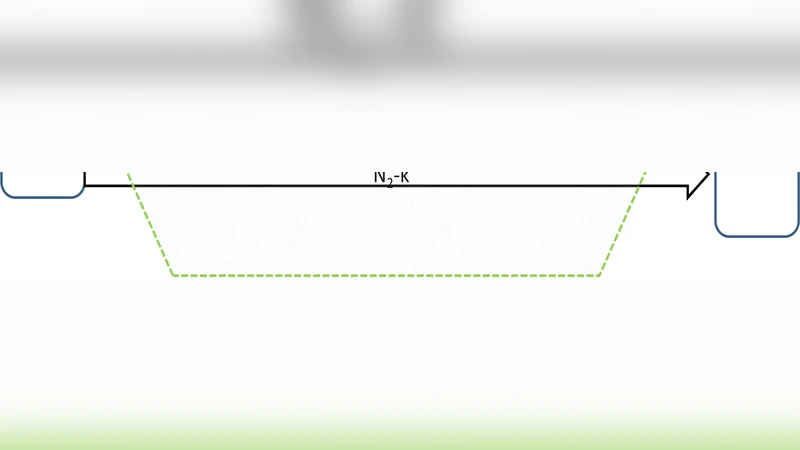
To aid intuition, the paper includes a graphical representation: Z‑states are drawn as rounded rectangles, preparation steps as arrows, and projection steps as polygonal shapes that consume qubits. Figure 1 illustrates a single‑cycle transformation, making clear that k qubits from each input are jointly projected, resulting in a new state and a reduction of the total qubit count by 2k.
Two concrete application examples demonstrate the protocol’s versatility:
-
Exact (Lossless) Distillation – Starting from |Z_k⟩{N₁} and |Z_k⟩{N₂}, a two‑cycle procedure produces |Z_k⟩{N₁+N₂}. The first cycle uses 4k ancillary qubits to create an intermediate |Z_k⟩{N₁+2k}; the second cycle combines this intermediate state with the second input to reach the final target. Throughout, only 2k‑local operations are required, preserving the deterministic nature of the transformation.
-
Incremental Manufacturing – Using only the minimal seed state |Z_k⟩{2k+1}, one can iteratively increase the total number of qubits by one per cycle. Each iteration distills a new state |Z_k⟩{2k+2}, then |Z_k⟩_{2k+3}, and so on, always employing 2k‑local projections. This demonstrates that arbitrarily large Z‑states can be built from a fixed small resource, a property especially valuable for scalable quantum networks.
When k = 1, the protocol reduces to known W‑state distillation schemes, confirming compatibility with existing experimental work. The authors also discuss connections to prior literature on GHZ and W‑state manipulation, random multipartite distillation, stabilizer‑based methods, and experimental implementations using linear optics or cavity QED.
In the concluding discussion, the authors highlight the broader significance of Z‑state algebra: it extends the limited degree of freedom of W‑states, offering richer entanglement structures while retaining a simple combinatorial description. The composition and distillation theorems provide a mathematically rigorous toolbox for constructing, reshaping, and scaling multipartite entanglement using only local operations. Potential applications span distributed quantum clock synchronization, quantum networking, topological quantum computation, and dense coding with magic states. Open challenges include efficient generation of ancillary Z‑states, robustness against noise and decoherence, and integration with error‑correction protocols. Nonetheless, the presented framework opens a clear pathway toward practical, tunable multipartite entanglement engineering.
Comments & Academic Discussion
Loading comments...
Leave a Comment