A Survey of Distributed Data Aggregation Algorithms
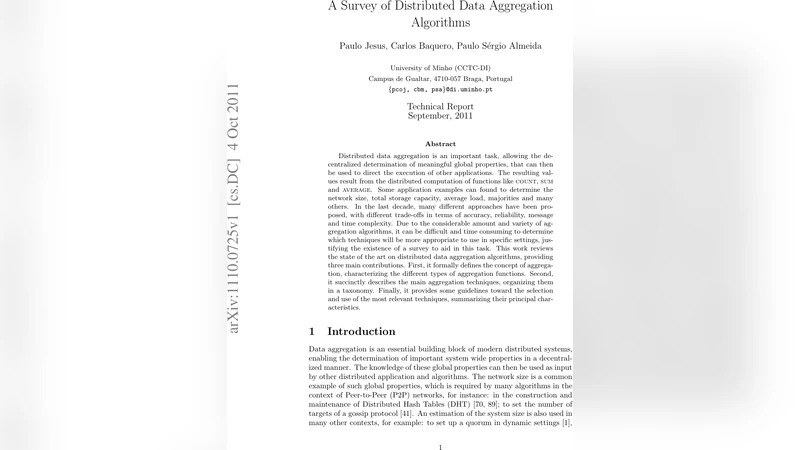
Distributed data aggregation is an important task, allowing the decentralized determination of meaningful global properties, that can then be used to direct the execution of other applications. The resulting values result from the distributed computation of functions like COUNT, SUM and AVERAGE. Some application examples can found to determine the network size, total storage capacity, average load, majorities and many others. In the last decade, many different approaches have been proposed, with different trade-offs in terms of accuracy, reliability, message and time complexity. Due to the considerable amount and variety of aggregation algorithms, it can be difficult and time consuming to determine which techniques will be more appropriate to use in specific settings, justifying the existence of a survey to aid in this task. This work reviews the state of the art on distributed data aggregation algorithms, providing three main contributions. First, it formally defines the concept of aggregation, characterizing the different types of aggregation functions. Second, it succinctly describes the main aggregation techniques, organizing them in a taxonomy. Finally, it provides some guidelines toward the selection and use of the most relevant techniques, summarizing their principal characteristics.
💡 Research Summary
The paper provides a comprehensive survey of distributed data aggregation algorithms, focusing on the computation of global properties such as COUNT, SUM, and AVERAGE in decentralized systems. It begins by formally defining aggregation functions as mappings from multisets of input values to an output domain, and introduces key theoretical concepts: self‑decomposable functions (e.g., min, max, sum, count) that admit an associative, commutative merge operator, and more general decomposable functions (e.g., average) that require an auxiliary domain for intermediate results. The authors also distinguish duplicate‑sensitive versus duplicate‑insensitive functions and discuss the importance of idempotent operators for fault‑tolerant aggregation.
Building on this foundation, the survey classifies existing algorithms along two orthogonal dimensions: communication structure and computational principle. From the communication perspective, three major families are identified:
-
Structured (hierarchy‑based) approaches – These rely on a pre‑established routing topology such as a spanning tree, cluster, or multi‑path overlay. A sink node initiates a request phase that floods the network, followed by a response phase where each node aggregates locally and forwards the partial result upward. This model offers predictable message complexity and low latency but suffers from single points of failure (the root or critical links) and requires topology maintenance in dynamic environments.
-
Unstructured (gossip‑based) approaches – These operate independently of any fixed topology, using patterns such as flooding/broadcast, random walks, or gossip (push‑pull, push‑sum). Gossip protocols repeatedly exchange local estimates among randomly selected neighbors, converging to the correct aggregate with high robustness to message loss and node failures. Their trade‑off lies in slower convergence (dependent on network diameter and gossip frequency) and probabilistic accuracy.
-
Hybrid approaches – These combine hierarchical routing within sub‑domains (e.g., clusters) with gossip across clusters, aiming to capture the fast convergence of structured methods while retaining the resilience of unstructured dissemination.
The paper enumerates representative algorithms for each class, including TAG, DAG, I‑LEAG, RIA‑LC/DC, Triburary‑Delta, Q‑Digest (structured); Push‑Sum, Unstructured Push‑Pull Gossiping, DRG, Flow Updating, Gossip Extrema Propagation, Equi‑Depth, Adam2, Hop‑Sampling, Interval Density (unstructured); and Hierarchy + Gossip hybrids. For each algorithm, the authors summarize message complexity (e.g., O(N), O(E)), time to convergence (number of rounds), accuracy (exact vs. approximate), and fault tolerance (tolerance to node/link failures).
A substantial portion of the survey is devoted to practical selection guidelines. The authors advise designers to first assess whether the target aggregation function is self‑decomposable; if so, idempotent merge operators can be exploited for resilience. Next, they recommend matching the communication model to the network’s characteristics: static sensor networks favor structured tree‑based aggregation for energy efficiency, whereas highly dynamic or large‑scale peer‑to‑peer systems benefit from gossip or hybrid schemes. Accuracy requirements further influence the choice: exact aggregates may necessitate structured protocols or sketch‑based techniques, while applications tolerant of bounded error can adopt gossip or sampling methods. Resource constraints (energy, bandwidth) and desired fault‑tolerance levels are also highlighted as decisive factors.
In the concluding section, the authors acknowledge gaps in current research, notably the lack of universal frameworks that adaptively balance accuracy, latency, and resource consumption across heterogeneous environments. They call for future work on adaptive algorithms that can switch between structured and unstructured modes, integrate privacy‑preserving mechanisms such as differential privacy, and explore synergy with emerging distributed ledger technologies.
Overall, the survey serves as a valuable reference for researchers and practitioners seeking to understand the landscape of distributed aggregation, offering a clear taxonomy, comparative analysis, and actionable guidance for selecting the most appropriate algorithmic approach in a given setting.
Comments & Academic Discussion
Loading comments...
Leave a Comment