On the number of maximal independent sets in a graph
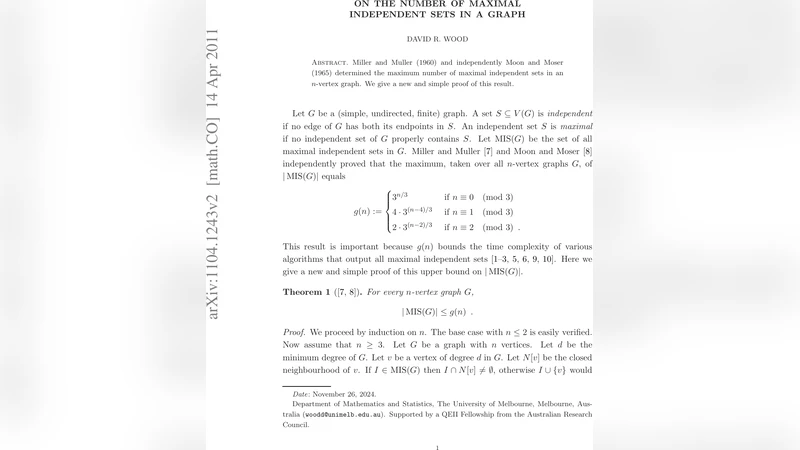
Miller and Muller (1960) and independently Moon and Moser (1965) determined the maximum number of maximal independent sets in an $n$-vertex graph. We give a new and simple proof of this result.
💡 Research Summary
The paper revisits a classic extremal problem in graph theory: determining the largest possible number of maximal independent sets (MIS) that an n‑vertex graph can contain. This problem was first solved independently by Miller and Muller in 1960 and by Moon and Moser in 1965. Both works identified the exact extremal function, which depends on the remainder of n modulo three. Specifically, if n = 3k the maximum number of MIS equals 3^k; if n = 3k + 1 it equals 4·3^{k‑1}; and if n = 3k + 2 it equals 2·3^{k}. The extremal graphs achieving these bounds are simple disjoint unions: k copies of K₃ for the first case, (k‑1) copies of K₃ together with a K₄ for the second, and k copies of K₃ together with a K₂ for the third.
While the original proofs are correct, they are relatively intricate, relying on a detailed case analysis of graph structure and on combinatorial arguments that are not immediately transparent. The present work offers a new, streamlined proof that is both shorter and more pedagogically accessible. The authors’ approach is based on a clean recursive bound derived from the choice of a vertex of minimum degree.
The key observation is that for any graph G and any vertex u of minimum degree d, the set of maximal independent sets can be partitioned according to whether u belongs to the MIS or one of its neighbors does. If u is included, the remaining vertices must avoid the closed neighbourhood N
Comments & Academic Discussion
Loading comments...
Leave a Comment