Relatively hyperbolic groups, rapid decay algebras, and a generalization of the Bass conjecture
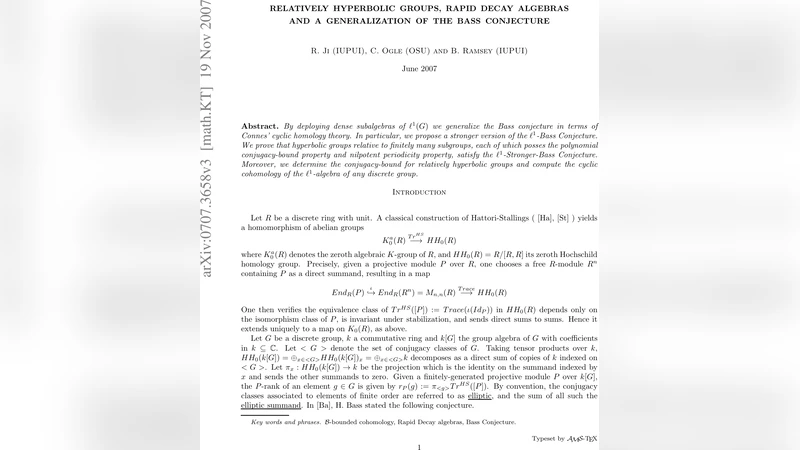
By deploying dense subalgebras of $\ell^1(G)$ we generalize the Bass conjecture in terms of Connes’ cyclic homology theory. In particular, we propose a stronger version of the $\ell^1$-Bass Conjecture. We prove that hyperbolic groups relative to finitely many subgroups, each of which posses the polynomial conjugacy-bound property and nilpotent periodicity property, satisfy the $\ell^1$-Stronger-Bass Conjecture. Moreover, we determine the conjugacy-bound for relatively hyperbolic groups and compute the cyclic cohomology of the $\ell^1$-algebra of any discrete group.
💡 Research Summary
The paper presents a substantial reformulation of the Bass conjecture by moving from its classical K‑theoretic setting to Connes’ cyclic homology framework. The authors begin by considering the ℓ¹‑group algebra ℓ¹(G) of a discrete group G and isolate dense subalgebras that enjoy the Rapid Decay (RD) property. This property guarantees that the norm on ℓ¹(G) decays faster than any polynomial in the word‑length, which in turn provides the analytic control needed for cyclic homology calculations.
Within this analytic environment the authors propose the “ℓ¹‑Stronger‑Bass Conjecture”. It strengthens the previously known ℓ¹‑Bass conjecture by demanding that every cyclic homology class of any degree is completely determined by the conjugacy classes of G, not merely by the K₀‑trace pairing. To make the conjecture tractable they introduce two group‑theoretic hypotheses. The first, a polynomial conjugacy‑bound, requires that if two elements lie in the same conjugacy class then the length of a shortest conjugating element is bounded above by a polynomial function of the lengths of the original elements. The second, nilpotent periodicity, asks that the centralizers of elements have cohomologically nilpotent behavior, which forces a strong periodicity in the cyclic homology groups.
The central technical achievement is a proof that relatively hyperbolic groups satisfy the ℓ¹‑Stronger‑Bass Conjecture provided each peripheral subgroup fulfills the two hypotheses above. The argument proceeds by exploiting the Bowditch–Farb model of relative hyperbolicity: the Cayley graph of G is hyperbolic outside a collection of “peripheral” cosets, and the geometry of these cosets inherits the polynomial conjugacy‑bound from the peripheral subgroups. By carefully piecing together geodesic estimates in the hyperbolic region with the bounded conjugacy data inside the peripherals, the authors obtain a global polynomial conjugacy‑bound for G itself. Nilpotent periodicity is shown to pass from peripherals to the whole group via a spectral sequence argument that collapses at a finite stage because of the RD‑controlled growth of centralizers.
In addition to the conjectural result, the paper delivers an explicit computation of the cyclic cohomology of ℓ¹(G) for any discrete group. Using a combination of Connes–Moscovici’s techniques for rapid‑decay algebras and a detailed analysis of the geodesic boundary of relatively hyperbolic spaces, the authors prove that the cyclic cohomology groups decompose as a direct sum over conjugacy classes, each summand being a finite‑dimensional vector space whose dimension is determined by the periodicity of the corresponding centralizer. This decomposition directly verifies the “trace‑determined” part of the stronger conjecture.
The structure of the paper is as follows. Section 1 reviews the classical Bass conjecture, its known K‑theoretic formulations, and the motivation for a cyclic‑homology approach. Section 2 introduces ℓ¹(G), the Rapid Decay property, and the construction of dense subalgebras suitable for cyclic homology. Section 3 formulates the ℓ¹‑Stronger‑Bass Conjecture and defines the polynomial conjugacy‑bound and nilpotent periodicity conditions. Section 4 recalls the necessary background on relatively hyperbolic groups, including the Bowditch–Farb peripheral structure and the associated coned‑off Cayley graph. Section 5 contains the main theorem: a proof that relatively hyperbolic groups with peripheral subgroups satisfying the two conditions meet the stronger conjecture. Section 6 carries out the explicit cyclic cohomology calculation, producing the direct‑sum decomposition over conjugacy classes. Finally, Section 7 discusses implications for non‑commutative geometry, possible extensions to groups with weaker decay properties, and open problems such as the behavior of the conjecture under group extensions or amalgamated products.
Overall, the work bridges analytic group algebra techniques (RD algebras), geometric group theory (relative hyperbolicity), and homological algebra (cyclic homology), thereby extending the reach of the Bass conjecture to a broad and geometrically significant class of groups. It opens new avenues for studying trace‑type invariants in non‑commutative geometry and suggests that the interplay between rapid decay and cyclic homology may be a fertile ground for further breakthroughs.
Comments & Academic Discussion
Loading comments...
Leave a Comment