Joint Routing, Scheduling And Power Control For Multihop Wireless Networks With Multiple Antennas
We consider the problem of Joint Routing, Scheduling and Power-control (JRSP) problem for multihop wireless networks (MHWN) with multiple antennas. We extend the problem and a (sub-optimal) heuristic solution method for JRSP in MHWN with single antennas. We present an iterative scheme to calculate link capacities(achievable rates) in the interference environment of the network using SINR model. We then present the algorithm for solving the JRSP problem. This completes a feasible system model for MHWN when nodes have multiple antennas. We show that the gain we achieve by using multiple antennas in the network is linear both in optimal performance as well as heuristic algorithmic performance.
💡 Research Summary
The paper tackles the Joint Routing, Scheduling and Power‑control (JRSP) problem in multihop wireless networks (MHWNs) where each node is equipped with multiple antennas (MIMO). While previous work addressed JRSP only for single‑antenna nodes, extending the formulation to the MIMO case introduces two major challenges: (i) link capacities become inter‑dependent because of mutual interference, and (ii) the number of feasible transmission “modes” (sets of simultaneously active links together with their power levels) grows exponentially with the number of links and power levels.
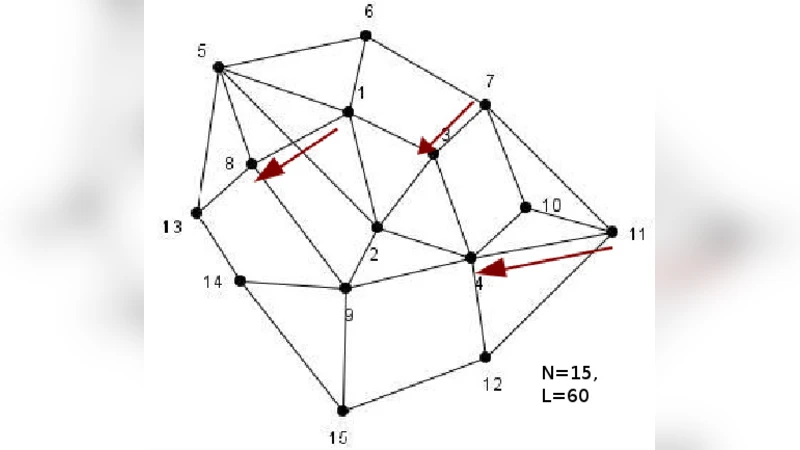
System model – The network is modeled as a fully connected directed graph G(N, L) with N half‑duplex nodes and L directed links. Each node has a identical number a of antennas and uses all antennas for a single point‑to‑point transmission (beamforming) at any time, so a node can participate in at most one active link per slot. Transmit power for a node can be chosen from a discrete set of K levels (including zero). The channel between any pair of nodes i and j is represented by an a × a complex Gaussian matrix H_ij, assumed known centrally.
Problem formulation – The objective is to maximize the fairness factor λ, defined as the minimum ratio of achieved flow rate r_f to demanded rate d_f across all flows f∈F. The constraints are: (1) flow conservation at each node, (2) average link capacity constraints, (3) average power constraints per node, (4) the time fractions α_m assigned to each mode sum to one, and (5) non‑negativity of all variables. The decision variables are the flow‑link rate matrix X, the mode time‑allocation vector α, and the flow rates r. The formulation is a linear program (LP) once the link capacities C_{m,l} for each mode m are known.
Link‑capacity computation – Because of MIMO interference, the capacity of a link cannot be expressed in closed form. The authors propose an iterative water‑filling algorithm (Algorithm 1). For a given mode, all active links are processed sequentially: keeping the transmit covariance matrices of the other links fixed, the algorithm performs water‑filling on the target link using the current interference covariance, yielding an optimal transmit covariance K_i and a corresponding capacity C_i. The process repeats over all links until the sum‑rate across the mode converges. This greedy scheme guarantees monotonic increase of the sum‑rate and provides a practical achievable point in the otherwise unknown capacity region.
Complexity considerations – The number of constraints in the LP is modest (≈ N·F + L + F + 1), but the number of variables includes the mode‑time fractions α_m for every feasible mode m. The total number of modes M can be bounded by K^L, i.e., it grows super‑exponentially with the number of links. Empirical measurements show that even a modest network of 11 nodes and 4 power levels yields more than one million variables, making direct LP solution infeasible.
Heuristic solution via column generation – To cope with the huge variable set, the paper adopts a column‑generation framework similar to earlier single‑antenna work. The master problem starts with a small subset of N + L + 1 randomly chosen modes (theoretical bound on basic feasible solutions). The sub‑problem searches for a new “good” mode that improves the objective. Formally, it maximizes θ(m) = uᵀC_m − vᵀP_m − β, where u, v, β are the dual variables from the master LP. Exhaustive search over the remaining modes is impossible, so the authors extend a previously proposed heuristic (Algorithm 2) to the MIMO case. The heuristic iteratively raises the power level of each link to the next admissible level, evaluates θ, and discards links that share a node with a link already set to zero power, thereby pruning the search space dramatically. The best mode found replaces a zero‑weight mode in the master problem, and the process repeats until no improvement is observed.
Performance evaluation – Simulations compare networks with a = 1, 2, 4 antennas per node while keeping all other parameters identical. Both the fairness factor λ and the total network throughput increase roughly linearly with a, confirming that the spatial degrees of freedom offered by multiple antennas translate into network‑wide gains, not merely per‑link capacity improvements. Moreover, the heuristic solution’s objective value is within a few percent of the optimal LP solution (computed for very small instances), demonstrating that the column‑generation plus heuristic approach yields near‑optimal performance while remaining computationally tractable for networks up to about 30 nodes.
Contributions – The paper makes four key contributions: (1) a linear‑programming formulation of JRSP that explicitly incorporates MIMO link capacities, (2) an iterative water‑filling scheme to obtain achievable link rates under mutual interference, (3) a scalable column‑generation algorithm with a tailored heuristic for mode selection, and (4) empirical evidence of linear scaling of network performance with the number of antennas.
Implications – By showing that joint optimization of routing, scheduling, and power control remains feasible in the presence of multiple antennas, the work paves the way for more efficient mesh, sensor, and ad‑hoc networks where hardware supports MIMO. The methodology can be extended to incorporate additional physical‑layer techniques (e.g., interference alignment, cooperative beamforming) or to decentralized implementations, making it a valuable reference for both theoreticians and system designers.
Comments & Academic Discussion
Loading comments...
Leave a Comment