A note on Pr"ufer-like coding and counting forests of uniform hypertrees
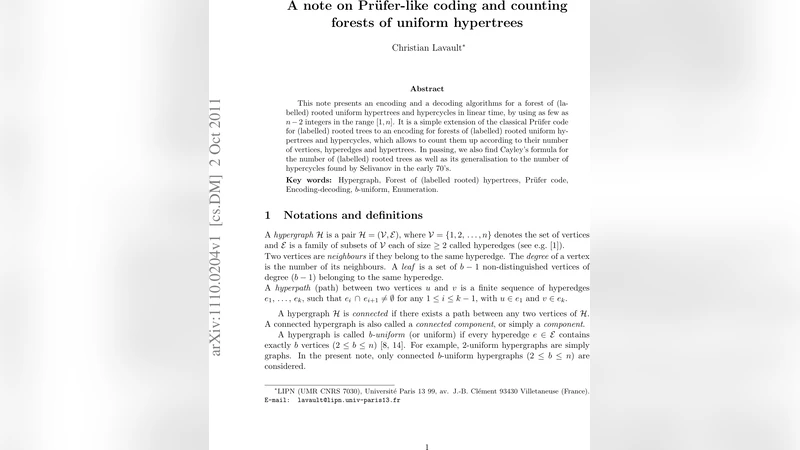
This note presents an encoding and a decoding algorithms for a forest of (labelled) rooted uniform hypertrees and hypercycles in linear time, by using as few as $n - 2$ integers in the range $[1,n]$. It is a simple extension of the classical Pr"{u}fer code for (labelled) rooted trees to an encoding for forests of (labelled) rooted uniform hypertrees and hypercycles, which allows to count them up according to their number of vertices, hyperedges and hypertrees. In passing, we also find Cayley’s formula for the number of (labelled) rooted trees as well as its generalisation to the number of hypercycles found by Selivanov in the early 70’s.
💡 Research Summary
The paper presents a linear‑time encoding and decoding scheme for forests composed of rooted, labelled, uniform hypertrees and hypercycles, extending the classical Prüfer code for labelled trees. A uniform hypergraph is a hypergraph in which every hyperedge contains exactly b vertices (b ≥ 2). The authors focus on two fundamental connected components of such hypergraphs: hypertrees (excess = −1) and hypercycles (excess = 0).
The central contribution is a bijective mapping between a forest of (k + 1) rooted b‑uniform hypertrees and a 4‑tuple (R, r, P, N). Here, R is the set of (k + 1) root vertices, r is the distinguished root that remains after the pruning process, P is a partition of the non‑root vertices into s subsets each of size (b − 1) (each subset corresponds to the leaf vertices of a hyperedge), and N is an (s − 1)‑tuple of vertices that records, at each pruning step, the vertex adjacent to the leaf being removed. The parameters satisfy n = s·(b − 1) + k + 1, where n is the total number of vertices and s the number of hyperedges.
Encoding (Algorithm 1). The algorithm repeatedly selects the leaf with the smallest lexicographic label, adds its (b − 1) leaf vertices to the partition P, records the adjacent vertex in N, and removes the leaf (and its incident hyperedge) from the forest. After s − 1 iterations only a single hyperedge remains; its two vertices become the distinguished root r. The process uses exactly n − 2 integers (the entries of N) and runs in Θ(n) time because each hyperedge is processed once.
Decoding (Algorithm 2). Given (R, r, P, N), the algorithm reconstructs the original forest by iteratively creating hyperedges: the first element of N together with the first subset of P (according to lexicographic order) form a hyperedge; the used elements are then removed from N and P. This continues until N is empty, after which the last subset of P is combined with r to form the final hyperedge. The decoding also runs in linear time.
The bijection enables direct enumeration. The number of possible choices for each component of the 4‑tuple is:
- |R| = (\binom{n}{k+1}) ways to pick the roots,
- (k + 1) ways to select the distinguished root r,
- (\frac{(n‑k‑1)!}{s!,(b‑1)!^{,s}}) ways to partition the remaining vertices into the leaf subsets P,
- (n^{,s‑1}) ways to fill the tuple N.
Multiplying these quantities and simplifying yields the enumeration formula for forests (Theorem 1):
\
Comments & Academic Discussion
Loading comments...
Leave a Comment