Fairy chimneys in Peru
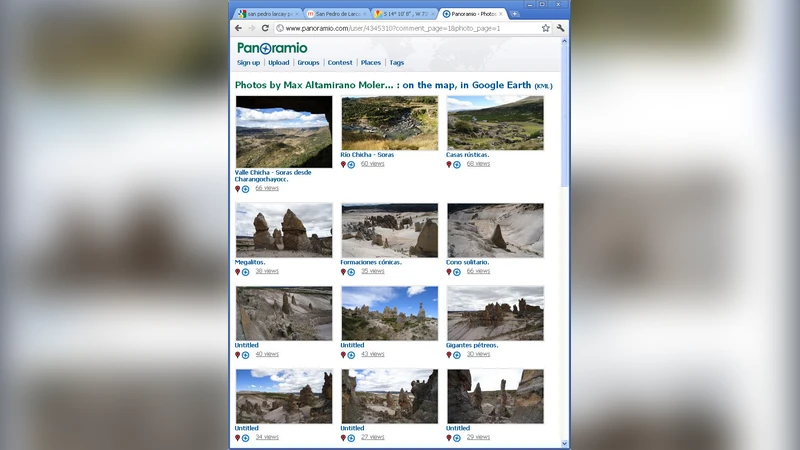
Erosion creates beautiful landscapes. In most cases, it is just the local population to know them. Google Maps can be helpful for locating the places, for their studies and eventual projects of preservation. An interesting example is given by a landscape of fairy chimneys in Peru, near Pampachiri and San Pedro de Larcay. It is remarkable the fact that some of them have been adapted as dwelling places.
💡 Research Summary
Amelia Carolina Sparavigna’s paper presents a novel approach to discovering and documenting remote geological formations by leveraging publicly available digital mapping services and user‑generated photographs. The focus is a cluster of “fairy chimneys” (hoodoos) located in the high Andes of Peru, near the villages of Pampachiri and San Pedro de Larcay. These slender, columnar rock structures are formed by differential erosion of soft volcanic or sedimentary rocks capped by a harder layer; freeze‑thaw cycles (frost wedging) and wind‑rain abrasion gradually sculpt the characteristic thin spires. While similar formations are well known in Italy (the Calanchi of Volterra), Turkey’s Cappadocia, and the Dolomites, the Peruvian examples have remained virtually undocumented in the scientific literature.
The author demonstrates that Google Maps, particularly its Street View and KML overlay capabilities, can serve as a low‑cost remote‑sensing platform. By dragging the Street View icon across the map, the system reveals blue dots where users have uploaded geotagged photos. In this case, the photographs contributed by a single user, Max Altamirano Moler, expose a “forest” of fairy chimneys that are not visible in the satellite imagery due to limited resolution. The same mapping exercise also identifies a network of pre‑Inca and Inca agricultural features—large circular ponds called qochas, linked by canals—situated a short distance to the southwest of San Pedro. These water‑management structures indicate a sophisticated, centrally coordinated agrarian system that historically supported the local population.
Crucially, several of the Peruvian chimneys appear to have been adapted for habitation. Altamirano’s images show stone‑reinforced interiors, with additional masonry supporting the fragile pillars, reminiscent of the rock‑cut dwellings of medieval Cappadocia. The paper suggests that these adaptations may provide thermal benefits in a high‑altitude environment characterized by large diurnal temperature swings. Citing a previous study on lumped‑element thermal models with phase‑change materials, the author proposes a quantitative analysis of heat flow through the chimneys to assess whether they act as natural thermal regulators, reducing heating and cooling loads for occupants.
The manuscript emphasizes the scarcity of formal archaeological or geological surveys of this area and argues that citizen‑generated content can fill critical data gaps. Altamirano’s photo collection, made freely available through Google Earth (KML) and Panoramio, currently constitutes the only detailed visual record of the Peruvian fairy chimneys. By highlighting this example, the author underscores the potential of “citizen science” to accelerate the discovery, documentation, and eventual preservation of culturally and geologically significant sites that might otherwise remain unknown to the broader scientific community.
In conclusion, the paper illustrates how a combination of remote digital tools and community contributions can reveal previously undocumented geological heritage. The Peruvian fairy chimneys not only enrich the global inventory of hoodoo formations but also demonstrate a cultural continuity with other regions where humans have transformed natural stone pillars into habitable spaces. The author calls for systematic field investigations, detailed geotechnical analyses, and thermodynamic modeling to better understand the structures’ stability, age, and potential for sustainable use, thereby laying the groundwork for informed conservation strategies.
Comments & Academic Discussion
Loading comments...
Leave a Comment