An Empirical Study of UDP (CBR) Packet Performance over AODV Single & Multi-Channel Parallel Transmission in MANET
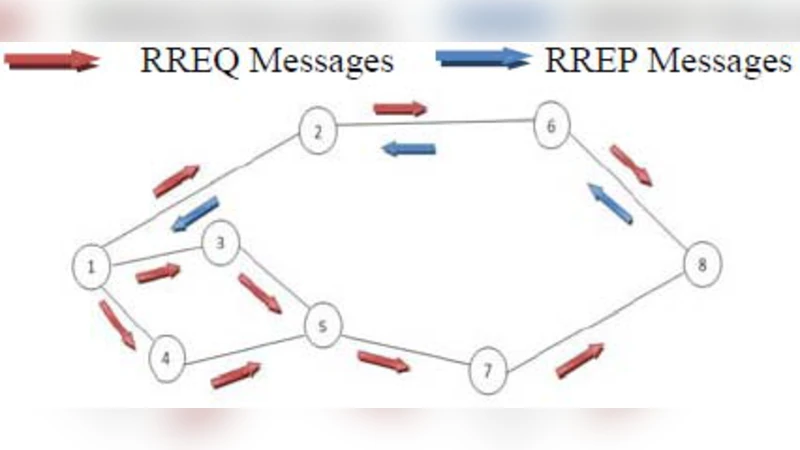
Mobile Ad-hoc Network is a temporary network which is the cooperative engagement of a collection of standalone mobile nodes that are not connected to any external network. It is a decentralized network where mobile nodes can be easily deployed in almost any environment without sophisticated infrastructure support. An empirical study has been done for AODV routing protocol under single channel and multi channel environment using the tool NS2. To compare the performance of AODV in the two environments, the simulation results have been analyzed by graphical manner and trace file based on QoS metrics such as throughput, packet drop, delay and jitter. The simulation result analysis verifies the AODV routing protocol performances for single channel and multi channel. After the analysis of the simulation scenario we suggest that use of Parallel MAC (P-MAC) may enhance the performance for multi channel.
💡 Research Summary
The paper presents an empirical evaluation of the Ad‑hoc On‑Demand Distance Vector (AODV) routing protocol in Mobile Ad‑hoc Networks (MANETs) under two radio configurations: a single‑channel setup and a multi‑channel (parallel) setup. Using the NS‑2 network simulator, the authors model a 1000 × 1000 m area populated by four mobile nodes equipped with IEEE 802.11 radios, a two‑ray ground propagation model, and omnidirectional antennas. Traffic consists of UDP Constant Bit Rate (CBR) flows generated at a fixed packet size and rate, and each node’s interface queue can hold up to 50 packets.
Four experimental scenarios are defined to isolate the effects of channel multiplicity and node mobility: (1) single‑channel with static nodes, (2) multi‑channel with static nodes, (3) single‑channel with mobility, and (4) multi‑channel with mobility. In the mobility cases, nodes remain stationary for the first 15 seconds of a 20‑second simulation and then move according to a random‑walk model for the final 5 seconds, thereby triggering route rediscovery events.
The performance metrics collected are packet drop count, throughput (packets per second), average end‑to‑end delay, and jitter (variation of inter‑packet delay). Results are presented both numerically and graphically. The key findings are:
- Packet loss – The single‑channel static case suffers a loss of 12 408 packets (49.63 % of sent traffic), whereas the multi‑channel static case drops only 367 packets (1.47 %). When mobility is introduced, loss rises dramatically for the single‑channel case (14 598 packets, 58.39 %) but remains modest for the multi‑channel case (2 879 packets, 11.52 %).
- Delivery ratio – Correspondingly, the delivery ratio is 49.99 % for single‑channel static, 98.53 % for multi‑channel static, 41.19 % for single‑channel mobile, and 88.38 % for multi‑channel mobile.
- Throughput – The multi‑channel configurations achieve roughly double the received throughput of the single‑channel configurations (≈25 127 700 pkt/s vs. ≈12 742 860 pkt/s).
- Delay and jitter – Average delay in the multi‑channel scenarios stays below 20 ms, with jitter values tightly clustered around zero, indicating smoother packet delivery compared with the single‑channel cases where delay spikes and jitter are more pronounced.
The authors interpret these results as evidence that parallel transmission on separate frequencies (or radios) dramatically reduces MAC‑layer contention, thereby lowering queuing, retransmission, and route‑maintenance overhead. In static networks the benefit is most pronounced because route discovery is rarely needed; even with mobility, the multi‑channel setup still outperforms the single‑channel baseline.
Based on the observed performance gap, the paper proposes the adoption of a Parallel MAC (P‑MAC) scheme, which would coordinate simultaneous transmissions on multiple radios while avoiding self‑interference. The authors argue that P‑MAC could further close the gap between the ideal multi‑channel throughput (approaching the raw PHY data rate) and the measured values.
However, the study has several limitations. The network size is limited to four nodes, which does not capture the scaling challenges of larger MANETs. The simulation duration (20 seconds) and traffic load are modest, potentially masking long‑term effects such as route aging, buffer overflow under sustained load, and energy consumption. The multi‑channel implementation assumes two radios with fixed channel assignments and does not explore dynamic channel‑selection algorithms, interference modeling, or the overhead of synchronizing multiple interfaces. Moreover, the suggested P‑MAC is not implemented or evaluated; its feasibility, required signaling, and impact on existing standards remain open questions.
In conclusion, the paper demonstrates that AODV can achieve substantially higher QoS metrics when operated over a multi‑channel, parallel‑radio architecture, especially in static topologies. It highlights the need for more comprehensive studies that scale up node count, incorporate realistic mobility models, evaluate dynamic channel allocation, and provide a concrete P‑MAC design and validation. Such future work would be essential to translate the promising simulation results into practical deployments of high‑performance MANETs.
Comments & Academic Discussion
Loading comments...
Leave a Comment