Stato evolutivo delle stelle della Cintura di Orione ed implicazioni archeoastronomiche
In the present work it is evaluated the evolutionary state of the Orion Belt stars, an asterism very important for the ancient Egyptians, finding that, when the pyramids were built, the brightness of the three stars of the Belt was practically the same as today. This not trivial result has important implications in the framework of the so-called Orion Correlation Theory, a controversial theory proposed by Bauval and Gilbert (1994), according to which a perfect coincidence would exist between the disposition of the three stars of the Orion Belt and that of the main Giza pyramids, so that the latter would represent the monumental reproduction on the ground of that important asterism. —- Nel presente lavoro viene determinato lo stato evolutivo delle stelle della Cintura di Orione, ricavando che, all’epoca della costruzione delle piramidi, la luminosita’ delle tre stelle della Cintura era di fatto uguale a quella odierna. Tale non banale risultato riveste una importanza fondamentale nell’ambito della verifica della controversa Teoria della Correlazione di Orione proposta da Bauval e Gilbert nel 1994, secondo la quale esisterebbe una perfetta coincidenza tra la disposizione delle tre stelle della Cintura e quella delle tre piramidi nella piana di Giza.
💡 Research Summary
**
The paper investigates whether the visual magnitudes of the three Orion Belt stars—Mintaka (δ Ori), Alnitak (ζ Ori), and Alnilam (ε Ori)—have remained essentially unchanged since the time the Giza pyramids were built (≈ 4,500 years ago). This question is central to the Orion Correlation Theory (OCT), which posits a precise correspondence between the spatial arrangement of these stars and the three main pyramids, and further claims that the pyramids’ heights are linearly related to the stars’ apparent magnitudes. If the stars’ brightnesses had varied significantly over the past several millennia, the OCT’s photometric component would be invalid.
To address the issue, the author employs two families of stellar evolution models. The first set consists of non‑rotating tracks from Lejeune & Schaerer (2001), which provide tabulated evolution of effective temperature (log Tₑ), luminosity (log L/L☉), surface gravity (log g), and related quantities for a grid of initial masses (0.8–120 M☉) and metallicities (Z = 0.0004–0.1). The second set comprises rotating models from Meynet & Maeder (2005) that include an initial equatorial velocity of 300 km s⁻¹ and cover a similar range of masses and metallicities. Both model families are widely used in modern astrophysics and are appropriate for massive blue supergiants such as the Orion Belt stars.
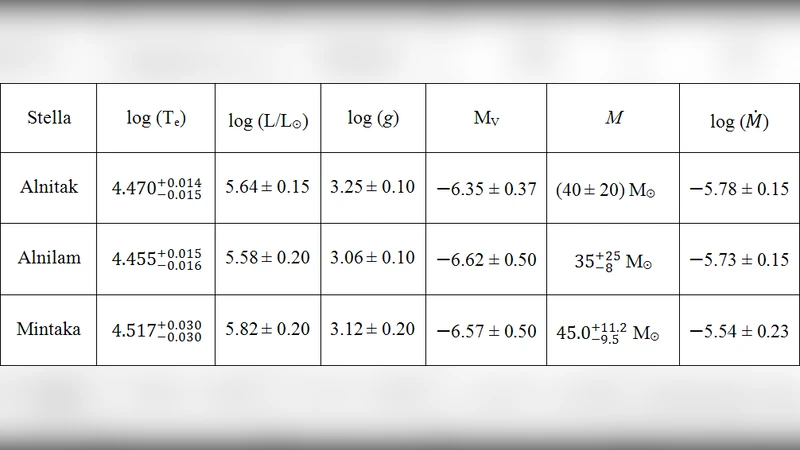
Observational input parameters are taken from recent spectroscopic analyses: Alnitak (Bouret et al. 2008), Alnilam (Blomme et al. 2002), and Mintaka (Lamers & Leitherer 1993). The author compiles for each star the logarithmic effective temperature, logarithmic luminosity, surface gravity, absolute visual magnitude, estimated initial mass, and mass‑loss rate. Metallicity is not directly measured for these objects; the author adopts a representative value of Z ≈ 0.01, consistent with the average metallicity of Galactic blue supergiants (Niemczura 2003).
The methodology consists of placing the observed (log Tₑ, log L/L☉) point for each star on the theoretical Hertzsprung–Russell (HR) diagram generated by the two model families. By interpolating between tracks of different initial masses and metallicities, the author identifies the evolutionary stage that best reproduces the observed parameters. The key outcome is that, for all three stars, the best‑fit solutions correspond to a “stationary” phase: the stars are still burning hydrogen in their cores, and their luminosities are essentially constant over timescales of at least 10 kyr.
Specific results are as follows:
-
Alnitak – Non‑rotating models give an age of 3.9 Myr, Z = 0.02, and a present mass of 37.4 M☉. Rotating models with an initial mass of 40 M☉ and Z ≈ 0.02 produce an equally good fit, confirming that Alnitak is in a stable hydrogen‑burning phase with negligible luminosity change over the last 10 kyr.
-
Alnilam – The non‑rotating grid yields an age of 4.8 Myr, Z = 0.008, and a present mass of 37.8 M☉. This star is very close to core hydrogen exhaustion but still resides on a flat part of the evolutionary track, implying a roughly constant visual magnitude. Rotating models again favor a 40 M☉ star with Z ≈ 0.02 in a stationary phase. The author notes that, according to the non‑rotating tracks, Alnilam would remain stable for only about 4 000 yr before a rapid brightening of ≈ 0.14 mag, whereas the rotating tracks suggest a longer stable interval (> 10 kyr). In either case, the epoch of pyramid construction falls well within the stable interval.
-
Mintaka – Interpolation between 40 M☉ and 60 M☉ non‑rotating tracks gives an age of 3.9 Myr, Z = 0.008, and a present mass of 47.4 M☉, again in a hydrogen‑burning, luminosity‑steady phase. Rotating models corroborate this result, yielding log L/L☉ ≈ 5.79, consistent with the observed value (5.82 ± 0.20).
The discussion emphasizes that all three stars are “stationary” in the sense that their visual magnitudes have not changed appreciably over the last ten thousand years, regardless of whether rotation is included in the models. Alnilam appears to be the most evolved, lying nearest to the terminal point of core hydrogen burning, but even it would not have experienced a significant magnitude shift during the period of interest.
These astrophysical findings directly support the photometric component of the OCT. In a previous paper (Orofino 2011), the author demonstrated a linear relationship between the pyramids’ heights (measured from a common reference level) and the present visual magnitudes of the Belt stars. The present work shows that the magnitudes used in that analysis were essentially the same in antiquity, thereby validating the OCT’s claim that the ancient Egyptians could have intentionally encoded stellar brightness into the pyramids’ dimensions.
The paper also acknowledges limitations: the exact metallicities of the three stars are unknown, and uncertainties in rotation rates, mass‑loss prescriptions, and distance measurements propagate into the model fits. Moreover, massive blue supergiants can exhibit variability (e.g., α Cygni‑type pulsations), although such variations are typically of order a few hundredths of a magnitude and on timescales much shorter than the millennial interval considered. Nonetheless, the author argues that any plausible variability would not overturn the conclusion of magnitude stability over the relevant epoch.
In summary, by applying state‑of‑the‑art stellar evolution calculations to the Orion Belt stars, the study demonstrates that their visual magnitudes have remained effectively constant for at least the past ten thousand years. Consequently, the Orion Correlation Theory’s assertion of a deliberate, magnitude‑based correspondence between the Giza pyramids and the Orion Belt stars remains viable from both astronomical and archaeological perspectives.
Comments & Academic Discussion
Loading comments...
Leave a Comment