Chains of Baire class 1 functions and various notions of special trees
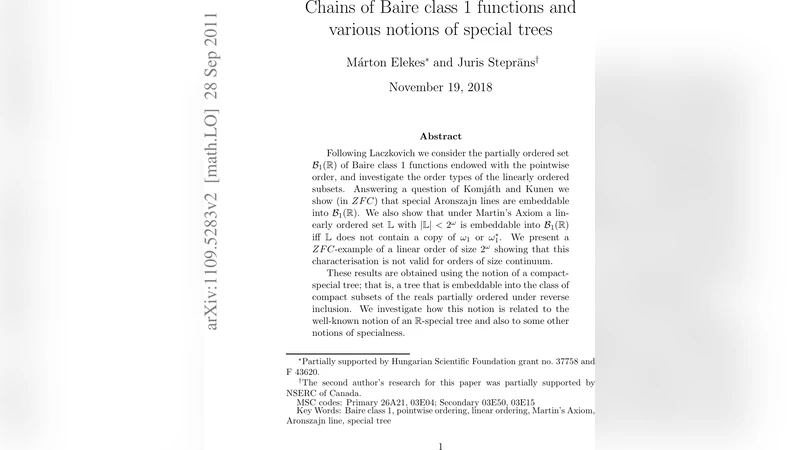
Following Laczkovich we consider the partially ordered set $\iB_1(\RR)$ of Baire class 1 functions endowed with the pointwise order, and investigate the order types of the linearly ordered subsets. Answering a question of Komj'ath and Kunen we show (in $ZFC$) that special Aronszajn lines are embeddable into $\iB_1(\RR)$. We also show that under Martin’s Axiom a linearly ordered set $\mathbb{L}$ with $|\mathbb{L}|<2^\omega$ is embeddable into $\iB_1(\RR)$ iff $\mathbb{L}$ does not contain a copy of $\omega_1$ or $\omega_1^*$. We present a $ZFC$-example of a linear order of size $2^\omega$ showing that this characterisation is not valid for orders of size continuum. These results are obtained using the notion of a compact-special tree; that is, a tree that is embeddable into the class of compact subsets of the reals partially ordered under reverse inclusion. We investigate how this notion is related to the well-known notion of an $\RR$-special tree and also to some other notions of specialness.
💡 Research Summary
The paper investigates the order types of linearly ordered subsets of the partially ordered set (\mathcal{B}_1(\mathbb{R})) of Baire‑class‑1 functions under pointwise ordering. The central problem, originally posed by Laczkovich, asks for a characterization of those linear orders (L) for which there exists an embedding (L\hookrightarrow\mathcal{B}_1(\mathbb{R})). While the analogous questions for continuous functions ((\mathcal{B}_0)) and higher Baire classes ((\alpha\ge 2)) are already settled, the Baire‑1 case remained open. Known results include Kuratowski’s theorem that (\omega_1) does not embed into (\mathcal{B}_1(\mathbb{R})) and Komjáth’s consistency result that a Souslin line can embed into (\mathcal{B}_1(\mathbb{R})).
The authors introduce a powerful tool: for a linear order (L) they construct its partition tree (T_L). This tree is built by repeatedly splitting non‑trivial intervals of (L) into two disjoint non‑empty sub‑intervals; the tree order is reverse inclusion, so larger intervals lie lower in the tree. The key Main Lemma (Lemma 1.2) shows that if (T_L) admits a strong embedding into the poset (\mathcal{K}(\mathbb{R})) of compact subsets of (\mathbb{R}) ordered by reverse inclusion (i.e., incomparable children are mapped to disjoint compact sets), then (L) embeds into (\mathcal{B}1(\mathbb{R})). The proof defines, for each (l\in L), a set (A_l) consisting of those compact pieces associated with the “right” side of the intervals that separate (l) from larger points. The characteristic function (\chi{A_l}) is shown to be Baire‑1, and the map (l\mapsto\chi_{A_l}) preserves order because (l_0<l_1) forces (A_{l_0}\subsetneq A_{l_1}).
Next, the paper studies several notions of special trees. A tree may be (\mathbb{R})-special (embeddable into the real line), (\mathcal{C})-special (into the Cantor set), strongly (S)-embeddable (into the Prikry‑Silver partial order), strongly (\mathcal{K}(\mathbb{R}))-embeddable, etc. Theorem 2.2 proves that for countably branching trees (every node has at most countably many immediate successors) all nine introduced notions are equivalent. The proof gives explicit transformations: from an (\mathbb{R})-embedding one builds a strong (S)-embedding by coding each real number with a rational sequence, then passes to compact subsets of the Cantor set, and finally to compact subsets of (\mathbb{R}). Conversely, a strong (\mathcal{K}(\mathbb{R}))-embedding yields an (\mathbb{R})-embedding by intersecting with a countable dense family of rational intervals. This equivalence shows that the newly coined “compact‑special” trees are essentially the same as the classical (\mathbb{R})-special trees when the branching is countable.
Armed with these tools, the authors answer two long‑standing questions. Theorem 3.1 shows that any special Aronszajn line (an Aronszajn linear order whose partition tree embeds into (\mathbb{Q})) embeds into (\mathcal{B}_1(\mathbb{R})). By Theorem 2.2 the (\mathbb{Q})-embedding yields a strong (\mathcal{K}(\mathbb{R}))-embedding, and the Main Lemma then produces the desired Baire‑1 embedding. Consequently, Komjáth and Kunen’s question “Is there an Aronszajn line that embeds into (\mathcal{B}_1(\mathbb{R}))?” receives a positive ZFC answer.
Theorem 3.2 works under Martin’s Axiom (MA) together with the regularity of the continuum. It proves that for any linear order (L) with (|L|<2^{\aleph_0}), \
Comments & Academic Discussion
Loading comments...
Leave a Comment