New Constructions for Query-Efficient Locally Decodable Codes of Subexponential Length
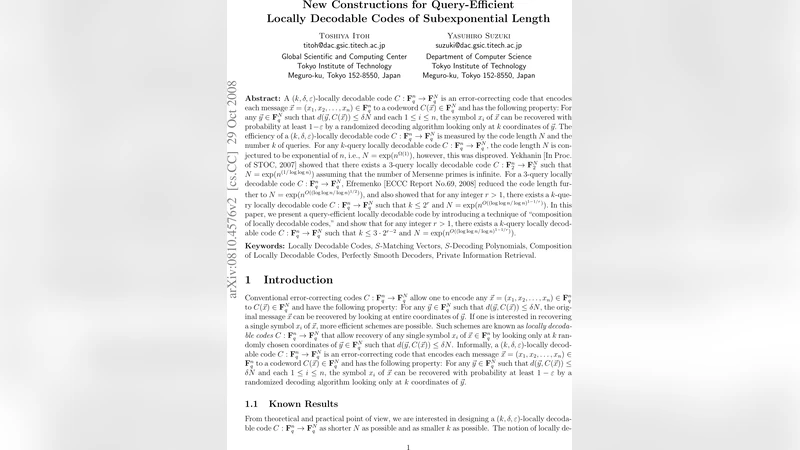
A $(k,\delta,\epsilon)$-locally decodable code $C: F_{q}^{n} \to F_{q}^{N}$ is an error-correcting code that encodes each message $\vec{x}=(x_{1},x_{2},…,x_{n}) \in F_{q}^{n}$ to $C(\vec{x}) \in F_{q}^{N}$ and has the following property: For any $\vec{y} \in {\bf F}{q}^{N}$ such that $d(\vec{y},C(\vec{x})) \leq \delta N$ and each $1 \leq i \leq n$, the symbol $x{i}$ of $\vec{x}$ can be recovered with probability at least $1-\epsilon$ by a randomized decoding algorithm looking only at $k$ coordinates of $\vec{y}$. The efficiency of a $(k,\delta,\epsilon)$-locally decodable code $C: F_{q}^{n} \to F_{q}^{N}$ is measured by the code length $N$ and the number $k$ of queries. For any $k$-query locally decodable code $C: F_{q}^{n} \to F_{q}^{N}$, the code length $N$ is conjectured to be exponential of $n$, however, this was disproved. Yekhanin [In Proc. of STOC, 2007] showed that there exists a 3-query locally decodable code $C: F_{2}^{n} \to F_{2}^{N}$ such that $N=\exp(n^{(1/\log \log n)})$ assuming that the number of Mersenne primes is infinite. For a 3-query locally decodable code $C: F_{q}^{n} \to F_{q}^{N}$, Efremenko [ECCC Report No.69, 2008] reduced the code length further to $N=\exp(n^{O((\log \log n/ \log n)^{1/2})})$, and also showed that for any integer $r>1$, there exists a $k$-query locally decodable code $C: F_{q}^{n} \to F_{q}^{N}$ such that $k \leq 2^{r}$ and $N=\exp(n^{O((\log \log n/ \log n)^{1-1/r})})$. In this paper, we present a query-efficient locally decodable code and show that for any integer $r>1$, there exists a $k$-query locally decodable code $C: F_{q}^{n} \to F_{q}^{N}$ such that $k \leq 3 \cdot 2^{r-2}$ and $N=\exp(n^{O((\log \log n/ \log n)^{1-1/r})})$.
💡 Research Summary
The paper addresses a central problem in the theory of locally decodable codes (LDCs): how to simultaneously keep the code length sub‑exponential in the message length n while reducing the number of queries k required for decoding. Historically, the conjecture that any k‑query LDC must have exponential length was disproved by Yekhanin (2007) and later refined by Efremenko (2008). Yekhanin showed that, assuming infinitely many Mersenne primes, a 3‑query binary LDC exists with length N = exp (n^{1/ log log n}). Efremenko removed the number‑theoretic assumption and constructed, for any integer r > 1, an LDC with at most 2^{r} queries and length N = exp (n^{O((log log n / log n)^{1‑1/r})}).
The present work builds on Efremenko’s framework but improves the constant factor in the query bound. For any integer r > 1 the authors exhibit a code with at most k ≤ 3·2^{r‑2} queries and the same sub‑exponential length bound as Efremenko’s construction. The improvement is achieved by a more efficient use of matching‑vector families (MVFs) and a refined composition of codes.
Key technical contributions are as follows:
-
Optimized Matching‑Vector Families – The authors redesign the MVFs so that the dimension of the family grows as 3·2^{r‑2} instead of 2^{r}. This is done by partitioning the set of coordinates into three blocks and constructing vectors that satisfy the required inner‑product conditions modulo a carefully chosen composite modulus m (which is a product of small prime powers). The new MVFs retain the “smoothness” property essential for uniform query distribution while reducing the number of distinct vectors that the decoder must consider.
-
Improved Code Composition – Starting from a base 3‑query LDC (the simplest non‑trivial locally decodable code), the authors iteratively apply a tensor‑product style composition. At each iteration the base code is replicated and the MVFs are used to intertwine the replicas. This yields a hierarchical code whose overall query complexity multiplies only by the optimized MVF dimension, leading to the factor 3·2^{r‑2}.
-
Query‑Efficient Decoding Algorithm – The decoder randomly selects k coordinates from the received word, maps them to the corresponding entries of the MVFs, and computes a linear combination modulo m. Because the MVFs guarantee that the inner product of the selected vectors is either 0 or a fixed non‑zero value, the linear combination isolates the desired message symbol with probability at least 1‑ε. The smoothness of the MVFs ensures that no coordinate is over‑sampled, keeping the error probability under control even when the received word is corrupted up to a fraction δ.
-
Parameter Analysis – By carefully bounding the degree of the underlying multivariate polynomials and the size of the modulus m, the authors show that the final code length satisfies
\
Comments & Academic Discussion
Loading comments...
Leave a Comment