Statistical aspects of birth--and--growth stochastic processes
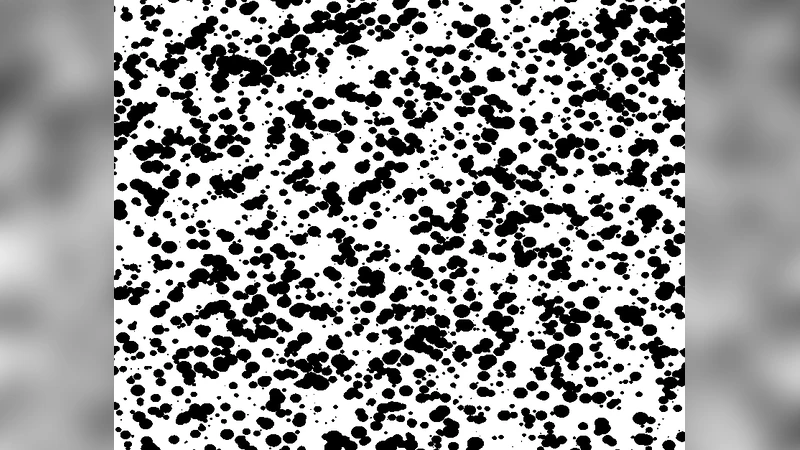
The paper considers a particular family of set–valued stochastic processes modeling birth–and–growth processes. The proposed setting allows us to investigate the nucleation and the growth processes. A decomposition theorem is established to characterize the nucleation and the growth. As a consequence, different consistent set–valued estimators are studied for growth process. Moreover, the nucleation process is studied via the hitting function, and a consistent estimator of the nucleation hitting function is derived.
💡 Research Summary
The paper develops a rigorous statistical framework for modeling birth‑and‑growth phenomena using set‑valued stochastic processes. Instead of the traditional static or continuous‑time parametric models, the authors work in discrete time and represent the system at each time step by a random closed set (RaCS). Two independent RaCS families are introduced: a nucleation (birth) process {Bₙ} and a growth process {Gₙ}. The evolution is defined recursively as Θₙ = (Θₙ₋₁ ⊕ Gₙ) ∪ Bₙ, where “⊕” denotes the Minkowski sum followed by closure. Assumption (A‑1) (0∈Gₙ) guarantees monotonicity (Θₙ₋₁⊆Θₙ); (A‑2) bounds each growth set by a fixed compact set K, preventing unbounded expansion; (A‑3) ensures that new nucleation does not overlap the existing structure after translation.
A central theoretical contribution is the notion of an X‑decomposition of a RaCS Y with respect to a sub‑set X⊆Y. The maximal growth component is given by G = Y ⊖ X̂ (Minkowski subtraction), and the minimal nucleation component by B = Y ∩ (X ⊕ G)ᶜ. Although the decomposition is not unique, the maximal‑minimal principle selects a canonical pair (G, B). This decomposition mirrors the physical intuition that the observed set consists of previously existing material expanded by growth plus newly born particles.
In practice observations are confined to a bounded window W, leading to edge effects. The naïve estimator Ĝ_W = Y_W ⊖ X̂_W coincides with the true G only when the whole process is bounded within some observation window. To address unbounded cases, two corrected estimators are proposed:
- Ĝ₁_W = (Y_W ⊖ X̂_W ⊖ K̂) ∩ K – it shrinks the observed X by K before subtraction, thus eliminating contributions that would lie outside W.
- Ĝ₂_W = ((Y_W ∪ ∂⁺_K W X_W) ⊖ X̂_W) ∩ K – it augments Y with the maximal possible growth outside W (the set ∂⁺_K W X_W) before subtraction.
Proposition 1.8 proves that Ĝ₁_W forms a decreasing sequence (with respect to set inclusion) as the observation windows {W_i} expand and converges to the true growth set G, with Hausdorff distance tending to zero. Proposition 1.9 shows that Ĝ₂_W always contains Ĝ₁_W and also contains G, making Ĝ₂_W the superior estimator in finite samples.
The nucleation process, which cannot be observed directly, is analyzed via its hitting (Choquet capacity) functional T_B(K)=P(B∩K=∅). By Matheron’s theorem, this functional uniquely determines the law of B. The authors construct an empirical estimator of the complementary functional Q_B(K)=1−T_B(K) by averaging over translations of the observation window: Q̂_B,W(K)=1−(1/|W|)∑{v∈W}1{B∩(K+v)=∅}. Under stationarity and ergodicity, they prove consistency of this estimator as the observation window grows to cover the whole space.
The paper is organized as follows: Section 1.1 reviews necessary set‑theoretic operations, Hausdorff metric, random closed sets, and capacity functionals. Section 1.2 introduces the birth‑and‑growth model and establishes the decomposition theorem. Section 1.3 focuses on growth estimation, presenting the three estimators and proving their monotonicity and consistency. Section 1.4 treats nucleation estimation via the hitting function and demonstrates the consistency of its estimator.
Overall, the work provides a non‑parametric, geometrically grounded statistical methodology for birth‑and‑growth processes that avoids regularity assumptions (such as smooth boundaries) required by many classical models. By coupling Minkowski algebra with capacity functional theory, it offers practical tools for analyzing image sequences in materials science, crystallography, biomineralization, and related fields where growth and nucleation occur simultaneously. The consistency results guarantee that, as more data become available (i.e., larger observation windows), the proposed estimators converge to the true underlying growth and nucleation characteristics, making the framework both theoretically sound and applicable to real‑world data.
Comments & Academic Discussion
Loading comments...
Leave a Comment