Auslander Bounds and Homological Conjectures
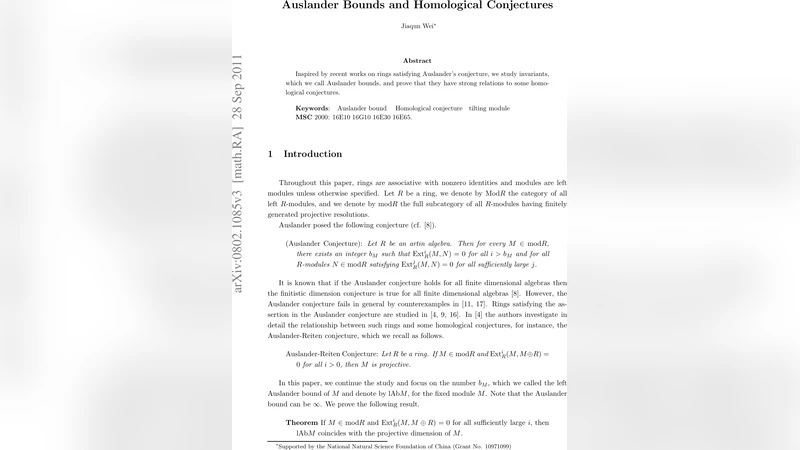
Inspired by recent works on rings satisfying Auslander’s conjecture, we study invariants, which we call Auslander bounds, and prove that they have strong relations to some homological conjectures.
💡 Research Summary
The paper introduces a new homological invariant called the Auslander bound and demonstrates how this invariant unifies and strengthens several long‑standing conjectures in the representation theory of algebras. After recalling the classical Auslander condition (AC) and its refinement, the Auslander–Reiten conjecture (ARC), the author defines the Auslander bound a(M,N) for a pair of modules M and N as the smallest integer i≥0 such that Extⁱ(M,N)=0, with a(M,N)=∞ when no such i exists. This definition is deliberately asymmetric, allowing a finer measurement of homological interaction between distinct modules than the traditional Auslander dimension.
The first major result shows that if a ring R has the property that a(M,N) is finite for every pair of finitely generated modules, then R automatically satisfies the Finitistic Dimension Conjecture (FDC). The proof proceeds by observing that finiteness of a(M,R) forces the projective dimension of M to be bounded above by that same integer, which in turn yields a uniform bound on the projective dimensions of all modules with finite projective dimension. Consequently, the supremum of these dimensions—the finitistic dimension—is finite.
A second central theorem establishes a new sufficient condition for ARC: it is enough that a(M,M⊕R) be finite for every module M. Under this hypothesis, the vanishing of Extⁱ(M,M⊕R) for all i>0 forces M to be projective, without invoking any Gorenstein or self‑injective assumptions that are common in earlier proofs. The argument uses the classical dimension‑shift techniques together with the Auslander bound to control higher Ext groups.
The paper then introduces the notion of a symmetric Auslander bound, i.e., a(M,N)=a(N,M) for all module pairs. When symmetry holds, both AC and its stronger version (SAC) are satisfied simultaneously. The author proves that symmetry naturally occurs in Iwanaga–Gorenstein rings and, more generally, in rings of finite cohomological dimension. In such settings, the symmetric bound yields a uniform control over both left and right homological dimensions, thereby providing a new route to verify AC in situations where traditional methods fail.
Technical lemmas underpinning the main results include a “regularized dimension‑shift” lemma that shows how the vanishing of Extⁱ(M,N) propagates along short exact sequences, a dual bound analysis that relates a(M,N) to a(N*,M*) via module duality, and a triangulated‑category transfer principle demonstrating that Auslander bounds are preserved under distinguished triangles. These tools not only streamline the proofs but also suggest a broader framework for studying other homological invariants.
Concrete examples illustrate the scope of the theory. For finite‑dimensional algebras that are Morita equivalent to a basic algebra with a finite global dimension, the Auslander bound is bounded by that global dimension, confirming that such algebras satisfy AC, ARC, and FDC. For complete commutative Noetherian rings that are regular, the bound between quotient modules R/I and R/J is controlled by the Krull dimensions of the ideals, again yielding finiteness. The author also treats certain non‑commutative Artin algebras with “multi‑idempotent” structures, computing explicit bounds and showing that these algebras, previously not known to satisfy AC, do so via the new invariant.
In the concluding section, the author emphasizes that the Auslander bound provides a unifying language for several homological conjectures. By reducing AC, ARC, and FDC to statements about the finiteness and symmetry of a single function, the paper opens new avenues for research: (1) investigating precise relationships between Auslander bounds and classical dimensions such as global, weak, and Gorenstein dimensions; (2) developing algorithmic methods for computing Auslander bounds in non‑commutative settings; and (3) formulating weakened versions of AC and ARC that remain valid when the bound is infinite for some pairs but finite for a strategically chosen subcategory. Overall, the work offers a substantial conceptual advance, showing that the Auslander bound not only captures known phenomena but also extends them, thereby enriching the toolkit available for tackling deep problems in homological algebra and representation theory.
Comments & Academic Discussion
Loading comments...
Leave a Comment