Deconvolution closure for mesoscopic continuum models of particle systems
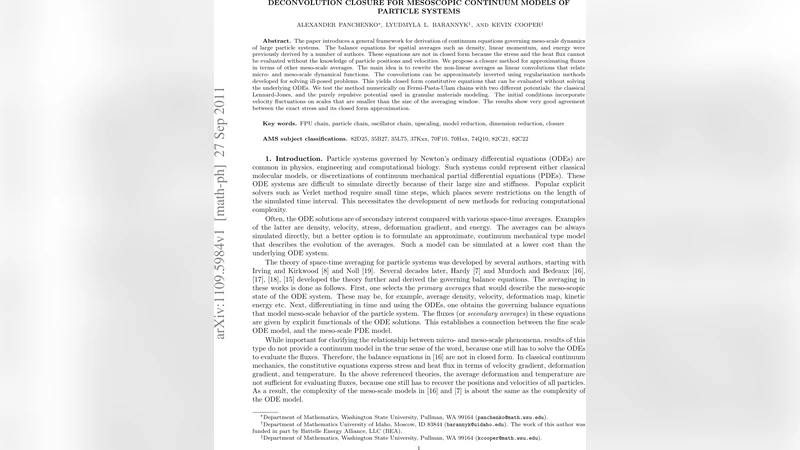
The paper introduces a general framework for derivation of continuum equations governing meso-scale dynamics of large particle systems. The balance equations for spatial averages such as density, linear momentum, and energy were previously derived by a number of authors. These equations are not in closed form because the stress and the heat flux cannot be evaluated without the knowledge of particle positions and velocities. We propose a closure method for approximating fluxes in terms of other meso-scale averages. The main idea is to rewrite the non-linear averages as linear convolutions that relate micro- and meso-scale dynamical functions. The convolutions can be approximately inverted using regularization methods developed for solving ill-posed problems. This yields closed form constitutive equations that can be evaluated without solving the underlying ODEs. We test the method numerically on Fermi-Pasta-Ulam chains with two different potentials: the classical Lennard-Jones, and the purely repulsive potential used in granular materials modeling. The initial conditions incorporate velocity fluctuations on scales that are smaller than the size of the averaging window. The results show very good agreement between the exact stress and its closed form approximation.
💡 Research Summary
The paper addresses a fundamental challenge in multiscale modeling of large particle systems: how to obtain closed continuum equations that describe the evolution of mesoscopic averages (density, momentum, energy, etc.) without having to solve the underlying microscopic Newtonian ODEs. Existing frameworks such as those of Irving‑Kirkwood, Hardy, and Murdoch‑Bedeaux provide exact balance laws for these averages, but the fluxes (stress, heat flux) remain explicit functionals of particle positions and velocities, making the macroscopic model as costly as the microscopic one.
The authors propose a novel “deconvolution closure” methodology. The key observation is that the primary mesoscopic averages are nonlinear integral operators acting on microscopic fields, yet they can be rewritten as linear convolutions of a chosen window (or kernel) function with appropriate microscopic quantities (e.g., the Jacobian of the inverse Lagrangian map, the product of that Jacobian with the microscopic velocity). This reformulation makes the averaging operator formally invertible, but the inversion is severely ill‑posed: small perturbations in the averages can produce large errors in the reconstructed microscopic fields because the convolution kernel smooths out high‑frequency information.
To overcome the ill‑posedness, the authors employ regularization techniques from inverse‑problem theory. Two non‑iterative regularization strategies are explored: (1) discretization‑based regularization, where the convolution integral is approximated by a quadrature rule, yielding a well‑conditioned linear system; and (2) truncated singular‑value decomposition (SVD), where the discrete convolution matrix is factorized, and components associated with the smallest singular values are discarded. Both approaches introduce a regularization parameter (e.g., a Tikhonov‑type λ or a singular‑value cutoff) that controls the trade‑off between accuracy and stability.
With the regularized inverse in hand, the microscopic velocity and deformation fields are reconstructed from the mesoscopic density and momentum. These reconstructed fields are then substituted into the exact microscopic expressions for stress and heat flux (derived from the same averaging framework). The result is a set of constitutive relations that express the fluxes solely in terms of the primary averages, thereby achieving a closed system of continuum equations. Importantly, the constitutive relations retain the inherent non‑local and nonlinear character of the original particle dynamics, distinguishing them from phenomenological peridynamic models.
The methodology is validated on one‑dimensional Hamiltonian chains (Fermi‑Pasta‑Ulam models) with two different short‑range pair potentials: the classical Lennard‑Jones potential and a purely repulsive Hertz‑type potential used in granular acoustics. Simulations with 10 000 particles provide “exact” reference data for density, momentum, and stress. The mesoscopic mesh consists of 500 cells, and the regularized deconvolution is applied to reconstruct microscopic fields from the coarse averages. The reconstructed stress (σ_approx) is compared against the exact stress (σ_exact) computed directly from particle data. Results show excellent agreement: L² errors are small, and visual plots of σ_approx and σ_exact are virtually indistinguishable.
The authors also compare their non‑iterative regularization with the classical Landweber iteration. While Landweber can achieve high accuracy with many iterations, it converges slowly and becomes unstable for initial conditions containing large high‑frequency fluctuations. In contrast, the truncated SVD and discretization regularizations achieve comparable or better accuracy with a single, well‑chosen regularization parameter, and they are computationally cheaper because the convolution kernel’s SVD can be pre‑computed and reused for different simulations.
In summary, the paper makes several significant contributions:
- It formulates a general, mathematically rigorous framework for deriving mesoscopic balance laws from microscopic Newtonian dynamics.
- It identifies the averaging operators as linear convolutions and proposes a systematic inversion via regularized deconvolution, turning a non‑closed macroscopic model into a closed one.
- It demonstrates that appropriate regularization (especially truncated SVD) can effectively filter out sub‑mesoscopic noise while preserving the physically relevant scales.
- It validates the approach on realistic particle chains, showing that the closed constitutive equations reproduce the exact stress with high fidelity.
- It provides practical guidance on kernel selection (piecewise‑polynomial kernels are preferred over overly smooth Gaussian kernels because they lead to milder ill‑posedness) and on the choice of regularization parameters.
The work opens the door to applying deconvolution‑based closure to more complex, higher‑dimensional systems, to models with long‑range interactions, and to coupled thermo‑mechanical problems where heat flux closure is also required. Future research directions include adaptive selection of the mesoscopic scale η, automated tuning of regularization parameters, and integration with existing multiscale simulation platforms.
Comments & Academic Discussion
Loading comments...
Leave a Comment