Note on the complexity of deciding the rainbow connectedness for bipartite graphs
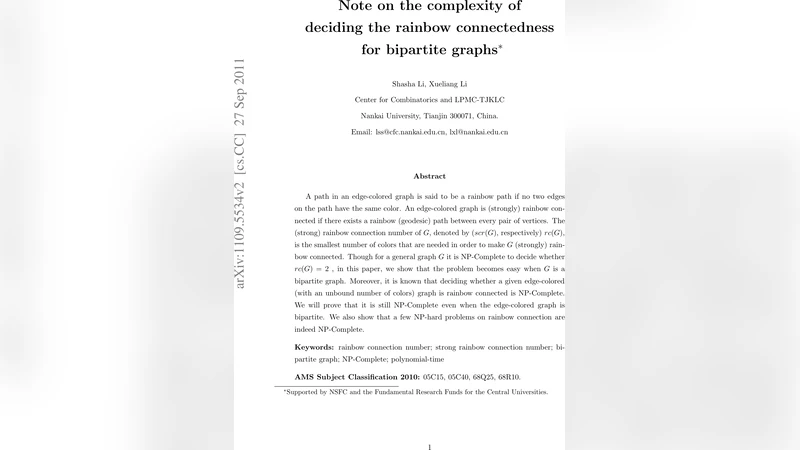
A path in an edge-colored graph is said to be a rainbow path if no two edges on the path have the same color. An edge-colored graph is (strongly) rainbow connected if there exists a rainbow (geodesic) path between every pair of vertices. The (strong) rainbow connection number of $G$, denoted by ($scr(G)$, respectively) $rc(G)$, is the smallest number of colors that are needed in order to make $G$ (strongly) rainbow connected. Though for a general graph $G$ it is NP-Complete to decide whether $rc(G)=2$, in this paper, we show that the problem becomes easy when $G$ is a bipartite graph. Moreover, it is known that deciding whether a given edge-colored (with an unbound number of colors) graph is rainbow connected is NP-Complete. We will prove that it is still NP-Complete even when the edge-colored graph is bipartite. We also show that a few NP-hard problems on rainbow connection are indeed NP-Complete.
💡 Research Summary
The paper investigates the computational complexity of determining rainbow connectivity and strong rainbow connectivity in graphs, with a particular focus on bipartite graphs. A rainbow path is a path whose edges all receive distinct colors; a graph is rainbow connected if every pair of vertices is joined by at least one rainbow path, and it is strongly rainbow connected if every pair is joined by a rainbow shortest‑path (geodesic). The rainbow connection number rc(G) and the strong rainbow connection number src(G) are the minimum numbers of colors needed to achieve these properties, respectively.
Previous work established that for general graphs the decision problem “rc(G)=2?” is NP‑Complete, and that for any fixed integer k≥3, deciding whether rc(G)≤k or src(G)≤k is NP‑hard. The authors first strengthen these hardness results to NP‑completeness. By showing that a certificate consisting of a k‑coloring can be verified in polynomial time—since one can enumerate all u‑v paths of length at most k (there are at most n^k of them) and check each for distinct colors—they prove that the problems “rc(G)≤k?” and “src(G)≤k?” belong to NP. Combined with the known NP‑hardness, this yields NP‑completeness for any fixed k≥2.
The paper then turns to bipartite graphs. Using a known formula for the rainbow connection number of complete bipartite graphs K_{s,t} (rc(K_{s,t}) = min{⌈s√t⌉, 4}), the authors observe that a bipartite graph can have rc(G)=2 only if it is a complete bipartite graph with parameters satisfying 2s≥t. Checking whether a given bipartite graph is complete and whether its part sizes meet this inequality can be done in linear time, so the decision problem “rc(G)=2?” becomes polynomial‑time solvable for bipartite graphs. As a corollary, they note that “rc(G)=3?” remains NP‑Complete even on bipartite graphs.
The final major contribution concerns edge‑colored graphs where the number of colors is unbounded. It is known that, for arbitrary graphs, deciding whether a given coloring makes the graph rainbow connected is NP‑Complete. The authors prove that this remains true when the underlying graph is bipartite. They construct a polynomial‑time reduction: each edge e of the original graph G is subdivided by a new vertex v_e, producing a bipartite graph G′ with bipartition (X = V(G), Y = {v_e}). The original colors are retained on the edges incident to the original endpoints, while each new edge receives a fresh, unique color. They show that G is rainbow connected under the original coloring if and only if G′ is rainbow connected under the constructed coloring. Hence the rainbow‑connectivity verification problem is NP‑Complete for edge‑colored bipartite graphs.
In summary, the paper establishes three key results: (1) the rc(G)=2 decision problem, hard for general graphs, is tractable for bipartite graphs; (2) for any fixed integer k≥2, both rc(G)≤k and src(G)≤k are NP‑Complete, upgrading earlier NP‑hardness findings; (3) verifying rainbow connectivity of an arbitrarily colored bipartite graph remains NP‑Complete. These contributions clarify the boundary between easy and hard instances of rainbow connectivity problems and reinforce the theoretical understanding of this graph‑theoretic concept.
Comments & Academic Discussion
Loading comments...
Leave a Comment