Recent data reported by the PAMELA and ATIC experiments, as well as cosmic ray lepton results from FERMI and H.E.S.S. collaborations sparked a series of papers explaining these results either by contributions of electron positron pairs to the local interstellar cosmic ray (CR) spectrum by dark matter (DM) or pulsars. Focusing here on pulsars, we argue that at the present, our knowledge about particle acceleration at pulsars as well as of the local Galactic CR propagation is still limited, i.e. the recent results for CR electrons and positrons constrain pulsar and propagation models. We will thus not present another attempt to explain the data by contributions of pulsars to the local CR lepton flux but rather to highlight the caveats in doing so.
Deep Dive into Signatures of middle aged, nearby pulsars in the cosmic ray lepton spectrum?.
Recent data reported by the PAMELA and ATIC experiments, as well as cosmic ray lepton results from FERMI and H.E.S.S. collaborations sparked a series of papers explaining these results either by contributions of electron positron pairs to the local interstellar cosmic ray (CR) spectrum by dark matter (DM) or pulsars. Focusing here on pulsars, we argue that at the present, our knowledge about particle acceleration at pulsars as well as of the local Galactic CR propagation is still limited, i.e. the recent results for CR electrons and positrons constrain pulsar and propagation models. We will thus not present another attempt to explain the data by contributions of pulsars to the local CR lepton flux but rather to highlight the caveats in doing so.
Recent data reported by the PAMELA 1 and ATIC 2 experiments, as well as cosmic ray lepton results from FERMI 3 and H.E.S.S. 4 collaborations sparked a series of papers explaining these results either by contributions of electron positron pairs to the local interstellar cosmic ray (CR) spectrum by dark matter (DM) or pulsars. Focusing here on pulsars, we argue that at the present, our knowledge about particle acceleration at pulsars as well as of the local Galactic CR propagation is still limited, i.e. the recent results for CR electrons and positrons constrain pulsar and propagation models. We will thus not present another attempt to explain the data by contributions of pulsars to the local CR lepton flux but rather to highlight the caveats in doing so.
Modelling the acceleration of particles at pulsars and subsequent injection of these particles into the interstellar medium, one may look at three scenarios: young pulsars (after the breakup of their pulsar wind nebulae), 5 mature pulsars 6 and millisecond pulsars. 7
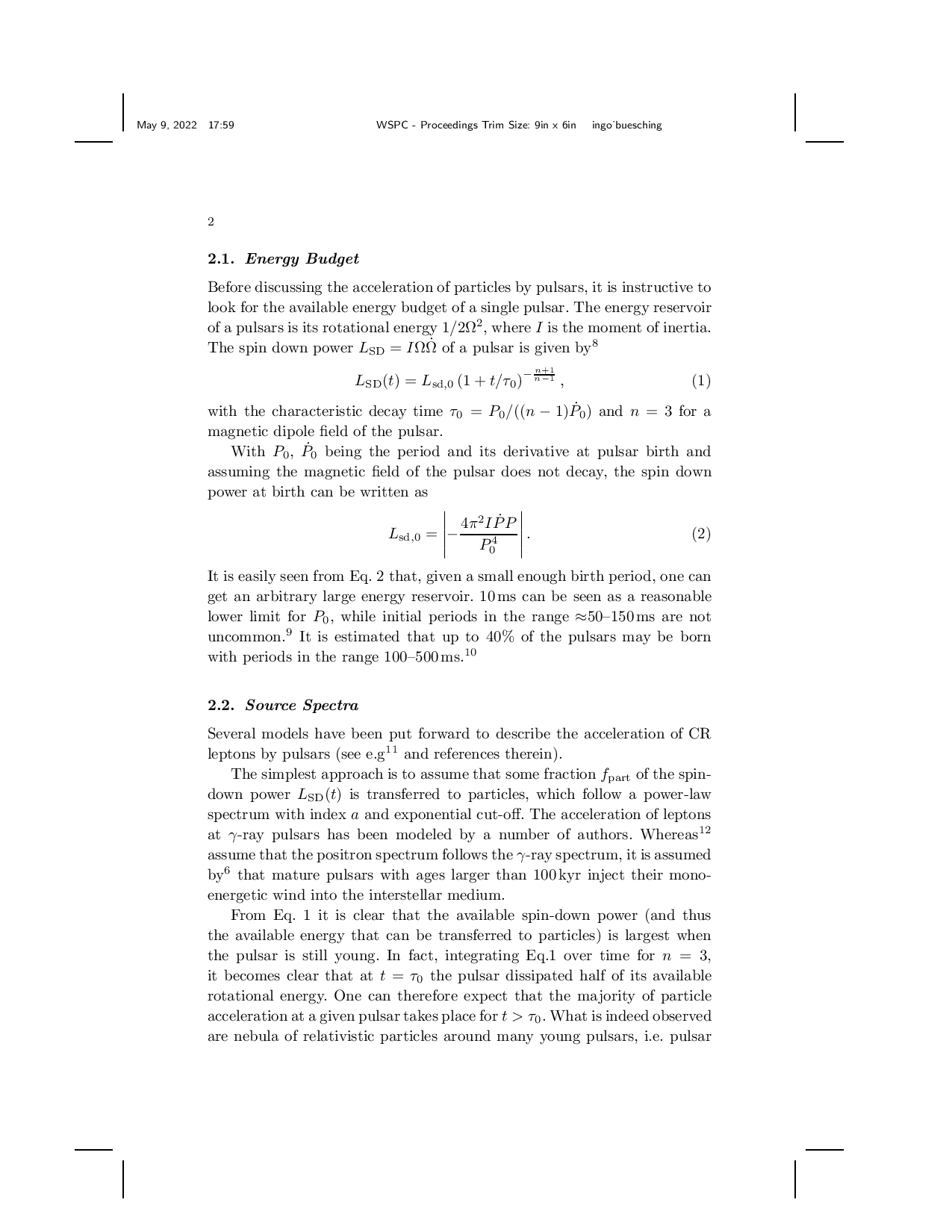
Before discussing the acceleration of particles by pulsars, it is instructive to look for the available energy budget of a single pulsar. The energy reservoir of a pulsars is its rotational energy 1/2Ω 2 , where I is the moment of inertia. The spin down power L SD = IΩ Ω of a pulsar is given by 8
with the characteristic decay time τ 0 = P 0 /((n -1) Ṗ0 ) and n = 3 for a magnetic dipole field of the pulsar. With P 0 , Ṗ0 being the period and its derivative at pulsar birth and assuming the magnetic field of the pulsar does not decay, the spin down power at birth can be written as
It is easily seen from Eq. 2 that, given a small enough birth period, one can get an arbitrary large energy reservoir. 10 ms can be seen as a reasonable lower limit for P 0 , while initial periods in the range ≈50-150 ms are not uncommon. 9 It is estimated that up to 40% of the pulsars may be born with periods in the range 100-500 ms. 10
Several models have been put forward to describe the acceleration of CR leptons by pulsars (see e.g 11 and references therein). The simplest approach is to assume that some fraction f part of the spindown power L SD (t) is transferred to particles, which follow a power-law spectrum with index a and exponential cut-off. The acceleration of leptons at γ-ray pulsars has been modeled by a number of authors. Whereas 12 assume that the positron spectrum follows the γ-ray spectrum, it is assumed by 6 that mature pulsars with ages larger than 100 kyr inject their monoenergetic wind into the interstellar medium.
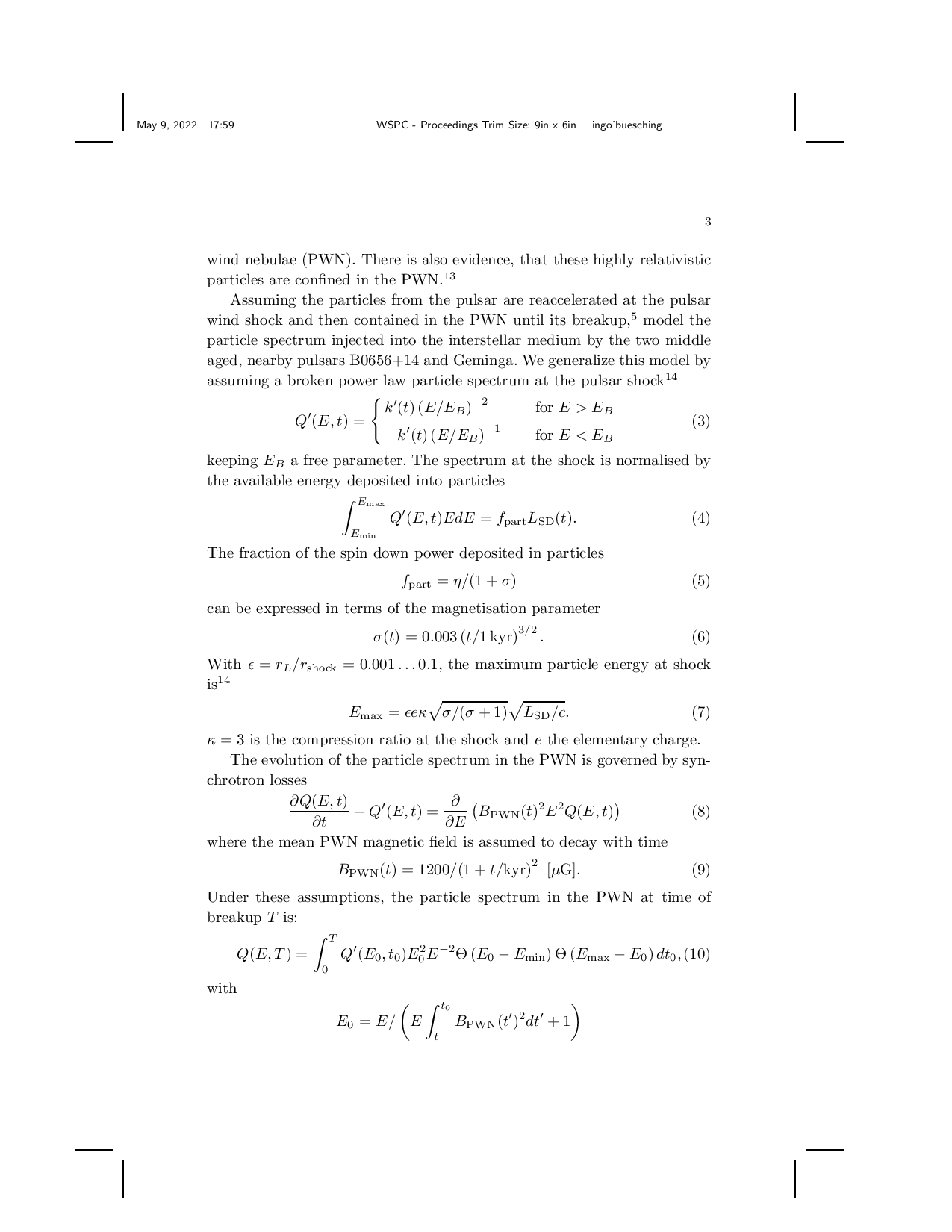
From Eq. 1 it is clear that the available spin-down power (and thus the available energy that can be transferred to particles) is largest when the pulsar is still young. In fact, integrating Eq.1 over time for n = 3, it becomes clear that at t = τ 0 the pulsar dissipated half of its available rotational energy. One can therefore expect that the majority of particle acceleration at a given pulsar takes place for t > τ 0 . What is indeed observed are nebula of relativistic particles around many young pulsars, i.e. pulsar wind nebulae (PWN). There is also evidence, that these highly relativistic particles are confined in the PWN. 13 Assuming the particles from the pulsar are reaccelerated at the pulsar wind shock and then contained in the PWN until its breakup, 5 model the particle spectrum injected into the interstellar medium by the two middle aged, nearby pulsars B0656+14 and Geminga. We generalize this model by assuming a broken power law particle spectrum at the pulsar shock 14
keeping E B a free parameter. The spectrum at the shock is normalised by the available energy deposited into particles
The fraction of the spin down power deposited in particles
can be expressed in terms of the magnetisation parameter
With ǫ = r L /r shock = 0.001 . . . 0.1, the maximum particle energy at shock is 14
κ = 3 is the compression ratio at the shock and e the elementary charge. The evolution of the particle spectrum in the PWN is governed by synchrotron losses
where the mean PWN magnetic field is assumed to decay with time
Under these assumptions, the particle spectrum in the PWN at time of breakup T is:
with
The propagation of CR leptons in the Galaxy is dominated by diffusion and energy losses due to synchrotron radiation in the Galactic magnetic field.
The differential density N satisfies the equation
where b 0 is determined by the Galactic magnetic field.
In the case of a pulsar, the source function is given by
where Q(E, t) is given by a model for particle acceleration at pulsars. Above ≈ 4 GV, the diffusion coefficient has an energy dependence of the form
where α = 0.3 . . . 0.7 and k 0 are determined by fitting observed secondary to primary and radioactive secondary data. Depending on the model, k 0 is in the range 0.006 kpc 2 Myr -1 -0.2 kpc 2 Myr -1 (e.g. 15 ). Although obtaining k 0 in this way is a well established procedure, we want to remark the following. First, fitting
…(Full text truncated)…
This content is AI-processed based on ArXiv data.