Counting Plane Graphs: Perfect Matchings, Spanning Cycles, and Kasteleyns Technique
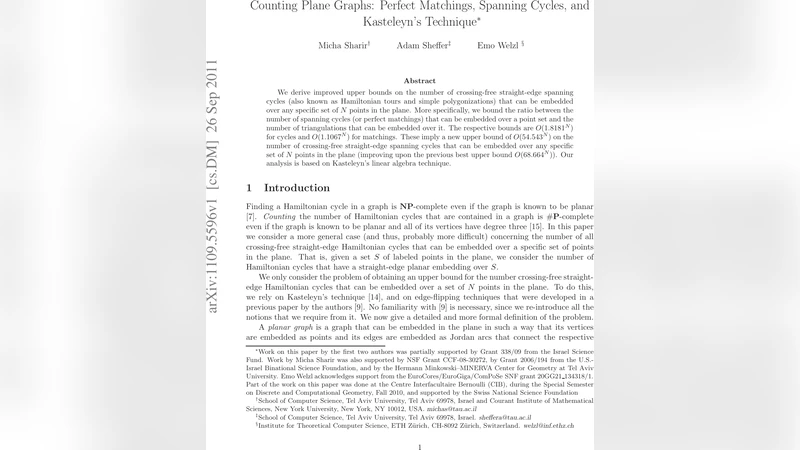
We derive improved upper bounds on the number of crossing-free straight-edge spanning cycles (also known as Hamiltonian tours and simple polygonizations) that can be embedded over any specific set of $N$ points in the plane. More specifically, we bound the ratio between the number of spanning cycles (or perfect matchings) that can be embedded over a point set and the number of triangulations that can be embedded over it. The respective bounds are $O(1.8181^N)$ for cycles and $O(1.1067^N)$ for matchings. These imply a new upper bound of $O(54.543^N)$ on the number of crossing-free straight-edge spanning cycles that can be embedded over any specific set of $N$ points in the plane (improving upon the previous best upper bound $O(68.664^N)$). Our analysis is based on Kasteleyn’s linear algebra technique.
💡 Research Summary
The paper addresses the long‑standing problem of bounding the number of crossing‑free straight‑edge spanning cycles (also called Hamiltonian tours or simple polygonizations) that can be drawn on any fixed set of N points in the plane. In addition, it studies the related problem of counting plane perfect matchings on the same point set. The authors improve the best known exponential upper bounds by combining two main ideas: a refined counting technique based on the notion of “support” and a careful application of Kasteleyn’s linear‑algebra method for counting perfect matchings in planar graphs.
First, the authors formalize the objects of interest. For a point set S they denote by C(S) the set of all crossing‑free spanning cycles and by sc(S)=|C(S)| its cardinality; similarly, M(S) is the set of all plane perfect matchings and pm(S)=|M(S)|. The global quantities sc(N)=max_{|S|=N} sc(S) and pm(N)=max_{|S|=N} pm(S) are the targets of the analysis. A naïve bound proceeds by multiplying the maximum number of triangulations tr(N) by the maximum number of cycles that can appear in a single triangulation, scΔ(N). This yields sc(N)≤tr(N)·scΔ(N), but it is weak because the same cycle can belong to many triangulations, leading to massive over‑counting.
To overcome this, the authors introduce the concept of “support”. For a plane graph G embedded on S, support(G) is defined as the exact number of triangulations of S that contain G. Consequently, \
Comments & Academic Discussion
Loading comments...
Leave a Comment