Shared Memory Concurrent System Verification using Kronecker Algebra
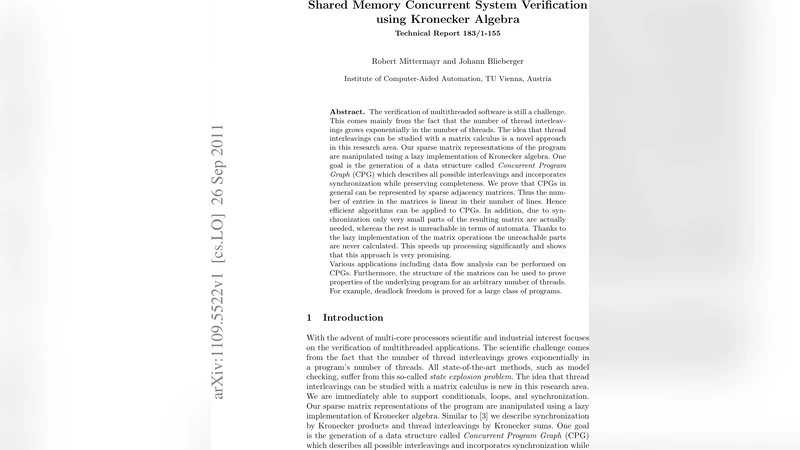
The verification of multithreaded software is still a challenge. This comes mainly from the fact that the number of thread interleavings grows exponentially in the number of threads. The idea that thread interleavings can be studied with a matrix calculus is a novel approach in this research area. Our sparse matrix representations of the program are manipulated using a lazy implementation of Kronecker algebra. One goal is the generation of a data structure called Concurrent Program Graph (CPG) which describes all possible interleavings and incorporates synchronization while preserving completeness. We prove that CPGs in general can be represented by sparse adjacency matrices. Thus the number of entries in the matrices is linear in their number of lines. Hence efficient algorithms can be applied to CPGs. In addition, due to synchronization only very small parts of the resulting matrix are actually needed, whereas the rest is unreachable in terms of automata. Thanks to the lazy implementation of the matrix operations the unreachable parts are never calculated. This speeds up processing significantly and shows that this approach is very promising. Various applications including data flow analysis can be performed on CPGs. Furthermore, the structure of the matrices can be used to prove properties of the underlying program for an arbitrary number of threads. For example, deadlock freedom is proved for a large class of programs.
💡 Research Summary
The paper presents a novel approach to the verification of shared‑memory multithreaded programs by representing all possible thread interleavings and synchronizations as sparse adjacency matrices, called Concurrent Program Graphs (CPGs). Each thread’s control‑flow graph (CFG) is first refined through an “edge‑splitting” process that isolates every shared‑variable access and semaphore operation into atomic edges. This yields refined CFGs (RCFGs) whose edges are labeled with elements from a semiring that distinguishes ordinary operations from semaphore P/V calls.
The core of the method is the use of Kronecker algebra. The Kronecker product (⊗) combines the transition matrices of two threads to model their concurrent execution, while the Kronecker sum (⊕) adds the independent transitions of each thread together with identity matrices, effectively constructing the Cartesian product of the underlying graphs. The authors prove fundamental properties of these operators, introduce a “Mixed Sum Rule” ((A⊕B)+(C⊕D) = (A+C)⊕(B+D)), and show that the resulting matrices remain sparse: the number of non‑zero entries grows linearly with the number of rows, even though the matrix order may be exponential in the number of threads.
Two major optimizations are proposed. First, when synchronization is heavy, only a tiny fraction of the theoretical state space is reachable. By implementing all matrix operations lazily, the algorithm computes only the reachable sub‑matrix, completely avoiding the construction of unreachable blocks. Second, when synchronization is sparse, edges that never touch shared variables are eliminated during a post‑processing step, further shrinking the graph. These optimizations together dramatically reduce both memory consumption and runtime.
Because CPGs are ordinary sparse adjacency matrices, existing graph‑based analyses can be applied directly. The paper demonstrates several applications: (1) data‑flow analysis using regular‑expression labels, (2) detection of data races by identifying conflicting shared‑variable accesses in the matrix, and (3) a formal proof of deadlock freedom for a broad class of “p‑v‑symmetric” programs, independent of the number of threads.
The authors validate their technique on a client‑server benchmark with 32 concurrent clients. Although the underlying state space has a potential size of 10^15, the lazy Kronecker computation produces the full CPG in 0.43 seconds, a speedup orders of magnitude beyond conventional model‑checking tools. Additional experiments with binary and counting semaphores, loops, and conditionals confirm the method’s generality.
Limitations include the current inability to handle recursion (sub‑programs must be inlined) and the theoretical exponential growth of matrix order, which may still pose challenges for programs with hundreds of threads. Future work is outlined to incorporate lock‑free algorithms, dynamic memory models, and more aggressive compression techniques.
In summary, the paper introduces a mathematically rigorous, matrix‑centric framework for concurrent program verification that overcomes the classic state‑explosion problem through sparsity and lazy evaluation, offering a scalable foundation for a wide range of static analyses on multithreaded software.
Comments & Academic Discussion
Loading comments...
Leave a Comment