Hidden complexities in the unfolding mechanism of a cytosine-rich DNA strand
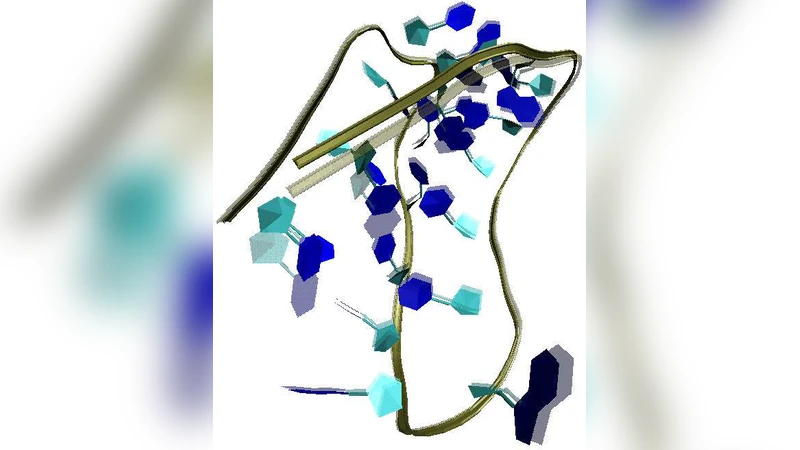
We investigate the unfolding pathway of a cytosine-rich DNA hairpin structure via Molecular Dynamics simulations. Our results indicate a hidden complexity present in the unfolding process. W e show that this complex behavior arises due to non-stochastic contributions which have an important impact on the description of the dynamics in terms of collective variables.
💡 Research Summary
This paper presents a detailed investigation of the unfolding mechanism of a cytosine‑rich DNA hairpin (i‑motif) using all‑atom molecular dynamics (MD) simulations. The authors simulated a 22‑nucleotide deprotonated i‑motif in explicit TIP3P water with 0.23 M Na⁺ at 500 K, employing the AMBER03 force field and GROMACS. After equilibration, they collected extensive trajectories that capture the full transition from the folded hairpin (states A and B) to a fully extended strand (state C).
To reduce the high‑dimensional atomic motion, the authors applied essential dynamics (principal component analysis) to the trajectory, extracting eigenvectors (principal components) ordered by their eigenvalues. The first three eigenvectors (EV1‑EV3) were visualized and interpreted: EV1 corresponds to end‑to‑end stretching, EV2 to a planar reorientation of the strand ends, and EV3 to a torsional twist of the hairpin core. Previous work suggested that EV1 and EV2 alone suffice to describe the unfolding pathway, assuming that all higher modes behave as stochastic Gaussian noise.
The novelty of this study lies in a quantitative assessment of the stochastic versus deterministic nature of the higher modes. The authors introduced a non‑Gaussian parameter D = ⟨σ⁴⟩ − 3⟨σ²⟩² / ⟨σ²⟩², which measures deviation from a Gaussian distribution for a given collective variable. By projecting the trajectory onto the (EV1, EV2) plane and evaluating D for EV3, they discovered pronounced non‑Gaussian behavior in the region where the hairpin adopts its folded conformations (EV1 ≈ −9 → −4 nm, EV2 ≈ 0 → 20 nm). This indicates that EV3 contributes deterministic, “non‑stochastic” motions that are essential for the transition from the hairpin to the extended state.
Further analysis showed that EV4 and EV5 also exhibit significant D values, although their variances are much smaller than those of EV3, suggesting that while they contain non‑Gaussian components, their impact on the overall unfolding is limited. Correlation analyses demonstrated that EV3 is essentially independent of EV1 and EV2, confirming that the torsional motion it represents is an orthogonal degree of freedom rather than a mere fluctuation of the stretching or planar motions.
Free‑energy landscapes constructed from EV1 and EV2 reveal two major barriers separating states A, B, and C. The barrier between A and B is associated with relaxation of the 5′ end, while the barrier between B and C is largely governed by the torsional motion captured by EV3. The authors argue that a two‑dimensional description (EV1 + EV2) neglects this critical torsional contribution, leading to an incomplete and potentially misleading picture of the unfolding dynamics.
The implications of these findings are twofold. First, for accurate modeling of DNA i‑motif behavior—especially in nanotechnological applications such as molecular switches, containers, or logic gates—one must include at least the third principal component to capture the essential torsional degree of freedom. Second, the introduced D‑parameter provides a general, computationally inexpensive tool to detect hidden non‑Gaussian behavior in any set of collective variables, offering a pathway to identify overlooked deterministic contributions in complex biomolecular processes.
In conclusion, the unfolding of the cytosine‑rich DNA hairpin is a combined process involving (i) end‑to‑end stretching (EV1), (ii) planar reorientation (EV2), and (iii) torsional twisting (EV3). The torsional motion, which exhibits significant non‑Gaussian statistics, is indispensable for the transition from folded to fully unfolded conformations. Ignoring this component by relying solely on low‑dimensional collective variables results in loss of critical mechanistic information. The study thus highlights the necessity of a multidimensional, statistically rigorous approach when dissecting biomolecular unfolding pathways, especially under conditions (high temperature, crowded environments) where subtle deterministic motions can dominate the observed dynamics.
Comments & Academic Discussion
Loading comments...
Leave a Comment