The ubiquity of small-world networks
Small-world networks by Watts and Strogatz are a class of networks that are highly clustered, like regular lattices, yet have small characteristic path lengths, like random graphs. These characteristics result in networks with unique properties of regional specialization with efficient information transfer. Social networks are intuitive examples of this organization with cliques or clusters of friends being interconnected, but each person is really only 5-6 people away from anyone else. While this qualitative definition has prevailed in network science theory, in application, the standard quantitative application is to compare path length (a surrogate measure of distributed processing) and clustering (a surrogate measure of regional specialization) to an equivalent random network. It is demonstrated here that comparing network clustering to that of a random network can result in aberrant findings and networks once thought to exhibit small-world properties may not. We propose a new small-world metric, {\omega} (omega), which compares network clustering to an equivalent lattice network and path length to a random network, as Watts and Strogatz originally described. Example networks are presented that would be interpreted as small-world when clustering is compared to a random network but are not small-world according to {\omega}. These findings have significant implications in network science as small-world networks have unique topological properties, and it is critical to accurately distinguish them from networks without simultaneous high clustering and low path length.
💡 Research Summary
The paper revisits the definition and measurement of small‑world networks originally introduced by Watts and Strogatz (1998). While the qualitative description—high clustering like a lattice combined with short average path length like a random graph—has been widely accepted, the quantitative practice has largely relied on the small‑world coefficient σ. σ is calculated by comparing a network’s clustering coefficient C and characteristic path length L to those of an equivalent random network (C_rand and L_rand), forming the ratios γ = C/C_rand and λ = L/L_rand, and then σ = γ/λ. A network is deemed small‑world when σ > 1, i.e., C ≫ C_rand and L ≈ L_rand.
The authors argue that this approach is fundamentally flawed because C_rand is typically extremely low (often <0.001). Consequently, even modest absolute differences in clustering can produce large variations in γ, inflating σ and causing networks with relatively low absolute clustering to be labeled as small‑world. They illustrate this with two hypothetical networks: one with C = 0.5, C_rand = 0.01, and another with C = 0.05, C_rand = 0.001. Both yield similar σ despite a ten‑fold difference in absolute clustering, demonstrating that σ is more a measure of deviation from randomness than a true assessment of lattice‑like clustering.
To address these shortcomings, the authors propose a new metric ω (omega). ω directly follows the original Watts‑Strogatz definition by comparing clustering to an equivalent lattice network (C_latt) and path length to an equivalent random network (L_rand):
ω = (L_rand / L) − (C / C_latt)
Because C_latt reflects the high clustering expected in a regular lattice, ω is less sensitive to the minute fluctuations that plague C_rand. ω is bounded between –1 and +1 regardless of network size. Values near zero indicate a balance where L ≈ L_rand and C ≈ C_latt, i.e., ideal small‑world behavior. Positive ω values denote random‑like networks (short L, low C), while negative values denote lattice‑like networks (long L, high C). The authors suggest that a practical small‑world interval might be –0.5 ≤ ω ≤ 0.5, though no strict cutoff is imposed.
Methodologically, random networks are generated using the Maslov‑Sneppen edge‑rewiring algorithm while preserving the original degree distribution, performing ten full rewiring passes and averaging over 50 realizations to obtain C_rand and L_rand. Lattice equivalents are constructed via a modified “latticization” algorithm (Sporns & Zwi, 2004) that iteratively swaps edges to move connections closer to the matrix diagonal while maintaining degree sequence, thereby maximizing clustering and lengthening paths. For large graphs, a sliding‑window approach is employed to reduce computational load.
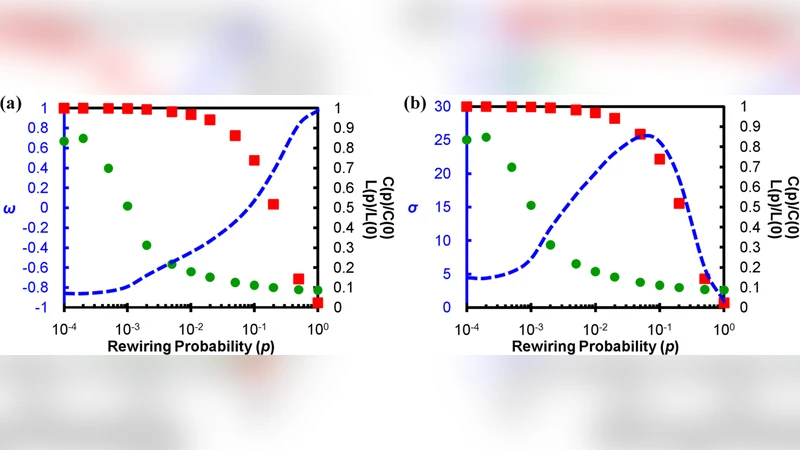
The authors first validate ω on synthetic networks: a 1000‑node lattice (average degree k = 10) is rewired with probability p from 0 (pure lattice) to 1 (pure random). As p increases, ω smoothly transitions from –1 to +1. The region where ω crosses zero aligns with the classic Watts‑Strogatz small‑world regime (high C, low L). Notably, σ remains >1 over a broader p range, confirming its tendency to over‑detect small‑worldness.
Next, ω and σ are applied to a diverse set of real‑world networks: an email communication network, the C. elegans metabolic network, Zachary’s karate club, a word‑adjacency network, a college football schedule network, an Internet autonomous‑system graph, and functional brain networks derived from resting‑state fMRI of 11 older adults (both control and exercise groups). While σ>1 for most of these systems, ω often deviates substantially from zero, indicating that many are closer to lattice‑ or random‑like extremes rather than true small‑world structures. In the brain data, σ fails to differentiate treatment from control, but ω reveals a modest shift toward more random‑like organization in the exercised group, suggesting ω’s greater sensitivity to subtle topological changes.
The paper’s contributions are threefold: (1) it exposes the inherent bias of σ caused by normalizing clustering against an unrealistically low random baseline; (2) it introduces ω, a bounded, scale‑independent metric that places any network on a continuum from lattice through small‑world to random; and (3) it demonstrates, through both simulations and empirical datasets, that many networks previously labeled as small‑world are in fact not, thereby challenging the perceived ubiquity of small‑world topology.
In conclusion, ω provides a more faithful quantification of the dual requirements—high clustering and short path length—that define small‑world networks. By aligning the measurement with the original conceptual framework, ω enables researchers to distinguish genuine small‑world organization from networks that merely deviate from randomness. The authors suggest that future work could employ ω to track dynamic network evolution, assess disease‑related topological alterations, and guide the design of engineered systems where an optimal balance between specialization (lattice) and integration (random) is desired.
Comments & Academic Discussion
Loading comments...
Leave a Comment