A Market for Air Traffic Flow Management
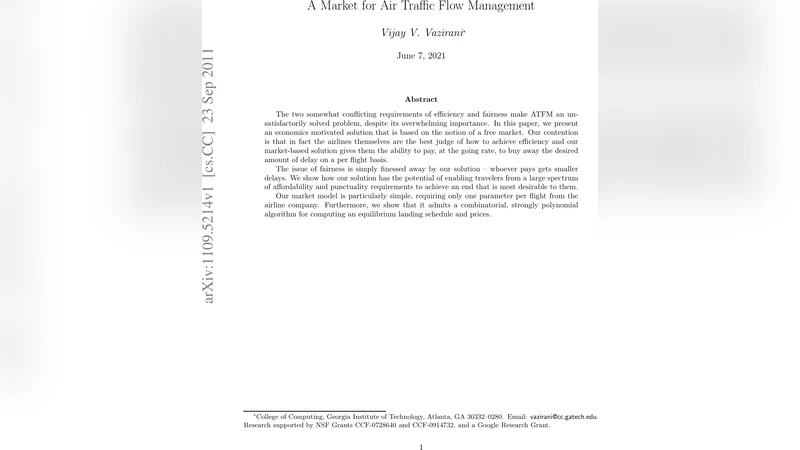
The two somewhat conflicting requirements of efficiency and fairness make ATFM an unsatisfactorily solved problem, despite its overwhelming importance. In this paper, we present an economics motivated solution that is based on the notion of a free market. Our contention is that in fact the airlines themselves are the best judge of how to achieve efficiency and our market-based solution gives them the ability to pay, at the going rate, to buy away the desired amount of delay on a per flight basis. The issue of fairness is simply finessed away by our solution – whoever pays gets smaller delays. We show how our solution has the potential of enabling travelers from a large spectrum of affordability and punctuality requirements to achieve an end that is most desirable to them. Our market model is particularly simple, requiring only one parameter per flight from the airline company. Furthermore, we show that it admits a combinatorial, strongly polynomial algorithm for computing an equilibrium landing schedule and prices.
💡 Research Summary
The paper tackles the long‑standing problem of Air Traffic Flow Management (ATFM), which must reconcile two seemingly contradictory goals: system‑wide efficiency and perceived fairness among airlines and passengers. Traditional ATFM approaches are centrally administered by the Federal Aviation Administration (FAA), which attempts to produce a globally optimal landing sequence but often fails to accommodate the heterogeneous value that different airlines place on delay. The authors propose a market‑based mechanism that hands the decision‑making power back to the airlines while preserving overall efficiency through a well‑designed pricing system.
Core Model
Each flight i is required to submit a single scalar, the “criticality factor” αᵢ (measured in dollars per unit of delay). This factor represents the airline’s marginal cost of delay for that flight; a higher αᵢ indicates that the airline is willing to pay more to avoid delay. The FAA partitions the day into a set of discrete landing slots s ∈ B, each with a capacity c(s) (the number of aircraft that can land in that slot). For each flight a feasible landing window W(i) ⊆ B is defined, reflecting weather, runway availability, and other operational constraints. If flight i lands in slot s, it incurs a physical delay dᵢ(s) (the difference between the scheduled arrival time and the actual slot) and must also pay a slot price pₛ set by the market. The total cost to the airline for that assignment is therefore pₛ + αᵢ·dᵢ(s).
Linear Programming Formulation
The authors formulate a primal linear program (LP) that minimizes the sum of all flights’ total costs subject to (1) each flight being assigned to at least one slot, (2) each slot’s capacity not being exceeded, and (3) non‑negativity of the assignment variables xᵢₛ (fractional in the LP, integral in the final solution). The objective function is Σᵢ αᵢ Σₛ∈W(i) dᵢ(s) xᵢₛ. Remarkably, the constraint matrix of this LP is totally unimodular, guaranteeing that any optimal solution is integral without the need for integer programming techniques.
The dual LP introduces variables pₛ (slot prices) and tᵢ (the minimum total cost experienced by flight i). Dual constraints enforce tᵢ ≤ pₛ + αᵢ·dᵢ(s) for every feasible (i,s) pair, while complementary slackness yields two equilibrium conditions: (i) each flight chooses a slot that minimizes its own total cost, and (ii) any slot that is not filled to capacity must have price zero—a standard market clearing condition.
Algorithmic Reduction
To compute the equilibrium efficiently, the authors map the LP to a minimum‑weight perfect b‑matching problem on a bipartite graph G = (A′ ∪ B, E). The left side A′ consists of all flights A plus a dummy vertex v; the right side B contains the time slots. An edge (i,s) carries weight αᵢ·dᵢ(s), while edges (v,s) have unit weight. The demand of each slot vertex equals its capacity c(s), and the dummy vertex supplies the surplus needed to make the total demand equal the number of flights. Because the underlying matrix is totally unimodular, solving the b‑matching yields an integral solution that directly corresponds to the optimal LP schedule. Efficient combinatorial algorithms for b‑matching (e.g., those based on the Hungarian method or more recent strongly polynomial approaches) solve the problem in strongly polynomial time, making the method practical for airports handling thousands of daily flights.
Extensions and Flexibility
While the baseline model assumes a linear delay cost (αᵢ·dᵢ(s)), the authors discuss a natural extension where airlines can provide a non‑linear, monotone increasing delay function dᵢ(s). For instance, a flight might tolerate up to 30 minutes of delay at a modest cost but incur sharply rising penalties beyond that threshold, reflecting cascading system effects. The same LP structure accommodates such functions, provided they remain non‑decreasing, preserving the economic interpretation of αᵢ as an upper bound on marginal cost per unit of delay.
Key Advantages
- Simplicity – Airlines need only report a single number per flight, avoiding the complexity of full utility functions.
- Computational Efficiency – The total‑unimodular LP and its b‑matching reduction guarantee integral solutions in strongly polynomial time, suitable for real‑time ATFM.
- Fairness by Market – Prices reflect aggregate demand: flights with higher willingness to pay obtain earlier slots, while unused capacity is priced at zero, aligning with the “who pays gets less delay” principle.
Limitations and Future Work
The paper deliberately restricts its analysis to a single airport and assumes all flights are interchangeable with respect to slot size, ignoring aircraft‑specific constraints (e.g., runway length, wake turbulence separation). The linear cost assumption may oversimplify airlines’ true preferences, and the model does not detail how the FAA should adjust landing windows W(i) in response to evolving weather or congestion. Moreover, the handling of infeasibility (insufficient slot capacity) is limited to “stretch windows or cancel flights,” without a systematic policy for such interventions. Extending the framework to multi‑airport networks, incorporating heterogeneous aircraft characteristics, and designing dynamic pricing rules that react to real‑time data are identified as promising research directions.
Conclusion
By introducing a market where airlines purchase “delay avoidance” at a per‑flight criticality price, the authors provide a theoretically sound, computationally tractable, and intuitively fair solution to ATFM. The combination of a simple input requirement, a total‑unimodular LP, and a strongly polynomial b‑matching algorithm bridges the gap between economic theory and operational feasibility, offering a compelling alternative to traditional centrally planned ATFM schemes.
Comments & Academic Discussion
Loading comments...
Leave a Comment