Second moment method for a family of boolean CSP
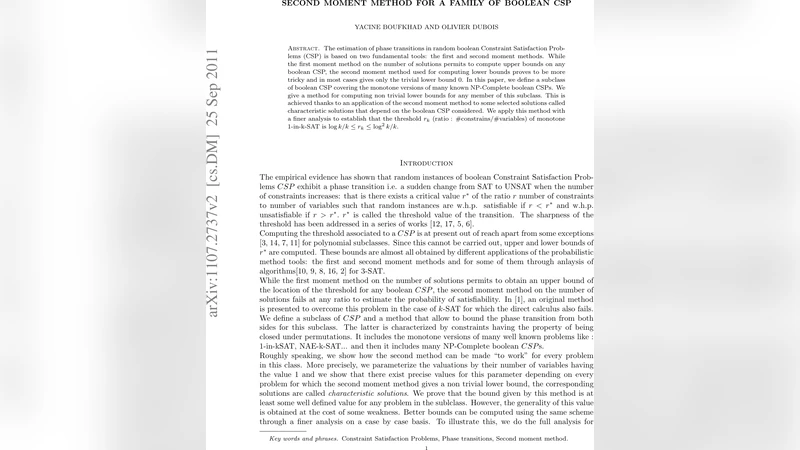
The estimation of phase transitions in random boolean Constraint Satisfaction Problems (CSP) is based on two fundamental tools: the first and second moment methods. While the first moment method on the number of solutions permits to compute upper bounds on any boolean CSP, the second moment method used for computing lower bounds proves to be more tricky and in most cases gives only the trivial lower bound 0. In this paper, we define a subclass of boolean CSP covering the monotone versions of many known NP-Complete boolean CSPs. We give a method for computing non trivial lower bounds for any member of this subclass. This is achieved thanks to an application of the second moment method to some selected solutions called characteristic solutions that depend on the boolean CSP considered. We apply this method with a finer analysis to establish that the threshold $r_{k}$ (ratio : #constrains/#variables) of monotone 1-in-k-SAT is $\log k/k\leq r_{k}\leq\log^{2}k/k$.
💡 Research Summary
The paper addresses the long‑standing difficulty of applying the second‑moment method to obtain non‑trivial lower bounds on the satisfiability threshold of random Boolean constraint satisfaction problems (CSPs). While the first‑moment method (expectation of the number of solutions) yields universal upper bounds, the second‑moment method often collapses to the trivial bound of zero because the variance of the total number of solutions is too large.
To overcome this, the authors focus on a natural subclass of Boolean CSPs whose constraints are invariant under any permutation of their arguments. Such “inv” relations are completely characterized by the set Iₖ ⊆ {1,…,k‑1} of admissible numbers of 1’s in a satisfying assignment of a k‑tuple. For example, with k = 4 and I₄ = {1,3} a constraint is satisfied iff exactly one or exactly three of its four variables are set to 1. This subclass includes monotone versions of many classic NP‑complete problems, notably positive 1‑in‑k‑SAT (Iₖ = {1}) and positive Not‑All‑Equal‑k‑SAT (Iₖ = {1,…,k‑1}).
A random instance Iₖ(m,n) is generated by drawing m k‑tuples uniformly and independently from the n variables; the ratio r = m/n is the key density parameter. The authors introduce the notion of a “δ‑solution”: an assignment with exactly δn variables set to 1. Let X_δ denote the random variable counting δ‑solutions in a random instance. The crucial insight is that, instead of counting all solutions, one can count only those with a prescribed density δ and choose δ so that a single random constraint is most likely to be satisfied.
Define
g_{Iₖ}(δ) = ∑{i∈Iₖ} C(k,i) δ^i (1‑δ)^{k‑i},
the probability that a random constraint is satisfied by a δ‑assignment. The values of δ that maximize g{Iₖ}(δ) are called characteristic densities and form the set Δ_{Iₖ}. A δ‑assignment with δ∈Δ_{Iₖ} is a characteristic solution.
First moment.
E
Comments & Academic Discussion
Loading comments...
Leave a Comment