Differing self-similarity in light scattering spectra: A potential tool for pre-cancer detection
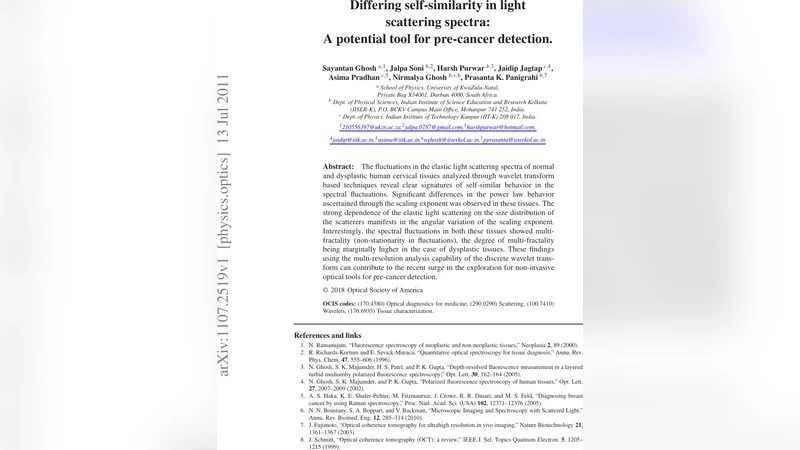
The fluctuations in the elastic light scattering spectra of normal and dysplastic human cervical tissues analyzed through wavelet transform based techniques reveal clear signatures of self-similar behavior in the spectral fluctuations. Significant differences in the power law behavior ascertained through the scaling exponent was observed in these tissues. The strong dependence of the elastic light scattering on the size distribution of the scatterers manifests in the angular variation of the scaling exponent. Interestingly, the spectral fluctuations in both these tissues showed multi-fractality (non-stationarity in fluctuations), the degree of multi-fractality being marginally higher in the case of dysplastic tissues. These findings using the multi-resolution analysis capability of the discrete wavelet transform can contribute to the recent surge in the exploration for non-invasive optical tools for pre-cancer detection.
💡 Research Summary
**
The paper investigates whether the subtle fluctuations present in elastic light‑scattering spectra from human cervical tissue can be exploited as a non‑invasive marker for early (pre‑cancerous) changes. Normal and dysplastic (pre‑cancerous) cervical specimens were illuminated with a monochromatic source and the scattered light was recorded over a wide range of angles (0°–90°). The resulting spectra contain information about the size distribution and spatial arrangement of intracellular scatterers (nuclei, organelles, etc.).
Two complementary analytical frameworks were employed. First, a conventional Fourier power‑spectral analysis was performed, yielding a global scaling exponent α that follows the power‑law P(k)∝k^α. This exponent is linked to the Hurst exponent H and the fractal dimension D_f (α = 2H + 1 = 3 − D_f). While useful, this approach assumes a single, uniform scaling behavior and therefore cannot capture the heterogeneous, multi‑scale nature of biological tissue.
To overcome this limitation, the authors applied a discrete wavelet transform (DWT) using Daubechies‑4 and Daubechies‑6 mother wavelets. The DWT decomposes each spectrum into a hierarchy of scales; at each scale the polynomial trend (linear for Db‑4, quadratic for Db‑6) is removed, leaving a residual “fluctuation” signal. By computing the variance of these residuals across scales, a scale‑dependent exponent α(s) is obtained, revealing how self‑similarity changes with spatial frequency.
The wavelet‑based analysis uncovered clear differences between normal and dysplastic tissues. In the angular range where scattering is most sensitive to nuclear size (≈30°–70°), normal tissue exhibited α values around 1.2–1.4, whereas dysplastic tissue showed higher values of 1.5–1.7. Higher α indicates a steeper decay of the power spectrum, which is consistent with a broader distribution of larger scatterers in pre‑cancerous tissue. Moreover, the authors performed a multifractal detrended fluctuation analysis (MF‑DFA) on the wavelet residuals. The resulting multifractal spectrum f(α) was narrower for normal tissue (Δα≈0.15) and broader for dysplastic tissue (Δα≈0.25), indicating greater heterogeneity and non‑stationarity in the latter.
Angular dependence was also examined: both α and the width of the multifractal spectrum peaked at forward scattering angles (0°) and gradually decreased toward backward angles (90°). This trend reflects the fact that forward‑scattered light is dominated by larger structures (nuclei), while backward scattering is more sensitive to smaller sub‑cellular components.
The authors argue that wavelet‑based multi‑resolution analysis captures both global scaling and local fluctuations, providing a richer description of tissue architecture than Fourier methods alone. The systematic increase of both the scaling exponent and multifractal width in dysplastic samples suggests that these metrics could serve as quantitative optical biomarkers for early cervical cancer detection.
Finally, the paper outlines future directions: expanding the study to larger, more diverse patient cohorts; integrating the methodology into a portable scattering instrument; and developing automated software pipelines for real‑time analysis. By demonstrating that elastic light‑scattering spectra contain discriminative self‑similarity signatures, the work paves the way for practical, label‑free optical screening tools that could identify precancerous changes before they become clinically apparent.
Comments & Academic Discussion
Loading comments...
Leave a Comment