Particle acceleration by circularly and elliptically polarised dispersive Alfven waves in a transversely inhomogeneous plasma in the inertial and kinetic regimes
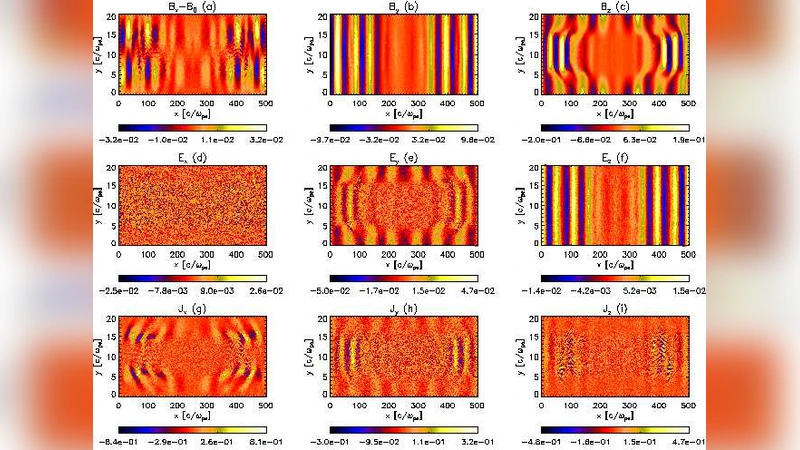
Dispersive Alfven waves (DAWs) offer, an alternative to magnetic reconnection, opportunity to accelerate solar flare particles. We study the effect of DAW polarisation, L-, R-, circular and elliptical, in different regimes inertial and kinetic on the efficiency of particle acceleration. We use 2.5D PIC simulations to study how particles are accelerated when DAW, triggered by a solar flare, propagates in transversely inhomogeneous plasma that mimics solar coronal loop. (i) In inertial regime, fraction of accelerated electrons (along the magnetic field), in density gradient regions is ~20% by the time when DAW develops 3 wavelengths and is increasing to ~30% by the time DAW develops 13 wavelengths. In all considered cases ions are heated in transverse to the magnetic field direction and fraction of the heated particles is ~35%. (ii) The case of R-circular, L- and R- elliptical polarisation DAWs, with the electric field in the non-ignorable transverse direction exceeding several times that of in the ignorable direction, produce more pronounced parallel electron beams and transverse ion beams in the ignorable direction. In the inertial regime such polarisations yield the fraction of accelerated electrons ~20%. In the kinetic regime this increases to ~35%. (iii) The parallel electric field that is generated in the density inhomogeneity regions is independent of m_i/m_e and exceeds the Dreicer value by 8 orders of magnitude. (iv) Electron beam velocity has the phase velocity of the DAW. Thus electron acceleration is via Landau damping of DAWs. For the Alfven speeds of 0.3c the considered mechanism can accelerate electrons to energies circa 20 keV. (v) The increase of mass ratio from m_i/m_e=16 to 73.44 increases the fraction of accelerated electrons from 20% to 30-35% (depending on DAW polarisation). For the mass ratio m_i/m_e=1836 the fraction of accelerated electrons would be >35%.
💡 Research Summary
This paper investigates how dispersive Alfvén waves (DAWs) can accelerate particles in a transversely inhomogeneous plasma that mimics a solar coronal loop, focusing on the role of wave polarisation (left‑hand, right‑hand circular, and elliptical) and on the distinction between the inertial and kinetic regimes. Using the fully electromagnetic, relativistic 2.5‑D particle‑in‑cell (PIC) code EPOCH, the authors launch low‑frequency DAWs (ω = 0.3 ω_ci) into a plasma whose density is enhanced in the centre of the simulation domain, thereby creating a transverse density gradient. The background magnetic field is uniform and directed along the invariant (z) direction. By varying the ratio of ion to electron mass (m_i/m_e = 16, 73.44, 1836) they explore both the inertial regime (β ≪ m_e/m_i) where electron inertia sustains the parallel electric field, and the kinetic regime (β ≫ m_e/m_i) where the electron pressure tensor dominates.
Key findings are as follows. First, as the DAW propagates through the density gradient, a parallel electric field (E_∥) is generated that is essentially independent of the mass ratio and reaches a normalized magnitude of 0.03 ω_pe c m_e/e. For typical coronal parameters this corresponds to a field roughly 10⁸ times larger than the Dreicer field, guaranteeing that electrons are not limited by collisional drag. Second, electrons become resonant with the wave’s phase speed (≈ Alfvén speed). Landau damping of the DAW thus accelerates electrons along the magnetic field. When the wave has travelled three wavelengths, about 20 % of electrons in the gradient region are accelerated; after thirteen wavelengths the fraction rises to ≈ 30 % in the inertial regime. In the kinetic regime the same propagation distance yields up to ≈ 35 % accelerated electrons. The accelerated electrons acquire velocities comparable to the wave phase speed; for V_A ≈ 0.3 c this translates into energies of order 20 keV, consistent with hard X‑ray observations of solar flares.
The polarisation of the DAW strongly influences the efficiency of acceleration. Right‑hand circular, as well as left‑ and right‑hand elliptical polarisation, produce an electric field component in the non‑ignorable transverse direction that is several times larger than the component in the ignorable direction. This asymmetry generates more pronounced parallel electron beams (with higher maximum velocities) and also drives transverse ion beams in the ignorable direction. In the inertial regime these polarisation states still give ≈ 20 % accelerated electrons, but in the kinetic regime the fraction climbs to ≈ 35 %. Ions, by contrast, are heated primarily across the magnetic field; roughly 35 % of ions experience significant transverse heating regardless of polarisation or regime.
Increasing the ion‑to‑electron mass ratio enhances the acceleration efficiency. With m_i/m_e = 16 the accelerated electron fraction is about 20 %; raising the ratio to 73.44 lifts the fraction to 30–35 % depending on polarisation, and extrapolation to the realistic value of 1836 suggests that more than 35 % of electrons could be accelerated under solar coronal conditions.
The study also documents that the DAW induces localized density and temperature perturbations confined to the gradient region, confirming that the parallel electric field and associated particle energisation are spatially limited to where the Alfvén speed varies sharply. This localisation is a hallmark of phase‑mixing in the kinetic regime and underpins the rapid dissipation of wave energy into particle kinetic energy.
Overall, the paper demonstrates that dispersive Alfvén waves constitute a viable, possibly dominant, mechanism for particle acceleration in solar flares, complementing or even supplanting magnetic reconnection in certain contexts. The results highlight three crucial points: (1) DAWs naturally generate super‑Dreicer parallel electric fields in transverse density gradients; (2) wave polarisation and plasma mass ratio critically control the fraction of electrons that are accelerated; and (3) the acceleration proceeds via Landau damping, producing electron beams with energies compatible with observed flare emissions while simultaneously heating ions across the field. These insights pave the way for more realistic three‑dimensional modelling of coronal loops and for laboratory experiments aimed at reproducing DAW‑driven acceleration, thereby bridging solar, magnetospheric, and fusion plasma research.
Comments & Academic Discussion
Loading comments...
Leave a Comment