Robustness of networks against propagating attacks under vaccination strategies
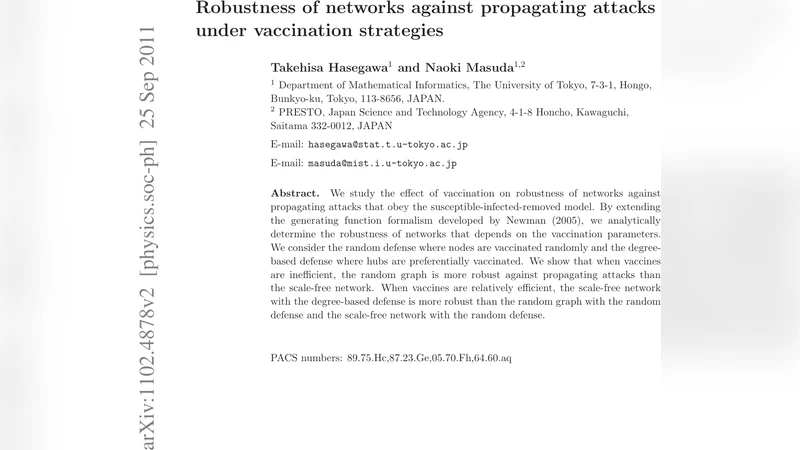
We study the effect of vaccination on robustness of networks against propagating attacks that obey the susceptible-infected-removed model.By extending the generating function formalism developed by Newman (2005), we analytically determine the robustness of networks that depends on the vaccination parameters. We consider the random defense where nodes are vaccinated randomly and the degree-based defense where hubs are preferentially vaccinated. We show that when vaccines are inefficient, the random graph is more robust against propagating attacks than the scale-free network. When vaccines are relatively efficient, the scale-free network with the degree-based defense is more robust than the random graph with the random defense and the scale-free network with the random defense.
💡 Research Summary
The paper investigates how vaccination strategies affect the robustness of complex networks against propagating attacks modeled by the susceptible‑infected‑removed (SIR) process. By extending Newman’s generating‑function formalism, the authors analytically derive two critical transmission probabilities: T_c1, the point at which a giant infected component first appears, and T_c2, the point at which the residual network (the set of nodes that remain susceptible after the epidemic has run its course) loses its giant component. The analysis distinguishes two vaccination schemes: (i) random defense, where a fraction f of nodes is immunized uniformly at random, and (ii) degree‑based defense, where the same fraction f of nodes with the highest degrees (the hubs) is immunized. Vaccine efficacy is captured by a parameter f_v (0 ≤ f_v < 1); a perfectly effective vaccine has f_v = 0, while a “leaky” vaccine has f_v > 0, reducing the transmission probability along edges incident to vaccinated nodes from T to T·f_v.
For uncorrelated, locally tree‑like networks, the authors first review the standard percolation mapping of the SIR model, recalling that the first epidemic threshold satisfies T_c1 = ⟨k⟩ / ⟨k(k‑1)⟩. Incorporating vaccination, they introduce separate degree distributions p_U,k and p_V,k for unvaccinated (U) and vaccinated (V) nodes, together with the corresponding excess‑degree distributions q_U,k and q_V,k. In the random defense, these distributions are identical for U and V, while in the degree‑based defense they differ sharply because high‑degree nodes are removed from the U class.
The first critical point under vaccination follows from the condition that the average number of secondary infections generated by a typical infected node exceeds one. This yields the compact expression
T_c1
Comments & Academic Discussion
Loading comments...
Leave a Comment