On zero-dimensionality and the connected component of locally pseudocompact groups
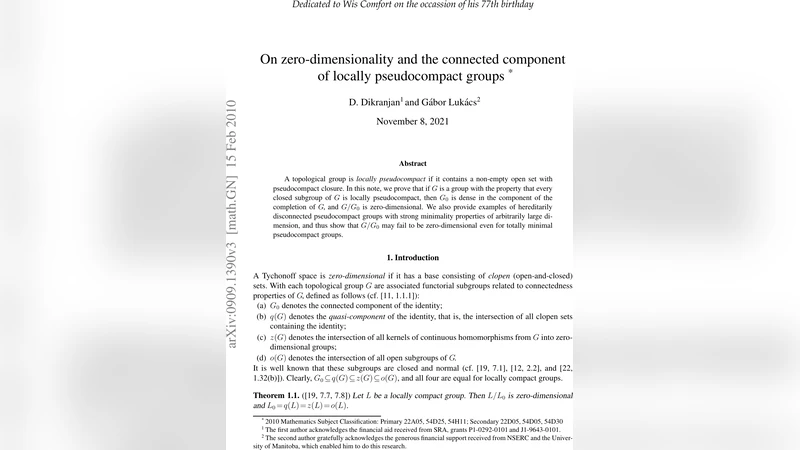
A topological group is locally pseudocompact if it contains a non-empty open set with pseudocompact closure. In this note, we prove that if G is a group with the property that every closed subgroup of G is locally pseudocompact, then G_0 is dense in the component of the completion of G, and G/G_0 is zero-dimensional. We also provide examples of hereditarily disconnected pseudocompact groups with strong minimality properties of arbitrarily large dimension, and thus show that G/G_0 may fail to be zero-dimensional even for totally minimal pseudocompact groups.
💡 Research Summary
The paper investigates the interplay between two central notions in topological group theory: local pseudocompactness and zero‑dimensionality. A topological group G is called locally pseudocompact if it contains a non‑empty open set whose closure is pseudocompact (i.e., every real‑valued continuous function on the closure is bounded). This condition is weaker than compactness but strong enough to control the behavior of the Raĭkov completion (\widehat G) and the connected component of the identity.
The authors begin by assuming a rather strong hypothesis: every closed subgroup of G is locally pseudocompact. Under this hypothesis they prove two main theorems.
-
Density of the identity component in the completion.
Let (G_0) denote the connected component of the identity in G, and let (\widehat G_0) be the connected component of the identity in the Raĭkov completion (\widehat G). The paper shows that (G_0) is dense in (\widehat G_0). The proof proceeds by exploiting the fact that local pseudocompactness is inherited by closed subgroups, which guarantees that each closed subgroup remains “almost compact’’ after completion. Using the completeness of (\widehat G) and the fact that the closure of a locally pseudocompact set is still pseudocompact, the authors construct a net in (G_0) converging to any point of (\widehat G_0). Consequently, the connected component of the completion is “filled’’ by the original component of G. -
Zero‑dimensionality of the quotient (G/G_0).
A space is zero‑dimensional if it has a base consisting of clopen (simultaneously closed and open) sets. The authors prove that under the same hypothesis the quotient group (G/G_0) is zero‑dimensional. The argument uses the density result above: because (G_0) is dense in (\widehat G_0), the quotient (\widehat G/\widehat G_0) is a totally disconnected compact group. Since the natural map (G/G_0 \to \widehat G/\widehat G_0) is a dense embedding, any open set in (G/G_0) can be refined to a clopen set, yielding a clopen base. Hence (G/G_0) inherits zero‑dimensionality from its compact completion.
These two theorems together give a clean structural picture: if every closed subgroup of a topological group is locally pseudocompact, then the identity component behaves nicely in the completion, and the “disconnected part’’ of the group, represented by the quotient, is as thin as possible (zero‑dimensional).
The second part of the paper addresses the limits of this picture. The authors construct hereditarily disconnected pseudocompact groups that are totally minimal (every continuous surjective homomorphism onto another topological group is open) and have arbitrarily large topological dimension. The construction uses high‑dimensional Σ‑products (σ‑products) of compact groups, carefully arranged so that every closed subgroup remains locally pseudocompact, yet the quotient (G/G_0) fails to be zero‑dimensional. In fact, the quotient can have any prescribed finite dimension, showing that the zero‑dimensional conclusion cannot be strengthened to “totally minimal + pseudocompact ⇒ zero‑dimensional quotient”.
These examples demonstrate that the hypothesis “every closed subgroup is locally pseudocompact’’ is essential for the zero‑dimensionality result; merely assuming pseudocompactness together with strong minimality does not suffice. Moreover, they reveal a subtle distinction between local pseudocompactness (a property of neighborhoods) and global pseudocompactness (a property of the whole space) in the context of minimality and connectedness.
In summary, the paper makes three significant contributions:
- It establishes that under the universal local pseudocompactness condition, the identity component of a group is dense in the connected component of its Raĭkov completion, and the quotient by this component is zero‑dimensional.
- It provides explicit constructions of high‑dimensional, hereditarily disconnected, totally minimal pseudocompact groups, thereby showing that the zero‑dimensionality of the quotient can fail even under strong minimality.
- It clarifies the precise role of local pseudocompactness in governing the topology of connected components and quotients, enriching the understanding of how compact‑type properties interact with algebraic structure in topological groups.
These results deepen the theory of topological groups by pinpointing the exact conditions under which connectedness and dimensionality behave predictably, and they open avenues for further exploration of minimality, pseudocompactness, and dimension in more exotic group constructions.
Comments & Academic Discussion
Loading comments...
Leave a Comment